
The underlying claim comes from TechNetBooks, which says AMD paired Ryzen AI processors and Radeon graphics with Meta Superintelligence Labs’ Apache 2.0-licensed Muse Glimmer 30B. The model release itself is independently reported by the Associated Press, which describes Muse Glimmer as a permissively licensed model intended to run on personal hardware. AMD’s current product documentation independently confirms the relevant hardware: Ryzen AI Max+ 395 systems can ship with up to 128GB of unified memory, while the Radeon AI PRO R9700 carries 32GB of GDDR6 VRAM.
What has not surfaced in AMD’s official announcements, developer documentation, product pages, or release notes is a Muse Glimmer-specific Ryzen AI or Radeon launch, a validated Windows configuration, a model download from AMD, or the claimed benchmark methodology. For Windows users, that changes the story from “AMD has introduced a localized computing platform” to something narrower and more useful: AMD hardware is capable of hosting a class of 30-billion-parameter local models, but Muse Glimmer deployment is currently a do-it-yourself software stack.
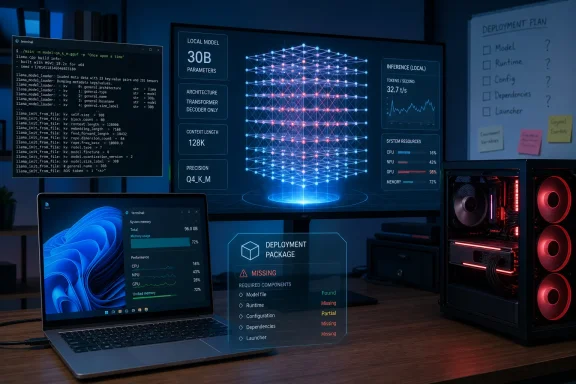 Muse Glimmer’s release is real; the AMD platform claim is unproven
Meta’s release matters because an Apache 2.0 license permits commercial redistribution and modification, subject to the license terms. That is more permissive than the custom licenses associated with many earlier frontier-adjacent model releases, and it makes a local model more attractive to software vendors that do not want their product availability or data handling dictated by a hosted AI API.
The TechNetBooks report characterizes Muse Glimmer 30B as a dense model designed for long-running, multi-step agent tasks with recovery from errors. Those are meaningful capabilities if confirmed in Meta’s model documentation and reproducible evaluations, but they should not be confused with a security guarantee. A locally executed agent can keep prompts and documents off a cloud inference endpoint; it can still expose them through its own tool permissions, local logs, browser sessions, extensions, prompt-injection attacks, or a compromised Windows account.
“Local” means that the model’s token generation occurs on the PC. It does not mean that an agent given access to Outlook, Teams, a browser profile, mapped drives, PowerShell, or an enterprise file share is safe to run without controls. For IT administrators, the material security decision is not simply whether inference leaves the device. It is which tools the agent can invoke, which credentials it inherits, what it records, and whether its activity is auditable.
AMD has legitimate hardware here. The Ryzen AI Max+ 395 combines CPU, integrated Radeon graphics, and an NPU in a high-memory unified-memory design. AMD says up to 96GB of system memory can be allocated as graphics memory in a 128GB configuration. The Radeon AI PRO R9700 is a different proposition: a 300W workstation GPU with 32GB of dedicated VRAM, a 256-bit memory bus, and Windows 10 and Windows 11 support.
But a GPU specification page is not a product integration. AMD’s existing AI documentation points developers toward frameworks such as ONNX Runtime GenAI and llama.cpp, and its Radeon AI PRO material focuses on ROCm-oriented developer workflows. Neither creates the turnkey, model-specific “Agentic PC” offering described by the report.
The 32GB memory threshold is a starting point, not a deployment recommendation
The report says systems need more than 32GB of memory to run Muse Glimmer smoothly. That statement leaves out the distinction that will determine whether a Windows PC actually works: system RAM, unified graphics memory, and dedicated GPU VRAM are not interchangeable in the way the headline suggests.
A 30B dense model has roughly 30 billion parameters. At 16-bit precision, weights alone would require about 60GB before accounting for runtime allocations or prompt context. Quantization reduces that substantially. A 4-bit representation puts the raw weights in the neighborhood of 15GB, but the real footprint depends on the quantization format, runtime overhead, context-window length, and key-value cache used to retain a conversation or agent history.
That makes 32GB a plausible minimum for a heavily quantized model on a Radeon AI PRO R9700, especially for modest contexts. It is not a universal “smoothly” threshold for agentic work. Long-term memory and multi-step execution create pressure on the context cache. Run a 30B model with a large context, parallel agent requests, tool output, document retrieval, or desktop applications consuming memory, and a nominal 32GB configuration can become constrained quickly.
The distinction is especially sharp on Ryzen AI Max+ 395 machines. A 128GB configuration offers the capacity to host a large quantized model in unified memory, but the integrated GPU shares that memory pool with Windows and every other active process. AMD’s own Ryzen AI Max+ material positions the platform’s high unified-memory ceiling as a way to make unusually large local models feasible; it does not turn a 32GB laptop into a practical host for every 30B model and context length.
For prospective buyers, model size should not become a shorthand for system requirements. A 30B label says almost nothing about a usable configuration without the model format, quantization, target context length, number of simultaneous sessions, and chosen backend.
AMD’s 24 and 53 token-per-second figures need reproducible detail
TechNetBooks reports AMD benchmarks of up to 24 tokens per second on a 128GB Ryzen AI Max+ 395 and 53 tokens per second on a Radeon AI PRO R9700, using llama.cpp on Windows 11 Pro with speculative decoding enabled. Those are credible-looking figures in broad terms: a 32GB workstation GPU should generally decode a suitably quantized 30B model faster than an integrated GPU operating from shared system memory.
They are still vendor-reported figures carried by one outlet, not independently replicated measurements. No benchmark command, exact model revision, GGUF quantization, context size, prompt length, draft model for speculative decoding, driver version, llama.cpp build, GPU-offload setting, or time-to-first-token result was provided in the submitted report.
Those omissions are not cosmetic. Speculative decoding uses a smaller draft model to propose several tokens that the larger model can validate in batches. When the draft is accurate, reported generation speed can rise dramatically; when the workload is less predictable, the benefit can narrow. A token-per-second figure achieved with speculative decoding therefore cannot be fairly compared with an ordinary decode benchmark unless the test conditions state that feature clearly.
AMD’s public Ryzen AI Max+ 395 benchmarks already show why this context is necessary. The company has published figures reaching 61 tokens per second in MLPerf Client tests for particular workloads, but those results do not establish performance for a 30B agent model in llama.cpp. The 24-token claim may be reasonable, but it cannot yet serve as a purchase guide.
A proper Windows benchmark report should state, at minimum:
- The exact Muse Glimmer checkpoint and quantization, including its on-disk size.
- The Windows 11 release, Radeon or Ryzen AI driver version, llama.cpp commit, and backend used.
- The prompt-processing rate, generation rate, context length, and time to first token.
- Whether speculative decoding was enabled, and the identity and settings of the draft model.
- How much VRAM or unified memory was reserved for the model and how much remained available to Windows.
Until those details are available, the R9700’s 53-token figure should be treated as a promising vendor result, not a verified performance expectation.
LM Studio and Lemonade solve different problems
The report presents LM Studio as a quick route for consumers and Lemonade as a way for developers to embed Muse Glimmer in software. The distinction is broadly sound, but the description overstates how frictionless the developer path is.
LM Studio is a desktop application designed to download and run supported local models and expose local API-compatible endpoints. Its usefulness depends on a compatible model artifact being published, the selected inference backend working correctly with the system’s AMD GPU, and sufficient available memory. It can make testing dramatically easier than compiling llama.cpp, but it does not validate an agent’s tool permissions, enterprise controls, or model behavior.
Lemonade is also a real AMD-associated local inference component, appearing in AMD’s Ryzen AI documentation as a local service and command-line tool. It is intended to simplify deployment of supported optimized model packages across AMD hardware. The TechNetBooks claim that it can package Muse Glimmer into a 4MB binary needs more evidence: a 30B model’s weights cannot be compressed into a 4MB executable. At most, a small binary could contain the inference runtime or bootstrap service while the multi-gigabyte model files remain separate or download on first use.
That is a material difference for commercial deployment. An embedded runtime is not an embedded model. ISVs still need to account for model distribution, disk use, model updates, license notices, hardware detection, fallback behavior, security patching, and whether customers can opt out of downloading a large local artifact.
Windows deployment should begin with containment, not office-file access
A local server connected to Hermes Agent, OpenClaw, or comparable tools could let Muse Glimmer inspect files and interact with applications on the same machine. That capability is precisely why local models are attractive for sensitive workflows, and why they should first be run in a constrained environment.
A sensible pilot begins with a non-administrator Windows account, a separate test folder containing synthetic documents, no browser-session access, no saved passwords, no mapped production shares, and logging that captures every tool invocation. The model should receive narrowly scoped actions rather than broad desktop control. If an agent needs to modify files, require a review or approval step before it writes outside a designated workspace.
The immediate AMD news is therefore less sweeping than the headline suggests. Ryzen AI Max+ 395 systems with 128GB of memory and Radeon AI PRO R9700 workstations have the capacity profile needed for a local 30B-class model, and Meta’s permissive Muse Glimmer release gives developers a model they may legally build around. The missing piece is an official, repeatable AMD-on-Windows deployment package with published compatibility and benchmarks.
Until that arrives, organizations should treat Muse Glimmer on AMD Windows hardware as an advanced local-inference evaluation—not as a drop-in secure agent platform ready to open real office files and act on them.