
AMD announced on August 6 that it had reached a definitive agreement to acquire Taalas, whose technology it says will be integrated into its accelerator roadmap and developed into system-level solutions alongside AMD Instinct GPUs. The announcement did not disclose a purchase price, expected closing date, regulatory conditions, product schedule, supported models, or whether Taalas’ first HC1 hardware will ship independently before AMD absorbs it.
That wording matters. AMD has announced an agreement to acquire Taalas; it has not publicly said that the transaction has closed. Reporting describing Taalas as already acquired runs ahead of AMD’s own disclosure. For customers and developers, there is therefore no new AMD product to buy, no published ROCm integration plan, and no commitment that existing Taalas silicon will be commercially supported under AMD ownership.
Still, the deal answers a much larger question raised by AMD’s July partnership with Cerebras: if AI serving increasingly splits prompt processing from response generation, how much of the latter does AMD want to own?
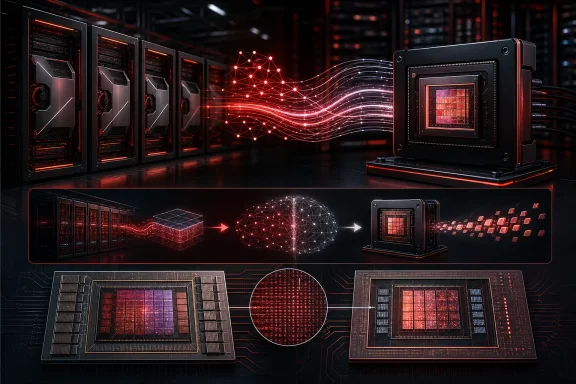 Taalas turns model weights into part of the chip
Taalas’ proposition is unusually narrow and unusually consequential. Rather than loading a model’s weights from high-bandwidth memory into a programmable GPU or another conventional accelerator, its “Hardcore Model” architecture encodes a model and its weights into the physical implementation of the processor. The company pairs that fixed model logic with very large on-chip SRAM structures, including storage used for the key-value cache that keeps track of context during generation.
Reuters reported in February that Taalas completes most of a chip design and customizes the final two metal layers for a target model. Chief executive Ljubisa Bajic told Reuters that this makes the approach materially faster to manufacture than designing a wholly new AI processor, though it remains a semiconductor production cycle rather than a software deployment. Taalas uses TSMC for manufacturing, according to that report.
The first HC1 design was built around Meta’s Llama 3.1 8B model. Taalas said its hardware could generate roughly 16,960 tokens per second for one user, a number repeated by several technical outlets after the February launch. That is an extraordinary claim, but it should be read correctly: it is a vendor benchmark for one purpose-built chip and one specific model configuration, not a general comparison showing that the device is always faster than Nvidia Blackwell, AMD Instinct, or Cerebras systems across real production workloads.
The engineering trade-off is plain. A conventional GPU earns its place by being programmable: operators can deploy a new model, change quantization, update weights, tune a kernel, or consolidate diverse workloads on the same fleet. Taalas shifts part of that flexibility into the chip-manufacturing process. A materially revised model, or a different model altogether, can require a new physical variant.
That constraint sharply limits where the design makes sense. It is poorly suited to experimentation, frequent model refreshes, model hosting marketplaces, and organizations still deciding which model to standardize on. It becomes much more compelling where a provider has a stable, high-volume model and can predict demand well enough to justify hundreds of thousands of dedicated devices.
Taalas has argued that the economics can work because training a frontier model costs vastly more than customizing a chip around it. That may be true for providers that serve a mature model at enormous scale, but it leaves out a central operational risk: model releases now move faster than traditional semiconductor cycles. A chip optimized for a model that is displaced, re-trained, or superseded before volume deployment can become a highly efficient asset with no preferred workload.
AMD is building both halves of disaggregated inference
AMD’s move follows its July 23 partnership with Cerebras, which pairs AMD Helios rack-scale systems with Cerebras Wafer-Scale Engine hardware. AMD and Cerebras say Helios will handle high-throughput prompt processing and long-context work while Cerebras accelerates token generation. The joint offering is expected to appear first through Cerebras Cloud in the second half of 2026.
This division is called disaggregated inference. It recognizes that serving a large language model contains two computationally different jobs. During prefill, the system digests the prompt and builds the context state; this work benefits from high-throughput parallel compute. During decode, the model emits one token at a time and repeatedly reads and updates state. Decode is latency-sensitive and often limited by memory movement rather than raw floating-point throughput.
GPUs can perform both tasks, and they remain the most flexible choice. But they are not inherently optimized for the predictable, token-by-token decode phase. That creates room for SRAM-heavy machines such as Cerebras’ systems, Groq’s language processing units, and Taalas’ hardwired approach.
AMD’s own partnership describes this explicitly, even if the company avoids turning it into a criticism of Instinct GPUs. Helios plus Cerebras is not a replacement for AMD GPUs; it is a workflow in which AMD’s GPU racks take the part of inference that suits them and hand response generation to specialized hardware. Tom’s Hardware and Axios both reported that the companies expect the combined system to improve efficiency by dividing the phases between architectures designed for them.
Taalas gives AMD an alternative long-term answer to that same decode problem. Cerebras is a partner with its own product, cloud business, customers, and roadmap. Taalas, once the transaction closes, would be AMD technology. The acquisition does not end the Cerebras relationship, and AMD has not said it will. But it reduces the chance that AMD’s low-latency inference strategy remains permanently dependent on a separate chipmaker.
The missing product roadmap is the real story
AMD’s announcement says Taalas will complement Helios, Instinct GPUs, EPYC CPUs, and ROCm. What it does not say is more revealing. There is no product name, no disclosed process node, no capacity plan, no target model family, no power target, no fabric architecture, and no date when a Taalas-derived accelerator will enter an AMD rack.
The omission is understandable. Folding a startup’s architecture into a large vendor’s platform is hard, particularly when that architecture assumes the model is a component of the physical chip. AMD will need to decide what “integration” means in practice.
One possibility is a dedicated decode appliance that works beside Instinct GPU clusters, much like the Cerebras partnership. Another is a Taalas-derived chiplet or accelerator card optimized for a limited selection of high-volume models. A more ambitious route would make model-specific decode hardware part of a future Helios system, connected closely enough to Instinct GPUs that the handoff between prefill and generation does not erase the latency advantage.
Each approach presents difficult software questions. The system needs reliable request routing, model-version control, observability across two compute domains, cache management, failover behavior, and a clear way to fall back to GPUs when a request needs a model or context length outside the hardwired device’s limits. ROCm compatibility alone will not solve those issues, because this is not simply another programmable GPU target.
There is also no evidence that Taalas’ published HC1 performance translates directly into the larger models most cloud providers use for premium reasoning, coding, or agent workloads. The company’s early hardware targeted an 8-billion-parameter model. Taalas had discussed a follow-on HC2 design for models around 20 billion parameters and proposed multi-chip configurations for substantially larger models, but AMD has not confirmed that it will commercialize either plan.
Flexibility has a cost, and AMD wants another option
The broader trend behind this deal is not that GPUs are obsolete. It is that the economic center of AI is moving from training a few models to serving them billions of times. In that environment, a GPU’s flexibility is valuable—but a stable production model can reward hardware that removes flexibility in exchange for deterministic latency and lower energy per generated token.
Nvidia has already moved in this direction through its deal for Groq technology and talent, while AMD has publicly embraced a GPU-plus-specialist approach with Cerebras. As The Next Platform noted in its analysis of the Taalas agreement, these are competing efforts to solve the decode bottleneck rather than merely chase benchmark peaks.
For Windows administrators and enterprise AI teams, none of this changes the near-term deployment choice: AMD Instinct systems remain the available AMD path, while the first AMD–Cerebras cloud offering is still scheduled for the second half of 2026. The Taalas deal is a roadmap acquisition, not a new platform release.
But it changes how AMD should be judged from here. The company is no longer only arguing that bigger, more capable GPUs and better software can close the inference gap. It is buying into a more radical proposition: for the highest-volume AI services, the model itself may become hardware.
References
- Primary source: The Next Platform
Published: August 7, 2026 at 7:22 PM UTC
With Taalas, AMD Can Bake AI Inference Directly Into Its Chippery
Jensen Huang, the chief executive officer and co-founder of Nvidia, let the cat out of the bag back ...www.nextplatform.com - Related coverage: datacenterdynamics.com
AI chip startup Taalas raises $169m, unveils HC1 processor optimized for Llama 3.1 8B - DCD
Company has raised more than $200m since emerging from stealth in 2024www.datacenterdynamics.com - Related coverage: techi.com
- Related coverage: amd.com
AMD與Cerebras Systems宣布推出領先業界的超低延遲與高吞吐量AI推論解決方案
www.amd.com
- Related coverage: kaitchup.substack.com
Taalas HC1: Absurdly Fast, Per-User Inference at 17,000 tokens/second
The Weekly Kaitchup #131kaitchup.substack.com - Related coverage: cnx-software.com
Taalas HC1 hardwired Llama-3.1 8B AI accelerator delivers up to 17,000 tokens/s - CNX Software
Taalas HC1 is an AI accelerator hardwired (i.e, implemented in hardware) with Llama-3.1 8B and delivering close to 17,000 tokens/s of AI performance withwww.cnx-software.com - Related coverage: taalas.oceanandeverest.biz
Taalas | 模型即计算机
Taalas — 将任何 AI 模型快速转化为定制硅芯片的平台。Hardcore Model 比软件实现效率提升 1000 倍。taalas.oceanandeverest.biz - Related coverage: trendforce.com.tw
推理經濟時代來臨:AI 晶片的規則正被重寫 | TrendForce
Computex 2026 聚焦 Agentic AI,推理效率成為勝出關鍵。回顧 Groq、Taalas、Cerebras 推理晶片技術進展。www.trendforce.com.tw - Related coverage: cnx-software.ru
Акселератор Taalas HC1 с аппаратно реализованной моделью Llama-3.1 8B обеспечивает до 17 000 токенов/с — CNXSoft- новости Android-приставок и встраиваемых систем
Taalas HC1 — это AI-акселератор с аппаратно реализованной (т.е. реализованной на уровне железа) моделью Llama-3.1 8B, обеспечивающий производительность около 17 000 токенов/с с этой моделью, что пр…cnx-software.ru - Related coverage: tomshardware.com
- Related coverage: sahmcapital.com