
The immediate significance for PC and electronics supply chains is not that Bac Ninh is opening a wafer fab or suddenly producing thousands of chip designers. It is that the province housing major electronics and semiconductor assembly activity is trying to staff the middle of the chain: equipment operation, automated production, inspection, industrial maintenance and packaging-related work. Those roles determine whether announced capacity can actually reach volume production.
The policy basis is real. Bac Ninh’s Resolution 113/2025/NQ-HĐND took effect on January 1, 2026 and runs through December 31, 2030, establishing support for vocational education and workforce development in semiconductors, artificial intelligence and digital technology. But the resolution is not a brand-new August response to a newly discovered labor shortage. The provincial council adopted it on December 10, 2025, and the government had already begun implementing it earlier this year.
What Lao Dong usefully adds is a local description of the bottleneck: employers need people with skills that conventional high-school education and broad IT degrees do not automatically provide. The missing piece is not simply more graduates. It is training tied to factory equipment, process discipline and the specific roles being recruited in an electronics-production hub.
 The 1.4 Million Figure Is Not a Semiconductor Hiring Target
Bac Ninh officials told Lao Dong that businesses could need about 1.4 million workers by 2030. That number is substantial, but readers should not read it as a forecast for semiconductor jobs. The article describes it as the province-wide labor requirement across its industrial base, where electronic-component manufacturing and assembly account for roughly 60% of employment, garments account for 16%, and other sectors make up the remainder.
This distinction matters when assessing semiconductor supply-chain claims. A province may employ vast numbers of workers in electronics assembly without possessing a comparable base of chip-design engineers, semiconductor-process specialists or advanced-packaging technicians. Conflating the entire industrial workforce with semiconductor headcount makes the skills gap look larger in one sense and less precise in another.
The World Bank’s recent assessment of Vietnam’s semiconductor prospects puts the national semiconductor workforce at roughly 14,000 to 17,000 people as of mid-2025, including design, assembly, testing, management and support staff. Its estimate for 2030 is around 85,000 jobs, driven by Vietnam’s national goal of training 50,000 chip-design engineers and announced expansion plans at packaging and test plants.
That national estimate puts the Bac Ninh story in focus. The province’s challenge is part of a much broader expansion effort, but it is especially acute because Bac Ninh is already a location for semiconductor back-end manufacturing. The question is whether local education can prepare workers for the jobs factories have, rather than merely produce credentials under a semiconductor label.
Amkor’s Ramp Makes Technician Training a Production Issue
The most concrete industrial reason Bac Ninh’s skills policy matters is Amkor Technology Vietnam’s facility in Yen Phong. The World Bank identifies Amkor’s site as an advanced system-in-package and memory-packaging operation, with 1,200 employees in its mid-2025 accounting and an announced Phase 1 staffing range of roughly 5,700 to 7,200 workers when the ramp is complete.
Those jobs are not interchangeable with generic electronics-assembly work. Semiconductor assembly, test and packaging—often abbreviated as ATP or OSAT when outsourced—depend on controlled processes, metrology, quality systems, automated equipment and traceability. Workers enter at many levels, from operators and maintenance technicians to process engineers and quality specialists, but all are part of a manufacturing chain where an error can reduce yields, delay deliveries or fail customer qualification.
Vietnam’s existing footprint remains much stronger in these back-end activities than in leading-edge wafer fabrication. The World Bank says the country has built a solid base in assembly and test through companies including Intel Products Vietnam, Amkor Technology and Hana Micron Vina, while design houses such as Synopsys, Renesas, Marvell, FPT Semi and Viettel employ a smaller but growing pool of specialist talent.
That makes Lao Dong’s focus on automation, precision mechanics, industrial electricity and quality testing more consequential than the article’s broad reference to “microchips” initially indicates. Those are the feeder disciplines for a packaging-and-test workforce. A vocational program that gives students practice on production-standard equipment could help factories fill roles faster than a four-year redesign of university engineering curricula.
It will not, however, quickly create the experienced engineers needed for front-end chip architecture, verification, physical design or advanced process integration. Those paths require deeper mathematics, electronics and software backgrounds, access to professional electronic-design automation tools, and mentors who have worked through real tape-outs or high-volume process ramps.
Resolution 113 Funds More Than Student Enrollment
The provincial resolution covers more than scholarships for local students. Its eligible groups include universities, vocational institutions and businesses authorized to provide vocational education; students at training institutions in Bac Ninh; employed workers seeking retraining or upskilling; instructors; visiting international specialists; and students studying relevant fields abroad.
That breadth is a useful acknowledgment of how semiconductor capabilities are actually built. Training a student cohort without instructors who know current equipment, or without employers willing to host practical work, produces graduates who still need to be trained from scratch at the factory gate. Resolution 113 allows support for workers already employed in local companies and for international cooperation, which recognizes the value of retraining and knowledge transfer rather than treating the pipeline as university-only.
There is also a policy continuity point missing from the latest local report. Resolution 113 replaced portions of an earlier Bac Ninh measure, Resolution 05/2024/NQ-HĐND, as well as vocational-support measures from the former Bac Giang province after the provincial reorganization reflected in the new framework. In practice, this is a consolidation and expansion of workforce policy across the current province, not a single standalone semiconductor initiative.
The regulation’s reach is broader than chip manufacturing: artificial intelligence and digital technology are included alongside semiconductors. That can help institutions share labs and attract a larger pool of students, but it also creates competition for the same instructors, electrical and computer engineering students, and laboratory capacity. A province that wants semiconductor technicians, automation specialists and AI workers at the same time must decide which programs receive scarce equipment and faculty first.
“Factory in School” Is the Useful Part—If Companies Actually Participate
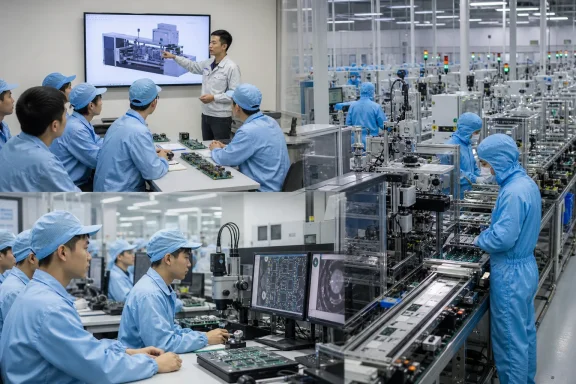
To Xuan Giao of the Vietnam Vocational Education Association told Lao Dong that businesses should become co-designers of training programs and that schools should use a “Factory in School” model, bringing simulated production lines or industrial-standard practice equipment into training spaces. This is the strongest practical recommendation in the report.
The term can become a slogan if it means only classroom mock-ups. For semiconductor and high-reliability electronics production, the useful version involves employers specifying job competencies, lending or helping procure relevant tools, supplying instructors from the factory floor, offering placements, and validating graduates against actual entry-level roles. It also requires schools to refresh programs when a factory changes equipment, process controls or quality requirements.
The provincial government has already publicly promoted a “Government–School–Enterprise” linkage model. In June, Bac Ninh officials discussed training cooperation with China’s Yangzhou University aimed at supporting the province’s electronics, semiconductor and high-tech industries. That gives the latest call for coordinated training more weight than a one-off interview: the province is pursuing formal institutional partnerships as well as local vocational reform.
Still, neither the Lao Dong report nor the publicly available provincial material identifies a binding hiring commitment, a published number of semiconductor trainees, a list of schools receiving equipment, or completion metrics tied to specific employers. Those omissions are important. A policy can fund enrollment and training activity without proving that it has solved the factory-level shortage.
Vietnam Is Chasing Two Different Talent Markets
Vietnam’s national semiconductor goal is often discussed as though there is one unified shortage. The World Bank’s analysis shows otherwise. The country must supply a large technical workforce for assembly, test and advanced packaging while also building a smaller, more specialized engineering base for design work.
The two markets overlap in foundational electronics, programming and automation skills, but they have different timelines. Packaging and test plants can absorb technicians, operators and applied engineers at scale, particularly when companies work directly with vocational schools. IC design requires fewer people per site but more advanced, specialized preparation and usually a longer period before graduates can contribute independently.
For PC enthusiasts and IT professionals watching semiconductor capacity, the Bac Ninh initiative should therefore be viewed as a manufacturing-readiness program, not evidence that Vietnam has solved its chip-design gap. It is directed at the workforce that lets electronics and semiconductor plants operate, qualify processes and expand production. That can strengthen the resilience of a region increasingly important to electronics manufacturing, even though it does not change where leading processors are designed or fabricated.
The near-term test will be visible in measurable outcomes: whether Bac Ninh names participating employers, publishes placement and retention rates, and shows that trainees are moving into semiconductor-specific jobs rather than the wider pool of electronics assembly. Amkor’s staffing ramp and the province’s 2025–2030 policy window give the effort a firm deadline. By the time that window closes on December 31, 2030, the relevant measure will be trained workers operating real production lines—not the number of programs announced.
