
A widely shared image purporting to show Prime Minister Andy Burnham jogging near his Cheshire home while being trailed by a film crew has been digitally altered: the camera operators, microphones and several background details were added to a genuine PA Media photograph taken on July 25. Full Fact’s analysis identifies the post as manipulated, while ITV News independently published the underlying PA image from the same run without the supposed production crew.
The distinction is more than cosmetic. The false image has circulated on Facebook and X alongside claims that Burnham was staging “social media for the cameras,” turning an ordinary press photograph into evidence of a political performance. The original did depict the Prime Minister running near his home, but there is no crew occupying the foreground of the authentic image.
Full Fact’s finding is supported by two separate lines of evidence: a comparison against the original news photography and an embedded provenance signal associated with OpenAI image tools. The combination makes this a stronger case than the increasingly common social-media verdict based solely on “AI-looking” visual flaws.
The real-world anchor for this falsehood is important. ITV News reported on July 25 that Burnham had been photographed running near his Cheshire home, using a PA image from the same occasion. That confirms the event itself happened and explains why the manipulated version can appear convincing at a glance.
Full Fact says the altered image closely follows a genuine PA Media frame. Its comparison points to a specific vehicle mismatch: in the authentic photograph, a black car is parked facing a police vehicle; in the circulated fake, a reddish vehicle faces away. The police vehicle’s registration plate also differs from the plate visible in other photographs taken during the run, and Full Fact says the fake plate does not appear to correspond to a real registration.
These are useful checks because they do not depend on judging a picture by instinct. A viral edit can preserve the subject’s face, pose, lighting and broad composition precisely because it begins with a legitimate photograph. Looking for stable details around the claimed event — vehicle direction, number plates, road furniture, weather, building lines and the position of security personnel — is often more reliable than focusing only on the political figure at the center of the image.
The manipulated frame also contains visible generation failures, according to Full Fact: feet that appear disconnected from bodies, vehicles that merge together in the background and a boom microphone that seems to emerge from a hedge. Those errors reinforce the source comparison, but they are the least durable part of the evidence. Better image-generation systems will keep reducing obvious defects. A newsroom or IT team that treats malformed hands and strange shadows as its principal test will eventually miss cleaner fakes.
OpenAI’s wording matters here. A detected signal indicates that a file was generated by or exported from OpenAI tools; it does not identify the person who made it, establish their motive, or determine whether every pixel in the final picture was fabricated. OpenAI also explicitly says its verifier can detect a new file produced when someone asks an OpenAI tool to modify an uploaded image.
That last point fits the evidence in this case. The most plausible explanation supported by the record is not that someone invented a full scene from scratch, but that they supplied a real press image and instructed a generative tool to add a film crew. The fabricated foreground turns a normal run into an apparent staged media event while retaining the authentic visual context of the original photograph.
There is a material limitation worth keeping clear: provenance signals are evidence of tool involvement, not a universal truth detector. OpenAI says a detected watermark does not establish that an image is accurate, unedited, legally owned or presented in its proper context. Conversely, the absence of a signal would not clear an image; metadata can be stripped, watermarks can degrade, and the image could have been made with another tool. In the Burnham case, the watermark is valuable because it sits alongside the original PA photograph and the mismatched physical details — not because it can independently adjudicate a political claim.
This is a recurring advantage for political image manipulation. An editor does not have to make a candidate or officeholder appear in an impossible location, wear an implausible uniform or say something outrageous. Adding one apparently contextual element — a crowd, protest sign, security detail, luxury item, camera crew or uniformed officer — can change how the public interprets an otherwise authentic moment.
The most effective alterations are therefore often context edits. They exploit the credibility accumulated by a genuine photograph and alter the reader’s conclusion rather than the recognizable identity of the subject. A viewer who recognizes Burnham, a police car and a familiar-looking street may stop checking before noticing that the critical claim is carried entirely by newly inserted objects.
Full Fact’s comparison also exposes a problem for platforms’ current disclosure systems. Even when a file retains provenance information, people usually encounter it as a compressed repost, screenshot or cropped image inside a social feed. The signal may be machine-readable while remaining invisible to the audience most likely to react to the image. The claim can spread faster than verification, particularly where the false addition confirms an existing political suspicion.
Then locate the earliest credible version of the event. In this instance, PA Media’s July 25 photograph, independently carried by ITV News, establishes the scene without the alleged crew. Compare the objects that should not change between shots taken in the same short period: cars, number plates, police vehicles, street features and the position of people already in the frame.
Only after that should a verifier use AI provenance tools. OpenAI’s verification service checks uploaded image and audio files for supported OpenAI-origin signals, including C2PA metadata and SynthID. It can be useful in a controlled workflow, but it should be treated as one evidence source rather than a replacement for source verification. The original file is preferable to a screenshot or a re-encoded social-media copy, since conversion and sharing can remove metadata or degrade detectable signals.
A concise triage process looks like this:
Full Fact’s finding is supported by two separate lines of evidence: a comparison against the original news photography and an embedded provenance signal associated with OpenAI image tools. The combination makes this a stronger case than the increasingly common social-media verdict based solely on “AI-looking” visual flaws.
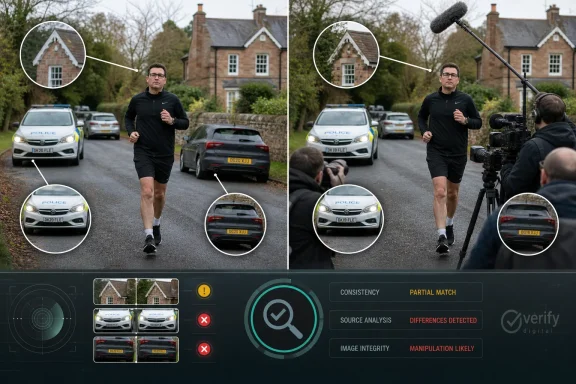 The original photograph establishes the setting, not the claim
The real-world anchor for this falsehood is important. ITV News reported on July 25 that Burnham had been photographed running near his Cheshire home, using a PA image from the same occasion. That confirms the event itself happened and explains why the manipulated version can appear convincing at a glance.Full Fact says the altered image closely follows a genuine PA Media frame. Its comparison points to a specific vehicle mismatch: in the authentic photograph, a black car is parked facing a police vehicle; in the circulated fake, a reddish vehicle faces away. The police vehicle’s registration plate also differs from the plate visible in other photographs taken during the run, and Full Fact says the fake plate does not appear to correspond to a real registration.
These are useful checks because they do not depend on judging a picture by instinct. A viral edit can preserve the subject’s face, pose, lighting and broad composition precisely because it begins with a legitimate photograph. Looking for stable details around the claimed event — vehicle direction, number plates, road furniture, weather, building lines and the position of security personnel — is often more reliable than focusing only on the political figure at the center of the image.
The manipulated frame also contains visible generation failures, according to Full Fact: feet that appear disconnected from bodies, vehicles that merge together in the background and a boom microphone that seems to emerge from a hedge. Those errors reinforce the source comparison, but they are the least durable part of the evidence. Better image-generation systems will keep reducing obvious defects. A newsroom or IT team that treats malformed hands and strange shadows as its principal test will eventually miss cleaner fakes.
The OpenAI watermark confirms tool involvement, but not the poster’s identity
Full Fact says the image carries a SynthID watermark associated with OpenAI. OpenAI’s own verification documentation says supported images generated through ChatGPT, Codex and the OpenAI API can carry both C2PA Content Credentials and a SynthID watermark. Unlike ordinary metadata, SynthID is designed as a signal embedded in the media itself, which can survive some common transformations such as compression, cropping and filtering.OpenAI’s wording matters here. A detected signal indicates that a file was generated by or exported from OpenAI tools; it does not identify the person who made it, establish their motive, or determine whether every pixel in the final picture was fabricated. OpenAI also explicitly says its verifier can detect a new file produced when someone asks an OpenAI tool to modify an uploaded image.
That last point fits the evidence in this case. The most plausible explanation supported by the record is not that someone invented a full scene from scratch, but that they supplied a real press image and instructed a generative tool to add a film crew. The fabricated foreground turns a normal run into an apparent staged media event while retaining the authentic visual context of the original photograph.
There is a material limitation worth keeping clear: provenance signals are evidence of tool involvement, not a universal truth detector. OpenAI says a detected watermark does not establish that an image is accurate, unedited, legally owned or presented in its proper context. Conversely, the absence of a signal would not clear an image; metadata can be stripped, watermarks can degrade, and the image could have been made with another tool. In the Burnham case, the watermark is valuable because it sits alongside the original PA photograph and the mismatched physical details — not because it can independently adjudicate a political claim.
The false narrative depends on a small but consequential edit
The added crew does not merely make the image look busier. It supplies the only visual basis for the accusation. Without the photographers, cameras and boom microphone in the foreground, the source image shows a prime minister exercising near his home — a mundane, newsworthy image perhaps, but no proof of a staged social-media shoot.This is a recurring advantage for political image manipulation. An editor does not have to make a candidate or officeholder appear in an impossible location, wear an implausible uniform or say something outrageous. Adding one apparently contextual element — a crowd, protest sign, security detail, luxury item, camera crew or uniformed officer — can change how the public interprets an otherwise authentic moment.
The most effective alterations are therefore often context edits. They exploit the credibility accumulated by a genuine photograph and alter the reader’s conclusion rather than the recognizable identity of the subject. A viewer who recognizes Burnham, a police car and a familiar-looking street may stop checking before noticing that the critical claim is carried entirely by newly inserted objects.
Full Fact’s comparison also exposes a problem for platforms’ current disclosure systems. Even when a file retains provenance information, people usually encounter it as a compressed repost, screenshot or cropped image inside a social feed. The signal may be machine-readable while remaining invisible to the audience most likely to react to the image. The claim can spread faster than verification, particularly where the false addition confirms an existing political suspicion.
Verification needs to start with the specific claim in the frame
For users, moderators and IT staff handling politically sensitive images, the Burnham case offers a practical order of operations. Start by defining the precise allegation the image is meant to prove. Here, it was not “Was Andy Burnham running near home?” That was true. The relevant question was whether a production crew was present and filming him.Then locate the earliest credible version of the event. In this instance, PA Media’s July 25 photograph, independently carried by ITV News, establishes the scene without the alleged crew. Compare the objects that should not change between shots taken in the same short period: cars, number plates, police vehicles, street features and the position of people already in the frame.
Only after that should a verifier use AI provenance tools. OpenAI’s verification service checks uploaded image and audio files for supported OpenAI-origin signals, including C2PA metadata and SynthID. It can be useful in a controlled workflow, but it should be treated as one evidence source rather than a replacement for source verification. The original file is preferable to a screenshot or a re-encoded social-media copy, since conversion and sharing can remove metadata or degrade detectable signals.
A concise triage process looks like this:
- Preserve the file as received and record where it was posted before downloading or re-saving it.
- Identify the image’s factual claim separately from the underlying event it depicts.
- Search for contemporaneous agency, broadcaster or official photographs of the same scene.
- Compare fixed environmental details before relying on visual “AI tells.”
- Check available C2PA and watermark signals, while documenting what a positive or negative result actually proves.
- Report the manipulation precisely, rather than describing the whole image as fake when its base photograph is genuine.