
The central privacy question is not simply whether a pair of smart glasses has a camera light, an opt-out toggle, or an attractive privacy policy. It is whether the product’s technical architecture limits collection, retention, access, and misuse before a wearer ever enters a settings menu. That distinction matters more when the device is worn on the face, receives ambient audio, captures a first-person visual perspective, and may be used in homes, offices, medical facilities, stores, schools, and other spaces where many people never agreed to participate. Google Virtual Reality News
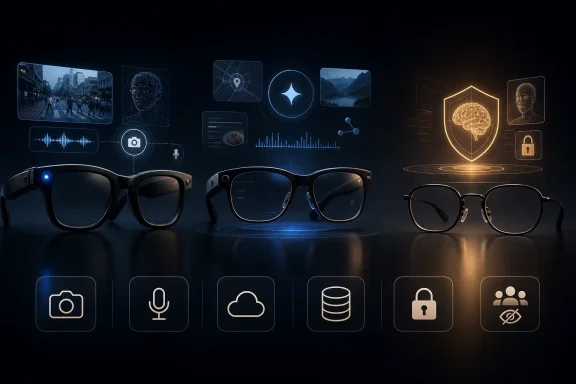
Meta, Google, and Apple therefore represent three very different positions in the emerging AI eyewear market:
- Meta has the market presence and the active consumer hardware.
- Google has the broadest platform ambition, with Android XR designed to reach multiple brands and both Android and iPhone users.
- Apple has no announced smart-glasses product, but it has already deployed a distinctive framework for on-device AI and cloud AI processing through Apple Intelligence and Private Cloud Compute.
The result is a privacy comparison with an unusual conclusion: the company with the most mature documented AI privacy model is also the company that has not yet entered the smart-glasses market.
 The Privacy Stakes of Always-On AI Eyewear
A conventional smartphone can record a person, but it is generally visible when raised and pointed at a subject. Smart glasses change that social signal. A camera mounted in eyewear can be operated hands-free, from a natural first-person viewpoint, and without the overt body language associated with taking out a phone.
That does not mean every smart-glasses wearer is recording constantly. Meta states that photos and videos captured for a user’s gallery are stored on the glasses until the owner chooses to import them, and it says the glasses are not designed to continuously save all surrounding activity. Meta Reporting on Meta’s voice features similarly noted that wake-word interactions—not continuous ambient recording—were the key trigger for voice data handling under the company’s policy. TechCrunch
But the new AI use case changes the nature of capture. Glasses that can answer questions about what a wearer sees, translate speech, identify objects, summarize information, or perform contextual tasks need access to a stream of real-world inputs. Google’s own description of Android XR glasses is unusually direct: equipped with a camera, microphones, speakers, and an optional display, the glasses paired with Gemini can “see and hear what you do” in order to understand context and help throughout the day. Google
That is the convenience proposition—and the privacy problem—in one sentence.
A face-worn AI device can collect information not only about its owner, but also about coworkers, children, friends, customers, strangers, documents, screens, conversations, addresses, medical settings, and private environments. The issue is therefore not confined to user consent. It is fundamentally a bystander privacy problem.
For Windows users, this will feel familiar in one respect. The industry has spent years learning that permissions dialogs alone do not establish trust. A microphone permission, a cloud backup default, or a telemetry switch can be technically disclosed while remaining poorly understood in daily use. Smart glasses multiply that challenge because their most sensitive sensors are embedded in an object intended to disappear into ordinary social life.
Four Tests for Smart-Glasses Privacy
A meaningful Apple smart glasses vs Meta Ray-Ban vs Android XR comparison needs to go beyond marketing language. Four questions offer a more useful framework.
1. Where does AI processing occur?
The most important architectural question is whether a request is handled:
- On the glasses
- On a paired phone
- In the vendor’s cloud
- Through a hybrid model
Local processing can reduce the amount of sensitive material that leaves a user’s immediate devices. Cloud processing can enable larger models and more capable AI features, but it creates an additional transmission, an additional system to secure, and a more consequential retention policy.
The answer is rarely binary. Powerful multimodal AI often needs more compute than a lightweight frame can comfortably provide. But the difference between local by default with privacy-constrained cloud escalation and cloud-first by design is material.
2. What happens by default?
Privacy settings are important, but defaults matter more. A product that automatically imports media, stores voice interactions, enables cloud processing, or uses submitted material to improve services creates a different risk profile from a product that requires active sharing or explicit feature use.
The practical test is straightforward: what leaves the glasses before the owner changes a single setting?
3. Can bystanders reliably tell when capture is happening?
A visible recording indicator is better than no indicator, but it is not a complete solution. It must be legible in normal conditions, difficult to defeat, and meaningful for the behavior it is supposed to disclose.
This is where the category’s hardest unresolved issue appears. A light that indicates gallery recording may not answer whether AI is processing live sensor input, whether an assistant request has been triggered, or whether data is being transmitted for cloud analysis.
4. Can anyone independently verify the company’s assurances?
Privacy claims become more credible when outsiders can inspect, test, audit, or otherwise validate the underlying implementation. A polished policy document is not the same as an enforceable technical guarantee.
That difference becomes especially important for generative AI, where companies can update models, routing logic, data flows, retention procedures, and server software faster than most consumers can read a revised privacy notice.
Meta Ray-Ban: The Shipping Leader Carries the Most Immediate Trust Burden
Meta has a crucial advantage in the smart-glasses race: it already has real products, recognizable eyewear partnerships, retail distribution, and a consumer base accustomed to using AI through a camera-and-microphone device. Its glasses are helping establish the category’s everyday behaviors—taking hands-free photos, asking an assistant for information, making calls, listening to audio, and sharing experiences from a first-person perspective. Meta
That head start also means Meta is confronting the category’s privacy pressures first.
The cloud and voice-data concern
Reporting on Meta’s 2025 policy changes found that voice transcripts and recordings related to Ray-Ban Meta interactions could be stored for up to a year to help improve Meta products, with users required to manually delete recordings if they did not want them retained for those purposes. TechCrunch
This is not a minor implementation detail. Voice requests may reveal where a person is, what they are looking at, what they are trying to do, and who may be nearby. In smart glasses, a spoken AI prompt can also be accompanied by the visual context that makes the request useful.
The privacy concern is not merely that cloud processing exists. Cloud AI is often necessary for complex tasks. The more important issue is whether users can clearly understand when media and voice information are being sent away, how long they remain available, whether they can be reviewed by people, and whether they can be used to improve models or services.
An investigation by Swedish outlet Svenska Dagbladet described concerns raised by data annotators about sensitive footage and reported that Meta’s terms allow certain material to be subject to human review. Meta told the publication that media used with Live AI is processed according to its AI terms and privacy policy. Svenska Dagbladet
That does not establish that every captured clip is reviewed by a human. It does, however, demonstrate why policy language and default behavior deserve close scrutiny when AI glasses are used in highly personal environments.
The capture LED has improved—but it is not the whole answer
Meta’s most significant public response to bystander concerns is the capture LED. The company says its glasses have a white front-facing LED that blinks when photos or videos are being captured for the gallery. Meta further says that on second-generation glasses, blocking the LED disables the camera, and that newer updates are intended to disable the camera if the hardware detects physical LED tampering or destruction. Meta
That is a meaningful improvement over a simple indicator that can be covered without functional consequences. It addresses one of the clearest objections raised against camera glasses: an indicator is only useful if a wearer cannot easily obscure it while continuing to record.
Still, Meta’s position does not entirely settle the issue. The Texas Attorney General’s office launched an investigation into Meta AI Glasses over privacy representations and alleged monitoring concerns, arguing that an “always enabled” mode permits continuous video processing for Meta AI products and that the LED is not active during that mode. Those are allegations and regulatory concerns, not final findings, but they underline the distinction between recording to a gallery and processing sensor data for AI functionality. Texas Attorney General
Meta’s July 2026 explanation is strongest when discussing user-initiated photo and video capture. The more complicated question is whether bystanders can reliably interpret every state in which cameras and microphones contribute to an AI experience.
Meta’s core privacy challenge
Meta’s architecture is under pressure because it must demonstrate that a company built around large-scale social platforms and AI services can credibly minimize data collection in a device that sees the physical world from a wearer’s point of view.
The company’s strengths are tangible:
- Mature consumer hardware and established eyewear partnerships.
- A capture LED that Meta says cannot be blocked without disabling camera functionality.
- Local storage for gallery photos and video until a user chooses to import them.
- Active work on anti-tampering measures and enforcement against services that modify capture indicators. Meta
Its risks are equally tangible:
- Voice and AI interactions can involve retention and product-improvement practices that users may not fully anticipate.
- AI use can create a more complex data trail than an ordinary camera action.
- Third-party and regulatory scrutiny has focused on gaps between visible capture signals, live AI processing, and the expectations of people around the wearer. TechCrunch Texas Attorney General
Meta can improve hardware safeguards, but long-term trust will depend on whether it can make its cloud, AI-training, human-review, and retention practices clearer and more restrictive by default.
Google Android XR: Broad Ambition, Limited Privacy Detail So Far
Google’s Android XR plan is expansive. The company is building an ecosystem platform with Samsung and Qualcomm, while working with eyewear brands including Gentle Monster and Warby Parker. Google has also said that its audio glasses will pair with both Android and iOS phones, expanding their potential audience well beyond the Android-only market. Google
The first audio glasses are due in fall 2026. Google describes two product categories: audio glasses that provide spoken help through the wearer’s ear and display glasses that add visual information through an in-lens display. Google
Gemini is the opportunity—and the exposure surface
Google’s planned feature set is ambitious. Android XR audio glasses are intended to support navigation, messages, calls, contextual questions about what the wearer sees, photo and video capture, translation, app access, and multistep tasks handled through Gemini. Google
Those features require unusually intimate context. For an assistant to answer a question about a restaurant, recognize a sign, translate a conversation, or provide natural directions based on where a wearer is facing, it may need access to images, audio, location, orientation, or a combination of those signals.
Google acknowledged the sensitivity of the design in its earlier Android XR glasses announcement, saying the company had begun collecting feedback from trusted testers to help ensure the product respects the privacy of both users and those around them. Google
That is a welcome statement of intent. It is not yet a full privacy architecture.
What Google has not publicly specified
The available public information does not yet clearly explain several details that will decide whether Android XR smart glasses earn trust:
- Whether visual and audio AI requests are processed primarily on the glasses, a paired phone, or Google’s cloud.
- What information is retained after Gemini processes a contextual request.
- Whether captured media is used to improve services or models by default.
- How users will see, manage, export, or delete glasses-derived AI data.
- What indicator system will inform bystanders when the camera or microphone is actively contributing to an AI experience.
- Whether Android XR partners will be required to meet uniform privacy and anti-tampering standards.
The platform approach magnifies the importance of those questions. Apple and Meta can set rules for relatively narrow hardware families. Google will need to coordinate standards across an ecosystem that includes its own software, hardware reference designs, phone integrations, application developers, eyewear brands, and potentially multiple camera and sensor implementations.
That openness is a strength for availability and innovation. It could also become a weakness if privacy expectations vary by manufacturer or if one partner implements a less protective design than the rest.
Android XR’s privacy test is still ahead
Google should not be penalized for failing to publish every technical detail before retail hardware ships. But it should be judged on what it discloses before consumers are asked to wear its devices all day.
For Android XR, the key metric is not whether Google can make Gemini useful. The company has already made a persuasive case that contextual AI can be useful. The key metric is whether that intelligence can operate with data minimization, intelligible defaults, effective bystander signals, and consistent partner enforcement.
Until Google publishes those answers, Android XR remains the most promising open-platform smart-glasses initiative—and the least fully specified privacy proposition among the three.
Apple Smart Glasses: A Strong Privacy Blueprint Without a Product
Apple has not announced Apple smart glasses. That caveat must remain central to any comparison. There is no Apple frame to test, no camera indicator to inspect, no battery life to measure, no thermal design to examine, and no Apple smart-glasses privacy policy to parse. Virtual Reality News
However, Apple’s existing work on Apple Intelligence and Private Cloud Compute provides the clearest available evidence of how the company might approach AI privacy if it enters the category.
On-device first, cloud only when necessary
Apple’s published Private Cloud Compute design says that Apple Intelligence handles tasks on-device whenever possible. When a request requires more computational power, it can be routed to Private Cloud Compute rather than a conventional cloud AI architecture. Apple Security Research
Apple says Private Cloud Compute was designed around stateless computation: personal data sent to its servers is used only to fulfill the immediate request, is not retained after the response returns, and is not available to Apple staff—even those with administrative access to production infrastructure. Apple Security Research
Those are unusually specific claims. They do not mean Apple’s system is beyond criticism or that all AI privacy concerns disappear. They do mean the company has expressed its privacy model in technical terms that can be examined: where data goes, how long it is intended to exist, who should be unable to access it, and what restrictions are supposed to be enforced by hardware and software rather than policy alone.
For smart glasses, that model would be particularly attractive. The less visual and audio context a device needs to upload, the less sensitive information becomes part of a remote service interaction. And when remote processing is unavoidable, short-lived, non-retained requests would represent a more privacy-protective posture than systems designed to keep interactions for product improvement or training.
Verification is Apple’s clearest differentiator
The most important element of Private Cloud Compute is not merely Apple’s assertion that it protects user data. It is the company’s attempt to make the system externally inspectable.
Apple has published a Private Cloud Compute security guide, a Virtual Research Environment that allows researchers to examine PCC node software on a Mac, transparency mechanisms for software releases, and a security-bounty pathway for findings that undermine PCC’s privacy claims. Apple Security Research Apple Security Research
Apple’s approach is notable because it confronts a standard cloud-AI problem: users are usually expected to trust that a provider is running the code it says it is running and handling data as promised. Apple’s PCC architecture is designed to publish production software images and cryptographic measurements so researchers can inspect binaries and validate the relationship between listed software and deployed systems. Apple Security Research
That is not the same as a guarantee that every future Apple AI feature will be perfect. Independent inspection can reveal flaws, but it cannot eliminate the risk of flaws. Still, it establishes a stronger foundation than a company simply asking users to accept a broad statement that data is “private.”
The major caveat: glasses are harder than phones and headsets
Apple’s documented AI architecture does not automatically solve smart-glasses privacy.
A lightweight pair of glasses has severe limits around battery capacity, heat dissipation, antennas, camera modules, microphones, processors, and physical space. Sustained on-device multimodal AI may prove difficult in a frame that people can comfortably wear all day. If Apple needs a paired iPhone, more frequent cloud assistance, or a compromise in sensor capability, the privacy model may be shaped as much by physics as by corporate philosophy.
The largest gap is bystander signaling. Apple’s Private Cloud Compute work speaks to how user data is processed once an AI request is made. It says little about how a non-user can tell whether a face-worn device is recording, sensing, analyzing, or transmitting information in public.
A hypothetical Apple smart-glasses product could retain strong on-device and cloud privacy protections while still failing to provide an adequate signal to people nearby. In that scenario, Apple would have solved only half the problem.
Apple vs Meta vs Android XR: The Structural Difference
The comparison becomes clearer when separated into what is available now, what has been announced, and what remains theoretical.
| Privacy criterion | Meta AI Glasses | Google Android XR glasses | Hypothetical Apple smart glasses |
|---|---|---|---|
| Product status | Available consumer category with active deployments | Audio glasses planned for fall 2026 | No product announced |
| AI processing model | Cloud and policy-dependent AI interactions are an active concern | Public processing and retention details remain limited | Apple Intelligence uses on-device processing where possible, with PCC for more complex requests |
| Data-retention posture | Voice interactions have drawn scrutiny over storage and product-improvement use | Not fully specified publicly for glasses | PCC is designed for request-only, non-retained processing |
| Bystander indicator | Capture LED with anti-blocking and anti-tampering measures claimed by Meta | Public hardware approach not yet detailed | Unknown |
| Independent verification | No PCC-style public production-code verification model identified | No equivalent glasses-specific model publicly described | PCC provides research tools, transparency mechanisms, and inspectable components |
The table does not declare Apple the winner. Apple does not have a shipping smart-glasses device, and a privacy architecture designed for iPhones, Macs, iPads, and Apple Intelligence cannot simply be assumed to translate intact into a face-worn camera product.
But it does identify the key competitive advantage Apple could possess: a documented model for reducing cloud exposure and allowing meaningful independent scrutiny when cloud processing is required. Apple Security Research Apple Security Research
Meta’s advantage is real-world scale. Google’s advantage is ecosystem reach. Apple’s potential advantage is that it would not need to invent a new AI privacy philosophy from scratch.
The Bystander Problem Will Decide the Category
The industry’s most difficult smart-glasses privacy problem is not necessarily cloud retention. It is whether people in the same room can know when they are being captured or analyzed.
Meta has made the strongest public hardware commitment so far by tying camera operation to its capture LED and claiming that blocking or tampering with the indicator disables the camera. Meta That deserves recognition as a practical engineering response to a practical abuse case.
However, the broader debate has moved beyond simple photo and video recording. AI glasses may use cameras and microphones for momentary interpretation, live context, translation, accessibility, navigation, and ambient assistance. A tiny indicator designed around gallery capture may not communicate all of those states in a way a bystander can understand.
Google has acknowledged the obligation to respect the privacy of people around the wearer, but it has not yet publicly detailed its final signaling model. Google Apple has no announced hardware, so it has not answered the question at all.
The company that earns the deepest public trust may be the one that treats bystander awareness as a first-class interface problem rather than a compliance footnote. That could involve obvious visual indicators, hardware-enforced anti-tamper measures, tightly limited sensor modes, clear AI-state cues, and social designs that make covert use inconvenient rather than effortless.
What Buyers Should Watch Before Trusting AI Glasses
The best smart glasses will not be defined only by camera quality, battery life, voice features, or fashionable frames. The decisive specifications will increasingly be privacy specifications.
Before buying Meta Ray-Ban glasses, Android XR glasses, or any future Apple smart glasses, consumers and IT decision-makers should examine:
- Local versus cloud processing
Determine whether visual, audio, and AI requests stay on the glasses or phone, or whether they are routinely transmitted to cloud systems. - Retention and training defaults
Check whether voice recordings, transcripts, images, video, and AI interactions are stored, how long they persist, and whether they can be used to improve products or train AI models. - Capture and AI-state signaling
Look for more than a simple camera light. Identify what the signal means, which functions activate it, and what prevents a wearer from disabling or bypassing it. - Deletion and control mechanisms
A usable privacy control should allow people to see stored data, delete it in bulk, disable optional cloud features, and understand the consequences of those choices. - Independent accountability
Prefer vendors that provide technical documentation, audit evidence, bug-bounty programs, transparency reports, or verifiable software assurances rather than relying solely on broad promises.
The smart-glasses market is at the point where design choices will become social norms. Meta is already setting many of those norms through mass-market hardware. Google’s Android XR launch will test whether a broad ecosystem can maintain coherent privacy standards. Apple, if and when it enters the category, will face a different challenge: proving that its existing AI privacy architecture can survive the physical, thermal, and social realities of a camera-equipped device worn all day.
For now, Meta has the hardware, Google has the platform, and Apple has the most fully articulated privacy blueprint. The company that ultimately earns lasting trust will be the one that can combine all three: useful AI, wearable hardware, and privacy protections that are visible, enforceable, and verifiable.
Update: Additional details (July 30, 2026)
TechRepublic, citing Bloomberg’s Mark Gurman, reports that Apple’s rumored N50 smart glasses are now targeted for a Worldwide Developers Conference unveiling in June 2027 and a consumer release by the end of 2027. The report says Apple had previously considered introducing the product in 2026 for an early-2027 launch.
The report also says Apple is evaluating privacy-led design choices, including a camera-free version or cameras restricted from conventional photo and video capture. Apple is reportedly expected to emphasize on-device processing, avoid facial recognition, and not use customer recordings for AI training or human review. None of these product details has been confirmed by Apple.
