
Technetbook reported the August 20 introduction, while Ukraine’s Computer Review separately published the same B3406CMA and B3606CMA model identifiers and core specifications. ASUS’s own 2026 third-quarter business product guide also lists those exact Intel B3 G2 model families, providing the strongest confirmation that this is a real refresh rather than a mistaken reuse of the existing AMD ExpertBook B3 G2 name.
The distinction is necessary because ASUS already announced an AMD Ryzen AI-based ExpertBook B3 G2 in January 2026. That earlier family carries substantially different specifications: up to a 55 TOPS NPU, up to 96GB of DDR5 memory through self-upgrade, and up to 3TB of storage. The new Intel models share the B3 G2 branding, chassis concept, security suite, and display options, but they are a separate configuration branch — and buyers should insist that quotations, procurement records, and support contracts name B3406CMA or B3606CMA rather than merely “ExpertBook B3 G2.”
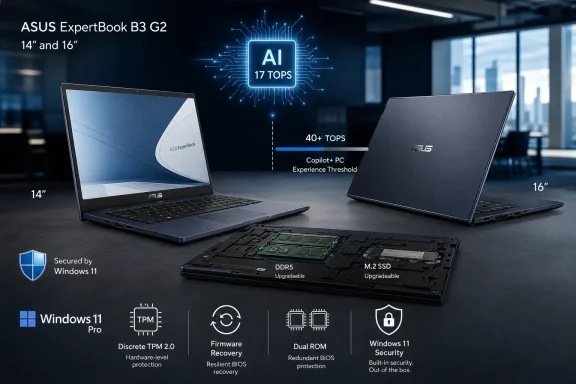 The Intel B3 G2 is an AI PC, not a Copilot+ PC
ASUS’s third-quarter guide describes the B3406CMA and B3606CMA as using Intel Core 7 Series 3 processors with Intel graphics and an NPU delivering up to 17 TOPS. That is enough for software that can make use of a local NPU, including certain camera, audio, and vendor applications. ASUS and the reports point to AI noise cancellation and Microsoft Copilot-related workflows as examples.
But 17 TOPS does not satisfy Microsoft’s published Copilot+ PC hardware requirement. Microsoft says the class requires an NPU capable of more than 40 TOPS, alongside Windows 11 version 24H2 or later, at least 16GB of RAM, and 256GB of SSD storage. The gap is not cosmetic: Microsoft’s hardware-gated, on-device experiences — including the broader Copilot+ feature set and workloads designed around a 40+ TOPS NPU — should not be presumed available on this ExpertBook configuration.
That does not prevent users from running Microsoft Copilot in Windows, Microsoft 365, or a browser. Those services can use cloud processing and do not turn a system into a Copilot+ PC. It does mean IT departments should reject any inventory description, reseller listing, or internal deployment plan that labels the 17 TOPS B3 G2 as Copilot+ without a specific Microsoft qualification to back it up.
ASUS’s naming choice may add to the confusion. Intel’s “Core 7 Series 3” branding is distinct from “Core Ultra,” which appears on many earlier AI-focused Intel laptop lines. The product guide identifies the processor family but does not publish a complete processor-SKU matrix for the B3406CMA and B3606CMA. That leaves buyers unable to compare core counts, vPro availability, graphics configuration, or expected battery behavior between the available CPU options before obtaining a country-specific datasheet or sales quote.
Upgradeability is the practical selling point
The B3 G2’s most useful differentiator is not the NPU; it is the chassis’s serviceability. ASUS’s product guide says systems ship with up to 32GB of DDR5 memory and 512GB of SSD capacity, while supporting self-upgrades to 64GB of memory and 4TB of storage. Technetbook reported up to 1TB of initial storage, but ASUS’s guide currently lists 512GB as the preconfigured ceiling for this Intel B3 G2 entry.
For fleet managers, those figures should be read as two different promises. The first is what ASUS or a channel partner may sell as a supported factory configuration. The second is the physical expansion ceiling that a customer can reach after purchase. They are not interchangeable, especially when hardware refresh standards require specific SSD capacities on day one or when warranty terms limit which components can be replaced in the field.
The details also matter for lifecycle planning. A laptop ordered with 16GB or 32GB today may remain viable longer if memory is socketed and the storage bays can accept standard M.2 drives, but ASUS has not yet published the detailed service manual or a regional technical sheet needed to verify slot count, SSD form factors, upgrade procedure, and whether both models have identical expansion layouts. “Up to 4TB” is a capacity claim, not a substitute for those deployment details.
Organizations evaluating the B3 G2 should get the following confirmed in writing before placing a volume order:
- The quote should identify the full CPU SKU, installed memory configuration, SSD layout, wireless adapter, operating-system edition, and whether Intel vPro management is included.
- The supplier should state which upgrades are customer-installable without changing warranty coverage, including the maximum supported capacity for each memory and SSD slot.
- The purchase order should distinguish the B3406CMA from the B3606CMA, because screen size alone is not a reliable proxy for every component and port option.
- The deployment team should confirm whether the selected configuration qualifies for Windows Autopilot, BitLocker recovery-key escrow, firmware management, and the organization’s endpoint-security baseline.
Firmware protections need an operational plan
ASUS is emphasizing its ExpertGuardian security package, including a TPM 2.0 chip, NIST SP 800-193-oriented firmware protection, a Security Processor Unit, dual-ROM recovery, chassis-intrusion detection, and cloud recovery. Those are meaningful features for a Windows business laptop, particularly the dual-ROM design intended to restore firmware following corruption or unauthorized modification.
However, NIST SP 800-193 is a firmware-resiliency guideline, not a blanket certification that a laptop is secure against every endpoint threat. The useful question for administrators is whether the firmware recovery mechanism is controllable and auditable at scale: who can authorize recovery, whether recovery events appear in management logs, how BIOS passwords are protected, and whether the fleet can report firmware version and configuration drift centrally.
ASUS’s January announcement for the AMD ExpertBook B3 G2 described five years of BIOS and driver updates. The August reports apply a similar five-year commitment to the Intel B3406CMA and B3606CMA, variously calling it security, BIOS, and driver support. ASUS’s third-quarter product guide confirms the Intel models and their ExpertGuardian branding, but does not spell out the five-year update policy in the model entry itself.
That ambiguity deserves attention. A promise of five years of security updates could mean firmware fixes; a promise of five years of BIOS and driver updates is broader; and support availability can differ by region and commercial channel. Procurement teams should ask ASUS to specify the start date, end date, covered software and firmware components, and whether critical security fixes remain available after a model is withdrawn from sale.
A durable office notebook with incomplete launch details
Both reports describe a 180-degree lay-flat hinge, a 70Wh battery option, ExpertCool thermal management, an FHD infrared camera, and an optional 2.5K anti-glare panel with a 144Hz refresh rate. They also cite MIL-STD-810H testing comprising 24 procedures. ASUS makes the usual and important qualification in its product materials: passing laboratory military-standard tests does not make the laptop suitable for military service, nor does it guarantee survival under every real-world drop, spill, heat, or vibration event.
The display option is more consequential than it first appears. A 2.5K, 144Hz panel may improve scrolling and visual comfort for desk-bound users, but it can also affect battery life, price, and fleet consistency. The reports do not establish whether that panel is available in both screen sizes, every region, or every CPU configuration. Nor has ASUS published U.S. pricing or an availability date for the B3406CMA and B3606CMA in the materials reviewed so far.
The Intel ExpertBook B3 G2 is therefore best understood as a conventional, serviceable Windows 11 business laptop with some local AI acceleration and a potentially credible firmware-resilience story. Its 17 TOPS NPU may help targeted applications, but it is not a replacement for a 40+ TOPS Copilot+ PC where Microsoft’s newest on-device Windows AI capabilities are a deployment requirement.
Until ASUS publishes full regional specification sheets and commercial availability, the immediate action for IT buyers is simple: verify the exact B3406CMA or B3606CMA configuration, obtain the written five-year update terms, and do not let “AI PC” become shorthand for Copilot+ eligibility.