
Notebookcheck first highlighted the configuration as a new China-only ProArt 16 option. Separate Chinese listings reported by GamerSky and IT Home put the price at 22,999 yuan. That is 5,000 yuan above the 17,999-yuan launch price IT Home reported for the RTX 5070, 64GB and 2TB ProArt 创16 2025 in May 2025, before any subsidies.
For Windows-based creative work, the immediate appeal is straightforward: Asus is still offering a thin 16-inch machine with 64GB of LPDDR5X memory, a dedicated RTX GPU and two M.2 storage slots. The catch is that buyers should treat this as a regional refresh and compare it directly against remaining 2025 stock, rather than assuming the new processor makes it an across-the-board upgrade.
 The Ryzen AI 9 H 465 changes the CPU balance
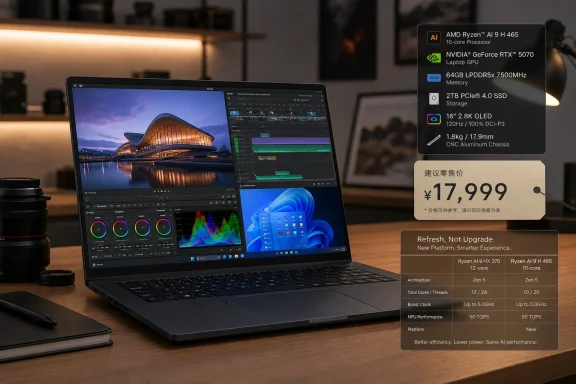
AMD’s product record identifies the Ryzen AI 9 H 465 as a China-availability Ryzen AI 400-series chip, codenamed Gorgon Point. It has 10 CPU cores and 20 threads, divided into four Zen 5 cores and six compact Zen 5c cores, with boost clocks up to 5GHz. AMD rates the chip for a configurable 15W to 54W range and lists a 50 TOPS NPU.
That NPU figure is important because it explains why the change is not a major shift in Windows AI capability. The prior Ryzen AI 9 HX 370 configuration also carries AMD’s 50 TOPS XDNA 2 NPU, sufficient for Copilot+ PC-class local AI features. Owners should not expect the revised ProArt to unlock a distinct tier of Windows features simply because its processor says Ryzen AI 400 instead of Ryzen AI 300.
The CPU comparison is less favorable for workloads that remain heavily multithreaded. The Ryzen AI 9 HX 370 used in the 2025 ProArt 创16 has 12 cores and 24 threads, while the H 465 has 10 and 20. The newer chip’s architecture and memory support may improve particular bursty or lightly threaded tasks, but Asus has not published application benchmarks for this exact configuration that would establish a rendering, export or compile-time advantage.
For creators buying the ProArt name for Blender rendering, code builds, media exports or large Photoshop and After Effects sessions, that missing evidence matters. A newer product designation does not overcome a two-core reduction on paper. The RTX 5070 will still carry much of the load in GPU-accelerated software, but CPU-limited projects are exactly where the 2025 HX 370 version may remain competitive—or faster—until independent testing says otherwise.
The display and graphics specification remain the practical draw
The 2026 model uses a 16-inch 2.8K OLED display with a 120Hz refresh rate, according to Notebookcheck and the Chinese retail reporting. GamerSky lists a 1,000-nit peak-brightness claim and a 0.2ms response time; Notebookcheck reports brightness of up to 1,100 nits. The difference is small, but it illustrates why prospective buyers should wait for Asus’s full product page or a calibrated review before treating either number as a sustained full-screen brightness rating.
The panel is the same broad direction Asus took with the 2025 machine: 2,880 by 1,800 resolution, 16:10 aspect ratio and 120Hz OLED rather than the older 4K 60Hz configuration. It is a sensible fit for timeline work, photo editing, general Windows desktop use and high-frame-rate playback. For color-critical work, however, refresh rate and peak brightness are incomplete specifications; coverage, calibration targets, delta-E measurements and brightness behavior with HDR enabled matter more than a headline nit figure.
Nvidia’s GeForce RTX 5070 Laptop GPU is also unchanged from the comparable 2025 Chinese model. Asus’s US ProArt P16 documentation for RTX 5070 variants identifies the GPU as an 8GB GDDR7 part. That is strong hardware for Adobe applications, DaVinci Resolve workflows that use CUDA, GPU rendering and some local AI tools, but 8GB of VRAM remains a real limit for demanding generative-AI models, large 3D scenes and high-resolution effects pipelines.
The RTX label alone also does not reveal performance. Laptop GPU behavior depends heavily on wattage, cooling policy and whether the system can sustain its advertised power limits. The 2025 ProArt 创16 was reported with a 125W total system-performance target, but no equivalent sustained-power figure or RTX 5070 power limit has been independently established for this specific Ryzen AI 9 H 465 refresh. That is the performance number Asus needs to disclose before professionals can make an informed comparison with a ROG Zephyrus, a mobile workstation or Apple’s MacBook Pro line.
The portable workstation hardware is mostly intact
The reported 14.9mm thickness and 1.8kg weight put the ProArt 创16 in a relatively unusual category: a 16-inch Windows creator laptop that is not built like a traditional thick workstation. GamerSky reports that Asus has retained the CNC-formed chassis and the three-fan, four-heat-pipe cooling assembly.
The rest of the platform also appears familiar. The Chinese reporting lists HDMI 2.1, USB4, USB-C 3.2 Gen 2, two USB-A 3.2 Gen 2 ports, an SD card reader and a 3.5mm audio jack. The 2025 model’s published configuration included Wi-Fi 7, a 90Wh battery, Windows Hello-capable IR camera hardware and Asus’s DialPad control surface. Asus has not yet provided a full official specification sheet confirming that every one of those features carries unchanged into the H 465 SKU.
Memory is more clear-cut: the 64GB is soldered LPDDR5X rather than user-replaceable SO-DIMM memory. That is ample for most 4K editing, large RAW photo catalogs, virtual machines and development workloads today, but it locks buyers into the capacity they choose. Professionals considering local model work or unusually memory-intensive engineering projects should factor that limitation into the purchase decision.
Storage is more flexible. The machine ships with a 2TB SSD and has two M.2 slots, matching the basic physical storage arrangement reported for the 2025 model. But Asus has not publicly specified the maximum supported capacity for this refresh. It would be premature to assume that two slots mean a particular two-drive capacity, even though Asus lists up to 4TB for the related US ProArt P16 family.
China availability leaves a major purchasing gap
This release is a China listing, not a global ProArt P16 launch. The 22,999-yuan price reported by GamerSky applies to the Chinese configuration, and Asus has not announced a US model number, US price or release date for a Ryzen AI 9 H 465 ProArt P16.
That distinction matters for Windows buyers outside China. Asus’s current US ProArt P16 listings continue to identify Ryzen AI 9 HX 370 processors for RTX 5070 models, with up to 64GB of memory and 4TB of SSD storage. Importing a China-market unit could introduce keyboard-layout, warranty, power-adapter, firmware-support and regional Windows licensing questions that are not solved by the hardware spec sheet.
The price comparison also weakens the idea that this is automatically a better deal than its predecessor. At launch, the 2026 configuration reportedly costs roughly 28% more in yuan than the comparable 2025 RTX 5070, 64GB and 2TB model’s official launch price, while holding the GPU, memory, storage, display format, thickness and weight broadly steady. The processor is newer, but its core count is lower.
Asus has kept alive a compelling Windows creator-laptop format: 64GB of RAM, an RTX 5070, OLED and two M.2 slots in a 1.8kg chassis. But the new China-only ProArt 创16 is best understood as a revised SKU, not a clean generational leap. Until Asus publishes sustained performance figures and independent reviewers test the H 465 under CPU-heavy work, the remaining HX 370 version is the comparison that matters most.