
In a wide-ranging interview, author and technology critic Cory Doctorow argues that the central question is not whether artificial intelligence is in a bubble, but when that bubble will deflate—and whether organisations that removed people from critical roles will discover too late that they discarded skills that cannot be bought back on demand. The Guardian’s report places that warning squarely in an Australian policy debate that now spans workplace protections, AI safety, public-sector adoption and copyright.
For Windows professionals, IT administrators, developers and business leaders, Doctorow’s argument lands well beyond Silicon Valley’s investment cycle. The issue is not simply whether a chatbot can draft a document, summarise a meeting, generate PowerShell or produce a first-pass application. It is whether businesses are using AI as a capability multiplier for skilled people—or as a rationale to hollow out the human systems that make technology reliable.
That distinction could define the post-boom era.
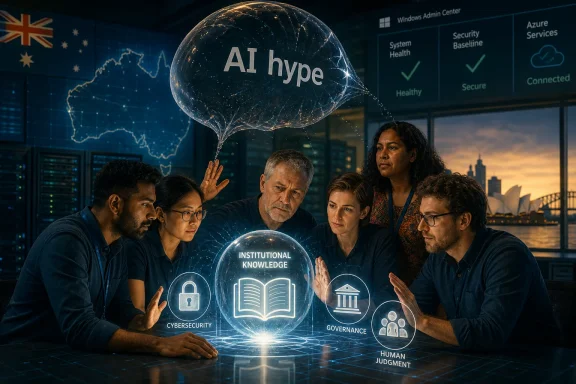 Overview: The AI Bubble Is Not the Same as AI Failure
Doctorow’s thesis is deliberately more nuanced than the familiar claim that AI is useless. His book, The Reverse Centaur’s Guide to Life After AI, is framed around the idea that useful tools can survive even if the financial and political stories built around them do not. The publisher describes his position as neither a blanket rejection of AI nor a refusal to use it; rather, it presents AI as a technology surrounded by exceptional hype and incentives that often work against workers and users. Macmillan’s description of the book makes the key distinction clear: Doctorow sees potential in the tools, while questioning who benefits from the way they are financed, marketed and deployed.
That is an important separation. A market correction in AI would not make machine learning, natural-language interfaces, computer vision, automation platforms or local models disappear. It would instead test which use cases were genuinely valuable without the assumption of ever-rising investment, cheap cloud credits and executive tolerance for expensive experimentation.
The personal computer did not vanish after the dot-com crash. Cloud computing did not disappear after failed startups burned through capital. Nor would AI become irrelevant simply because some companies, datacentre projects or model providers failed to meet the expectations embedded in their valuations.
But the shape of AI adoption could change dramatically.
A post-bubble market would likely reward systems that are:
- Measurably useful rather than merely impressive in a demo.
- Affordable to operate without indefinite external subsidy.
- Auditable and secure enough for regulated workplaces.
- Integrated into real business processes rather than bolted onto them.
- Governed by people who understand the work being automated or augmented.
- Portable and interoperable, reducing dependence on one vendor’s roadmap.
For Australian organisations, that is not a theoretical exercise. The federal government’s own AI policy is already constructed around a dual objective: capturing economic opportunity while spreading gains and managing risks. The government’s response to the Senate committee on AI describes a strategy anchored in infrastructure and domestic capability, worker support and skills, and safeguards for Australians. The Department of Industry, Science and Resources outlines those three goals here.
The strongest version of Doctorow’s argument is therefore not “do nothing with AI.” It is: do not confuse a tool’s usefulness with the inevitability of the business model currently wrapped around it.
The Real Risk: Institutional Knowledge Walks Out the Door
Doctorow’s sharpest warning concerns the executive temptation to treat AI as a direct replacement for labour. In the Guardian interview, he argues that organisations which dismiss staff, force workers into retirement or push them into unrelated careers could find it extraordinarily difficult to recreate the lost operational knowledge later. His warning about unrecoverable workplace knowledge is reported here.
That concern should resonate with anyone who has inherited an under-documented Windows environment.
A company can retain its Microsoft 365 tenant, Azure subscriptions, Intune policies, Active Directory or Entra ID configuration, endpoint fleet and ticketing system. Yet it can still lose the knowledge that makes the environment manageable:
- Why a legacy Group Policy Object exists.
- Which line-of-business application breaks after a certificate rollover.
- How a payroll integration handles exceptions.
- Which service account must not be disabled.
- Why a PowerShell remediation script has an apparently redundant step.
- Which executive workflow is dependent on a fragile SharePoint list.
- How staff actually complete a process when the documented process fails.
This is tacit knowledge: the practical understanding accumulated through observation, incident response, maintenance and repeated interaction with real users. It rarely sits in a single knowledge base, and even when documentation exists, documentation is not the same thing as judgment.
An AI assistant may be capable of retrieving a runbook. It may even produce a persuasive explanation of what the runbook means. But it cannot reliably recreate the experience of an administrator who remembers the one failed disaster-recovery exercise, the vendor’s undocumented workaround, or the political sensitivity around a particular business unit.
Automation debt can become a form of technical debt
The term technical debt usually describes the future cost created when teams choose a faster but weaker engineering path today. AI-driven automation can create a related problem: automation debt.
Automation debt emerges when an organisation deploys systems that appear to reduce work while quietly reducing understanding. The work has not vanished; it has become harder to inspect, harder to repair and more dependent on the vendor or model that made the initial shortcut possible.
“Vibe coding” is a useful example. Generative AI can help experienced developers brainstorm, scaffold tests, explain legacy code, generate documentation and accelerate repetitive tasks. Those are legitimate gains. But code created from prompts and moved into production without architecture review, test coverage, dependency management, security assessment and ownership is not an efficiency miracle. It is a future incident with an unclear author.
The risk is especially acute in environments where low-code tools, copilots and AI agents can now create workflows faster than IT teams can evaluate them. An employee may build a useful Microsoft Power Automate flow, a Teams bot, a desktop automation routine or an internal dashboard in hours. If that workflow then becomes essential to finance, customer support or HR, the organisation has created a production system—whether or not anyone chose to call it one.
The correct response is not to ban experimentation. It is to establish boundaries between personal productivity automation and business-critical automation.
A sensible hierarchy looks like this:
- Personal or disposable tools can tolerate occasional failure.
- Team workflows need shared ownership, basic documentation and access controls.
- Business-critical processes require formal change management, testing, logging, backup and a named accountable owner.
- High-risk decisions involving employment, credit, health, government services or customer eligibility require human review, appeal pathways and legal scrutiny.
Australia’s voluntary AI guidance already points in this direction. The government states that its guidance is intended to support safe and responsible AI governance, while its associated guardrails focus heavily on practical deployment by organisations that use AI rather than build foundation models themselves. The guidance’s deployer-focused approach is explained by the Department of Industry, Science and Resources.
Australia Should Preserve Capability, Not Just Chase Capacity
Doctorow’s proposed response to a downturn is striking: governments should avoid becoming overcommitted buyers at the height of the AI boom, then take advantage of the hardware, expertise and open-source models that could become available after the market changes. The Guardian reports his case for salvaging useful tools and infrastructure after a correction.
There is a pragmatic logic here. Technology booms often leave behind valuable assets once the speculative layer recedes. Fibre networks, server capacity, developer skills, software libraries and operational practices can outlive the companies that overspent on them.
However, Australia should be careful not to interpret that argument as a reason to defer all investment. The country’s public strategy already recognises that AI capability is about more than buying access to offshore chatbots. The National AI Plan identifies infrastructure, domestic capability, responsible adoption and workforce development as linked priorities rather than separate projects. The plan describes support for AI adoption, infrastructure and skills development.
The better policy is neither “buy everything now” nor “wait for a crash.” It is selective capability building.
What capability building should mean
Australia should invest in assets that retain value across market cycles:
- High-quality computing and data infrastructure for research and public-interest applications.
- Cybersecurity capacity for evaluating AI systems and protecting AI-enabled services.
- Workforce training that teaches verification, systems thinking, data literacy and domain expertise.
- Procurement skills inside government, so agencies can assess claims rather than merely purchase products.
- Open standards, interoperable data practices and strong records management.
- Research partnerships that convert AI tools into practical gains in health, agriculture, education, climate resilience and public administration.
- Local expertise capable of auditing models, validating outputs and identifying harmful failure modes.
This is where the Windows ecosystem offers a concrete lesson. Organisations that built lasting value from previous technology shifts did not succeed simply because they bought the newest platform. They succeeded because they developed administrators, architects, security professionals and service owners who could operate systems across versions, vendors and unexpected failures.
The same principle should apply to AI.
A government department that adopts an AI assistant without maintaining internal expertise may save short-term effort while becoming unable to assess whether the assistant is accurate, compliant or cost-effective. A company that replaces its support desk with automated agents may reduce headcount while losing the feedback loop that reveals product defects. A software team that relies on generated code without retaining senior engineering oversight may move faster until a security incident, compliance audit or platform migration reveals the true cost.
Resilience comes from retained judgment. AI can support that judgment; it should not be used as an excuse to dismantle it.
The Workplace Question Is Bigger Than Job Counts
Australia’s official position is more cautious than the most aggressive replacement narrative. Government analysis cited in its Senate response says that AI is more likely to augment than replace most work in the near term, while acknowledging uncertainty and the need for active planning with employers, workers and unions. The government’s workforce assessment and transition measures are detailed here.
That is the right starting point, but it should not become complacency.
The central workplace issue is not only whether a whole occupation disappears. It is also whether AI changes the quality, autonomy and sustainability of work inside the occupations that remain.
A help-desk analyst who uses AI to surface relevant knowledge articles may resolve issues faster and spend more time on complex cases. That is augmentation. But an analyst forced to process an unrealistic volume of AI-triaged tickets, while acting as the human fallback for errors the system cannot understand, may be working in a more stressful and less skilled role.
Likewise, a developer who uses coding assistance to remove boilerplate can focus on architecture and customer needs. But a developer judged solely by machine-inflated output metrics may be pressured to ship more code than anyone can realistically review.
Doctorow’s “reverse centaur” idea is useful precisely because it shifts attention from the machine’s capabilities to the worker’s experience. The publisher’s definition describes a reverse centaur as a person pushed by technology into an inhuman work pace rather than empowered by it. That framing appears in Macmillan’s book description.
For employers, this creates a practical test: does AI give employees more control, more time for higher-value work and clearer decision-making—or does it turn them into monitors of an opaque system running at an unreasonable speed?
The Albanese government’s recently announced AI safety priorities include workplace AI among the areas for coordinated action, alongside privacy, consumer protection, a digital duty of care and automated decision-making in federal agencies. The July 2026 government announcement sets out those priorities. That agenda is welcome, but it will need enforceable workplace practices—not just broad commitments—to protect workers from algorithmic management and poorly governed deployment.
Copyright Matters, but It Cannot Carry the Whole Burden
The clash between AI training and copyright has become one of the defining policy fights of generative AI. The Guardian reports that Prime Minister Anthony Albanese promised clearer copyright protections intended to ensure AI companies pay for the use of creative works, following debate about a possible text-and-data-mining exception. The Guardian’s account of the copyright dispute is here.
The government has since stated that it is not considering a text-and-data-mining exception in Australian copyright law and is examining licensing, legal certainty around AI-generated material and lower-cost enforcement options through its Copyright and AI Reference Group. The government’s formal position is set out in its AI Senate response.
That matters. Creative workers deserve meaningful protection against uncompensated extraction, and businesses need clearer rules about training data, licensing and liability. The Australian Copyright Council notes that text and data mining, fair dealing and AI raise interconnected questions about copyright material, exceptions and licensing arrangements. Its overview of the issue is available here.
Yet Doctorow’s criticism is also valuable: copyright reform alone cannot guarantee that creators, journalists, musicians, designers or software developers will receive a fair share of the proceeds. A licensing payment to a large platform, publisher or rights holder does not automatically flow to the people whose work created the value.
That is why Australia needs a broader creative-economy response that considers:
- Collective bargaining power for creative workers.
- Transparent licensing terms and reporting.
- Contractual protections against coerced AI substitution.
- Attribution and provenance mechanisms where technically feasible.
- Rights to challenge misleading synthetic impersonation.
- Better access to legal remedies for small creators.
- Competition policy that examines whether dominant platforms absorb both audience attention and AI licensing value.
Copyright should be one tool in the kit, not the entire kit.
A Post-Bubble AI Strategy for Australian Organisations
A business does not need to predict the exact timing of an AI correction to prepare for one. It simply needs to avoid decisions that become catastrophic if vendor pricing changes, funding dries up, a model is retired or promised labour savings fail to materialise.
The most durable AI strategy is built around reversibility.
Keep a human operating model
Do not automate away the last people who understand a core process. Maintain a deliberate human capability for incident handling, quality review and manual fallback—even if AI handles the bulk of routine work.
For IT teams, that means preserving administration skills around identity, endpoints, networking, backup, security operations and application ownership. A copilot can accelerate a script; it cannot be the accountable owner of a domain controller recovery, an incident response decision or a regulatory disclosure.
Demand exit paths from AI suppliers
Procurement teams should ask practical questions before committing to a platform:
- Can prompts, logs, configurations and knowledge bases be exported?
- What happens to custom agents if the service changes price or is discontinued?
- Can the organisation move to a different model provider?
- Are APIs documented and stable enough to support migration?
- Is there a workable offline or manual process?
- Who owns generated outputs, fine-tuning data and usage telemetry?
- Can the system be independently audited?
These are not anti-innovation questions. They are standard enterprise architecture questions, now applied to AI.
Measure outcomes, not activity
Many AI projects are evaluated through superficial metrics: prompt volume, licences assigned, content generated or hours claimed to be saved. Those numbers can conceal a rise in rework, security exposure or customer dissatisfaction.
Better measures include:
- Error rates before and after deployment.
- Escalations and manual interventions.
- Time saved after quality review.
- Employee workload and satisfaction.
- Customer resolution quality.
- Security incidents and data-handling exceptions.
- Cost per completed, correct business outcome.
- The ability to continue operating if the AI service becomes unavailable.
A pilot should be allowed to fail without becoming a political embarrassment. In fact, the ability to stop a weak AI project is evidence of sound governance.
Useful Tools Can Outlive Bad Incentives
Australia does not need to choose between being an AI booster and an AI sceptic. It needs to become better at distinguishing durable technical value from the temporary incentives of a boom.
The government’s own guidance emphasizes a human-centred approach, safety, accountability and the need for organisations to deploy systems that earn trust. The Department of Industry’s AI safety guidance explains that human-centred deployment is intended to protect people and support trustworthy use. Those principles should remain valid whether AI investment accelerates, plateaus or contracts.
Doctorow’s warning is most compelling when treated as an organisational design problem. If executives use AI to shed expertise, weaken workers’ control and create brittle dependencies, a market correction could expose severe gaps. If they use AI to improve documentation, automate drudgery, widen access to expertise and strengthen human decision-making, the same tools could remain valuable long after the bubble rhetoric fades.
The outcome will not be determined by a chatbot’s fluency or a vendor’s valuation. It will be determined by whether Australian institutions retain the people, skills, governance and public-interest infrastructure needed to make AI serve the work—rather than make workers serve the machine.
