

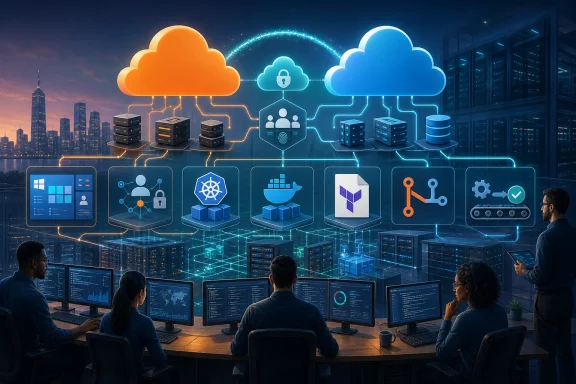
The study, conducted by web-intelligence company Oxylabs and reported by WBIW, reviewed postings published from January 2025 through March 2026. It found that early 2026 accounted for 39% of the listings in its sample, an apparent surge that sits uneasily alongside the public narrative of layoffs and hiring freezes. The market is not uniformly healthy, but the roles being opened are increasingly specific: employers want people who can build, deploy, secure, monitor, and govern systems that run across public-cloud and hybrid environments.
That distinction matters. A company reducing headcount in a product team can still be recruiting for an Azure administrator, a platform engineer, an AWS security specialist, or a data engineer with Kubernetes and Terraform experience. Those jobs are not simply interchangeable with general “tech” openings; they support the infrastructure behind modern applications, internal data platforms, AI workloads, and increasingly complex compliance requirements.
AWS and Azure Are the Employment Baseline
Oxylabs found that almost 42% of the analyzed postings mentioned at least one of the three largest public-cloud platforms: AWS, Azure, or Google Cloud Platform. AWS led the list, Azure followed, and GCP appeared among the commonly requested technologies alongside Git, Excel, Kubernetes, Docker, Power BI, Terraform, and Tableau.
The AWS-Azure combination is particularly meaningful for the Windows ecosystem. Azure has long been the natural extension of Microsoft-heavy organizations running Active Directory, Windows Server, Microsoft 365, SQL Server, Power BI, and endpoint-management stacks. But many large companies operate in multicloud mode, whether intentionally or through years of acquisitions, line-of-business decisions, and software-as-a-service adoption. That leaves hiring managers looking for people who can work across AWS and Azure rather than treating either platform as an isolated specialty.
For a Windows admin, the practical version of “cloud experience” is no longer limited to creating a virtual machine in Azure. Employers increasingly expect familiarity with Microsoft Entra ID, Azure networking, role-based access control, Azure Policy, logging, backup and recovery, PowerShell automation, and a credible approach to hybrid identity. In AWS-heavy shops, the equivalent vocabulary includes IAM, VPC design, CloudWatch, EC2, S3, EKS, and infrastructure automation. The transferable skill is the operating model: least privilege, repeatable deployments, observability, cost controls, and disaster recovery.
Robert Half’s 2026 hiring research points in the same direction, describing cloud, AI, and IT operations skills as persistent bottlenecks for employers trying to execute priority projects. Its analysis lists AWS, Azure, Kubernetes, Docker, Linux, Python, and SQL among the skills that continue to appear prominently in technology hiring. That does not validate every percentage in Oxylabs’ dataset, but it reinforces the broader finding that cloud competency is surviving the market’s wider retrenchment.
Infrastructure Work Has Become Software Work
Git’s appearance in 21% of the Oxylabs job postings helps explain how the definition of infrastructure work has shifted. Source control is no longer reserved for application developers. Administrators and operations teams are increasingly expected to version PowerShell scripts, ARM templates, Bicep files, Terraform configurations, Kubernetes manifests, CI/CD pipelines, and documentation.
That is the real significance of the study’s cluster of DevOps requirements: Docker, Kubernetes, Terraform, and Git are not four unrelated products. Together, they signal a demand for infrastructure that is described as code, reviewed like code, tested like code, and deployed through controlled pipelines rather than one-off changes in a management portal.
For enterprises, this approach reduces the familiar risks of manual configuration drift. A VM, virtual network, conditional-access policy, or Kubernetes namespace can be recreated, audited, and compared to a documented desired state. For IT professionals, it means that traditional server and desktop administration experience becomes more valuable when it is paired with automation and platform engineering habits.
Terraform deserves special attention in Windows-centric environments because it bridges vendors. An organization can use it to provision Azure resources, AWS resources, SaaS integrations, identity-related configuration, and monitoring components from a shared workflow. Microsoft’s own Bicep language may be the more Azure-native option, but the labor market tends to reward tools that travel across employer boundaries. Terraform’s cross-platform reach is a major reason it continues to surface in cloud job descriptions.
Kubernetes and Docker have a similar effect. Not every IT role requires an administrator to operate a production Kubernetes cluster, and candidates should not overstate shallow exposure as expertise. Still, understanding the difference between a container image and a running container, knowing why persistent storage and secrets management are difficult, and being able to read a deployment manifest can materially improve a Windows professional’s ability to work with modern development teams.
The Hiring Rebound Is Real, but It Is Not Broad-Based Relief
The Oxylabs data says the first quarter of 2026 represented 39% of postings reviewed. That is a notable concentration, but it should not be read as proof that the entire tech labor market has returned to its pandemic-era peak. Online job-posting analysis can be affected by seasonality, reposted roles, changes in collection methods, and the fact that a listing represents employer intent rather than a completed hire.
Other market trackers describe a more uneven picture. Dice, in a report covered by CIO Dive in July, found job postings with AI skills rising sharply, while traditional software-development openings were weaker over the same period. Experis and ManpowerGroup have likewise characterized 2026 technology hiring as more selective, with employers seeking workers for AI, cloud, data, security, and operations priorities rather than expanding teams indiscriminately.
That is consistent with the Oxylabs findings. The top roles in its sample were led by software engineering, then data science, AI, engineering management, DevOps, and business intelligence. Those categories overlap in a crucial way: nearly all depend on infrastructure that is available, secure, instrumented, and capable of handling data at scale.
The job market, in other words, may be moving from capacity hiring to capability hiring. Companies may be less willing to hire broadly on potential alone when they need immediate experience with a cloud platform, a deployment toolchain, a data stack, or a security control framework. That makes the market harsh for generalists without recent hands-on evidence, but it creates clearer lanes for people who can demonstrate depth.
The Best Career Strategy Is a Coherent Stack
The most useful takeaway from the report is not that every professional should collect AWS, Azure, GCP, Kubernetes, Docker, Terraform, Tableau, Power BI, and every new AI credential. The listed tools form different career paths, and indiscriminate certification accumulation can leave candidates with a fragmented résumé and little practical fluency.
A Windows systems administrator targeting cloud infrastructure roles might build a stack around Azure, PowerShell, Microsoft Entra ID, Intune, Windows Server hybrid management, networking, Terraform or Bicep, Git, and Azure Monitor. An engineer targeting multicloud platform work could add AWS fundamentals, containers, Kubernetes, CI/CD, and a stronger Linux foundation. A data-oriented candidate may get better returns from SQL, Python, Power BI or Tableau, cloud data services, and governance tools than from deep Kubernetes administration.
Oxylabs’ separate research on programming-language hiring offers another useful corrective to the hype cycle. Its analysis of more than 800,000 U.S. postings that required a programming language found Python and SQL appearing in 46% and 45% of listings, respectively. SQL’s persistence is especially relevant for IT pros because reporting, databases, operational analytics, and data migrations are embedded in far more roles than the public conversation about generative AI suggests.
For IT departments, the lesson is equally direct: training plans need to connect to the systems the organization is actually modernizing. An administrator supporting Microsoft 365, Windows endpoints, and on-premises Active Directory will benefit more from identity automation, Azure governance, Graph API knowledge, and PowerShell than from a generic survey course on every emerging platform. A company migrating applications from VMware or legacy Windows Server estates may need a different mix again, including networking, container platforms, backup architecture, and FinOps discipline.
Geography Still Follows Infrastructure
California, Texas, and New York produced the largest volumes of postings in the Oxylabs analysis, with Virginia also standing out. The Virginia result is unsurprising in an infrastructure context: Northern Virginia remains one of the country’s most important data-center regions, supporting cloud providers, government contractors, network operators, security vendors, and the broader ecosystem around them.
But cloud hiring is not confined to traditional coastal technology hubs. The study places technology, data, and telecommunications at 45% of listings, while professional services, manufacturing, and finance also account for substantial demand. That aligns with Oxylabs’ programming-language research, which found coding and data skills spreading well beyond pure technology companies.
For job seekers, that means the better target may not be the most visible software company. Manufacturers need operational technology and data platforms. Financial organizations need cloud governance, identity, auditability, and resilient transaction systems. Consulting firms need people who can deliver cloud projects across clients. Healthcare and public-sector organizations need the same capabilities with additional compliance constraints.
The next hiring cycle will test whether the early-2026 listing surge becomes sustained employment growth. But the skills signal is already clear: cloud platforms, automation, and operational reliability remain the durable core of tech hiring. For Windows professionals, the strongest move is to turn existing Microsoft-stack knowledge into demonstrable cloud and infrastructure capability before the next role demands it.
Update: Reported cloud-job percentages lack a published methodology (August 5, 2026)
India New England reports that Oxylabs’ public research pages do not currently include the underlying cloud-skills study or a methodology supporting the reported 30% AWS, 24% Azure, 42% major-cloud, and first-quarter 2026 figures. That means those percentages should be treated as job-ad keyword signals rather than independently verifiable measurements of hiring volume.
Oxylabs has published a separate June 4 analysis of roughly 800,000 U.S. postings requiring programming languages, naming Coresignal as its data provider. That study found Python in 46% and SQL in 45% of its selected listings, but it did not rank AWS, Azure, Kubernetes, Terraform, or other cloud tools. It also notes that its collection date can differ from an ad’s publication date by up to a month, that recruiter listings were retained, and that some—but not all—duplicates were removed.
The distinction matters for interpreting the apparent early-2026 surge: without the cloud study’s selection and deduplication rules, the concentration of ads may reflect collection timing, refreshed listings, or source-mix changes as well as real hiring demand. The broader skills takeaway remains intact, but the AWS-versus-Azure comparison and quarterly-growth claims should be viewed as unverified until Oxylabs publishes the relevant dataset and methodology.