

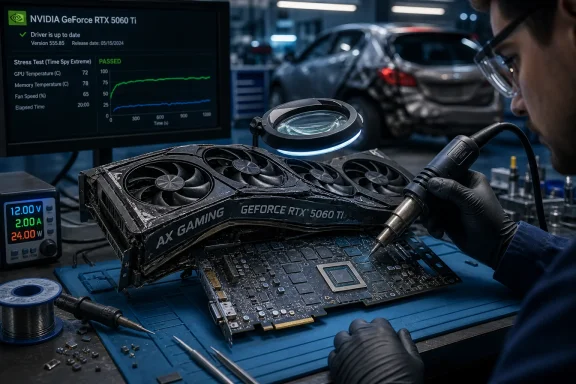
VideoCardz reported that the owner’s card had been left in a car when it was hit from behind. The cooler, backplate, I/O bracket and shroud were badly distorted, giving the finished assembly the appearance of a card bent nearly in half. Brother Zhang, the Chinese GPU repair technician who handled the job, found that the actual printed circuit board was only slightly bowed.
That distinction is the entire story. A GPU cooler can be long, heavy and visibly wrecked while the board underneath remains short enough to escape the worst of an impact. If the PCB had fractured, torn a PCIe trace, or damaged the solder joints beneath the GPU package itself, this would almost certainly have been a donor-parts project rather than a sensible repair of an 8GB RTX 5060 Ti.
The board survived where the cooler did not
AX Gaming’s own product listing for its triple-fan RTX 5060 Ti X3W 8GB describes a 316 mm-long, 65 mm-thick graphics card with an 180 W TDP, one 8-pin power connector, 8GB of GDDR7, and a 128-bit memory bus. That exterior length matters: the cooler occupies substantially more real estate than the PCB on many current midrange designs.
VideoCardz says the repair technician could see that the board itself had not suffered an obvious short circuit and could be carefully straightened. The original heatsink and shell were not so fortunate. The card eventually ran with a partially corrected heatsink and two fans attached externally, an arrangement good enough for bench validation but plainly not suitable for installation in a normal PC.
AX does not publish the PCB’s exact dimensions on the product page, so the claim that its short board saved it cannot be measured against a manufacturer board drawing. Still, the repair outcome supports the practical observation: the force that mangled the extended cooler did not necessarily travel through the GPU substrate, memory packages, power stages, PCIe fingers, and multilayer signal traces with equal severity.
This is also why the photographs, while spectacular, should not be treated as evidence that an ordinary full-length graphics board can be physically bent and expected to function. The card’s most dramatic deformation was in the overhang beyond the board. A design with a PCB extending nearer to the end of the cooler would face a much worse mechanical prospect in the same crash.
Windows detection was only the first checkpoint
The first power-on result was encouraging but incomplete. VideoCardz says Windows detected the RTX 5060 Ti and the system could output an image after the card was straightened. But NVIDIA driver installation immediately produced a black screen.
For technicians, that behavior is more revealing than the initial display output. A bare display signal can prove that the GPU has passed enough early initialization to bring up a screen. Loading the vendor driver asks far more of the card: the driver programs the GPU, initializes and trains graphics memory, exposes accelerated functions, and begins using memory paths that may not be exercised by a pre-driver desktop session.
Brother Zhang reportedly ran memory tests that did not flag an error, then removed and resoldered the GDDR7 package nearest the bent section. After that work, the driver installed and the card was recognized correctly as an 8GB RTX 5060 Ti using Samsung memory on a PCIe 5.0 x8 link.
The PCIe result is consistent with the RTX 5060 Ti platform. NVIDIA lists 8GB and 16GB GDDR7 configurations for the model, while independent specification databases list the 8GB version’s host connection as PCIe 5.0 x8. The physical edge connector can be misleading to users accustomed to x16-length cards, but the RTX 5060 Ti is designed to use eight lanes electrically.
The repair sequence also illustrates why consumer memory diagnostics should not be treated as a final verdict after mechanical damage. A marginal BGA solder joint, damaged pad, or issue triggered only under particular temperature, voltage, or driver-state conditions can evade a short automated pass. Reworking the package closest to the stressed area was a targeted hypothesis, not a magic cure; in this case, it was enough to restore stable driver operation.
The stress-test result is promising, not a return-to-stock certification
VideoCardz reports that the improvised cooling setup held the GPU at 67°C and memory at 68°C during stress testing, with a reported 98.9% stability result. Those figures show that the repaired card can run a meaningful load without instantly crashing or overheating. They do not establish that it has returned to the reliability, acoustic behavior, physical rigidity, or thermal margins of an intact retail board.
Several critical details are absent. The report does not identify the stress-test application, its duration, ambient temperature, clock behavior, fan speed, power limit, or whether the card was looped through repeated cold starts and heat cycles. It also does not say whether the memory chip was merely resoldered or replaced, nor whether X-ray inspection or continuity checks were performed on the board’s internal layers.
A 98.9% figure is particularly hard to interpret without the utility and test profile that produced it. It is a useful datapoint for the owner and repair shop; it is not an industry-standard reliability grade. Long-term problems from board flex often emerge later, after thermal expansion works on a partially compromised solder joint or trace.
The missing original cooler remains the immediate operational problem. An RTX 5060 Ti with an 180 W board power rating needs a cooler that makes solid, correctly pressured contact with the GPU die and the memory and power-delivery components. Simply attaching fans to a bent heatsink can move enough air for an open-bench check, yet still leave uneven mounting pressure, poor memory thermal transfer, fan-control complications, or unsafe clearance inside a case.
An aftermarket solution could make the card usable again, but it is not as simple as buying a universal fan kit. The replacement must fit the actual PCB, avoid stressing the already-repaired board, clear the 8-pin connector and I/O bracket, and cool the VRM and GDDR7 packages as well as the GPU core. Cutting the original heatsink down is a poor bet: heat pipes depend on a sealed internal structure, and opening one generally destroys it.
Why this repair makes economic sense only in a narrow set of cases
NVIDIA introduced the RTX 5060 Ti in 8GB and 16GB forms, with the 8GB model originally positioned as the lower-cost option. The economics of board-level repair remain harsh for that class of card. Advanced work near the GPU core or a cracked multilayer PCB can quickly exceed the cost justification, especially when a replacement cooler and post-repair validation are added.
This one survived because the repair did not appear to require a GPU-core reball, a PCB reconstruction, or replacement of multiple power-delivery components. The fault was localized close enough to one memory package that reworking it restored normal driver behavior. The short PCB turned a violent-looking accident into a repairable memory-and-cooler problem.
That should not be confused with a consumer repair recommendation. A damaged graphics card can retain charge in its power circuitry, have invisible cracks, and short catastrophically when reinstalled. Anyone recovering hardware from a vehicle accident should not power it casually or attempt to straighten a board by hand; professional inspection is the prudent route, and the manufacturer warranty is unlikely to cover collision damage.
The practical conclusion is narrower but useful: visible GPU damage is not a reliable measure of board damage. When a long cooler has absorbed the deformation and the PCB remains intact, a modern card may be recoverable. When the board itself is creased, cracked, or compromised beneath the GPU package, the same card is usually finished regardless of whether the shroud still looks presentable.
For this AX Gaming RTX 5060 Ti, the next expense is not another rework station session. It is a properly fitting replacement cooler that can turn a successful bench repair into a graphics card safe enough to put back into a Windows gaming PC.
Update: Tom’s Hardware identifies the benchmark tools used after the repair (August 2, 2026)
Tom’s Hardware reports that Brother Zhang used FurMark and a 3DMark loop for the post-repair validation, filling in details absent from the earlier report. According to Tom’s Hardware, FurMark held the GPU at roughly 64°C without visible artifacts, while the longer 3DMark loop produced the reported 98.9% stability result.
The outlet also says the card ran at about 92% of its maximum power limit during the loop, with GPU core temperature peaking around 67°C. That makes the test result more meaningful than a simple Windows boot or driver-install check: the repaired RTX 5060 Ti was able to sustain a graphics workload while using most of its available board power.
These results still do not establish long-term reliability or solve the damaged cooler’s fitment and mounting-pressure risks, but they narrow the immediate concern. The repaired memory-package connection and PCIe 5.0 x8 link appear to remain stable under at least one recognized synthetic benchmark loop.