

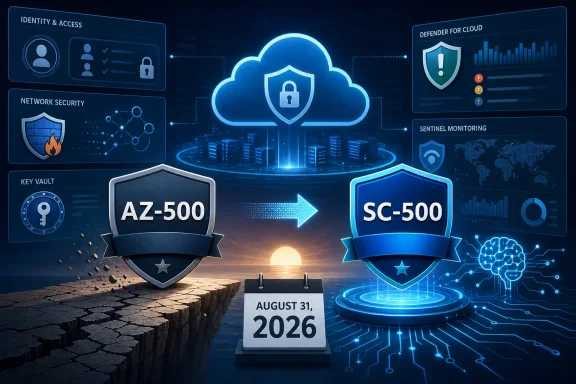
The Oneworld News article correctly identifies identity, access control, data protection, network security, governance, compliance, monitoring, and risk management as cloud-security subjects. But Microsoft’s current AZ-500 study guide shows a much narrower and more operational Azure curriculum than that generic list suggests. It also makes clear that the certification is being replaced by SC-500, Microsoft’s Cloud and AI Security Engineer Associate credential.
Pearson VUE’s Microsoft exam-update page independently lists the same August 31 retirement date and identifies SC-500 as the successor. For Windows administrators and security teams, the practical conclusion is simple: AZ-500 remains useful as a map of Azure controls, but it is no longer the sensible default certification target unless a candidate is already prepared to sit the exam before the deadline.
AZ-500 is an implementation exam, not a cloud-security survey
The Oneworld News piece frames AZ-500 concepts as introductory education, emphasizing transferable skills such as critical thinking, ethics, collaboration, and professional growth. Those are reasonable outcomes of security training. They are not, however, a close description of what Microsoft currently measures under AZ-500.
Microsoft’s January 22, 2026 skills outline divides AZ-500 into four assessed areas:
- Secure identity and access accounts for 15–20 percent of the exam.
- Secure networking accounts for 20–25 percent.
- Secure compute, storage, and databases accounts for 20–25 percent.
- Securing Azure with Microsoft Defender for Cloud and Microsoft Sentinel accounts for 30–35 percent.
That weighting is revealing. The largest part of the exam is not an abstract discussion of governance or privacy; it is operating Microsoft security tooling to assess posture, remediate risk, manage alerts, configure automation, and collect security data. A learner who understands that multi-factor authentication is important but cannot use Microsoft Entra Privileged Identity Management, configure Conditional Access, interpret Defender for Cloud recommendations, or create Microsoft Sentinel analytics rules has learned the vocabulary without acquiring much of the skill AZ-500 was built to assess.
The official study guide calls for practical Azure and hybrid-administration experience, plus strong familiarity with Microsoft Entra ID, Azure compute, network, and storage. That is a prerequisite-level expectation, not a gentle introduction for cloud-security newcomers. The difference matters for training managers: a general cloud-security awareness course can be useful, but presenting it as AZ-500-aligned risks sending learners into a retiring, hands-on security-engineering exam without the platform foundation it assumes.
The missing products are where the real work happens
The submitted explainer identifies categories—“firewalls,” “secure storage,” “event logging,” and “threat detection”—without connecting them to the Azure services and design choices that determine whether a deployment is actually protected. Microsoft’s published AZ-500 objectives are specific enough to expose what that abstraction leaves behind.
In identity, the current objectives include Azure built-in and custom role assignments, Entra roles, Privileged Identity Management, Conditional Access, managed identities, enterprise application access, application registrations, OAuth permission grants, service principals, and consent. These are not interchangeable labels for “secure sign-in.” They deal with how users, workloads, and third-party applications obtain permissions—and how administrators limit standing privilege.
The network portion similarly goes beyond “virtual networking” and “traffic management.” Microsoft lists Network Security Groups, Application Security Groups, user-defined routes, virtual-network peering, VPN gateways, Virtual WAN, ExpressRoute encryption, Private Endpoints, Private Link, Azure Firewall, Application Gateway, Azure Front Door, Web Application Firewall, and Azure DDoS Protection Standard. An Azure administrator has to decide where traffic should terminate, which resources should lose public exposure, what identities or subnets can reach a service, and which logs will prove that a control worked. Calling all of that “network security fundamentals” understates the operational decisions involved.
Data protection is also more complicated than encryption and backups. AZ-500 includes storage-account access control, access keys, Azure Files and Blob Storage authorization choices, soft delete, versioning, immutable storage, customer-managed keys, double encryption, Entra authentication for Azure SQL, auditing, dynamic data masking, Transparent Data Encryption, and Always Encrypted. Each control protects a different failure mode. Encryption at rest does not stop an overprivileged application from reading data; a backup does not prevent ransomware damage if the backup is mutable and accessible with the same compromised credentials.
The Oneworld News article is right to put ethics, privacy, governance, and accountability in the conversation. Yet governance in Azure also has a concrete enforcement layer. AZ-500 includes Azure Policy assignments and initiatives, Key Vault access and network settings, key rotation, backup protection, asset management, compliance standards, and custom standards in Defender for Cloud. For organizations already managing Windows Server, Active Directory, Microsoft 365, and Azure resources, the useful educational question is not merely whether governance matters. It is whether policy, role assignments, network isolation, secret management, and monitoring are configured in a way that administrators can audit and enforce.
Defender for Cloud and Sentinel dominate the current blueprint
The strongest indication that the supplied overview is incomplete is AZ-500’s allocation of 30–35 percent of its assessment to Microsoft Defender for Cloud and Microsoft Sentinel. The article mentions monitoring, activity logs, alerts, and incident awareness, but never names the services that Microsoft expects learners to use.
Microsoft’s current outline includes Defender for Cloud Secure Score and Inventory; security-framework assessments; compliance-standard management; custom standards; cloud workload protection; agentless virtual-machine scanning; Defender Vulnerability Management; and integrations with GitHub, Azure DevOps, and GitLab through Defender for Cloud DevOps Security. It also explicitly covers connecting Amazon Web Services and Google Cloud Platform environments to Defender for Cloud.
That multi-cloud objective is an important corrective to the article’s otherwise platform-neutral tone. AZ-500 is Azure-centric, but Microsoft was testing an Azure security engineer’s ability to use its security-management plane across hybrid and non-Azure estates. A Windows-focused IT department with on-premises servers, Azure workloads, Microsoft 365 identities, and some AWS or GCP services can see why that matters: the goal is to identify risk through one operating model, rather than treat every cloud as an isolated security program.
Sentinel adds the operational response dimension. Current AZ-500 objectives include configuring data connectors, analytics rules, and automation, alongside managing Defender for Cloud alerts and workflow automation. Knowing that “continuous monitoring” is a security principle is useful. Knowing which telemetry sources must be connected, what detection logic is enabled, and what automated response should happen after a high-confidence alert is the job.
SC-500 changes the direction of travel
Microsoft’s replacement credential, SC-500: Cloud and AI Security Engineer Associate, is currently in beta. Microsoft describes it as validating the ability to design, implement, and manage end-to-end controls across Azure, hybrid, and AI-enabled environments, with coverage of identities, data, applications, infrastructure, regulatory compliance, and security posture.
The broad skill groups overlap heavily with AZ-500: identity, access, governance, storage, databases, networking, compute, and security-posture management all remain. The material change is the explicit addition of securing AI solutions and the AI workloads, platforms, data, identities, and infrastructure that support them. Microsoft’s Partner Center announcement says SC-500 expands the security-engineer role to include cloud and AI model protection.
That does not mean the AZ-500 material suddenly has no value. Entra roles, Conditional Access, Key Vault, Private Endpoints, Azure Firewall, Defender for Cloud, Sentinel, storage controls, and SQL protections remain relevant technologies. But the certificate’s shelf life and the vendor’s emphasis have changed. A course explaining AZ-500 ideas without mentioning SC-500 leaves readers unable to distinguish between learning durable Azure security fundamentals and pursuing a credential Microsoft is in the process of retiring.
Microsoft says existing AZ-500 credentials remain valid until they expire, and its transition guidance says partners may use AZ-500 or SC-500 for relevant Security Solutions Partner requirements during the transition. The company also advises people who have not already registered and are not close to testing for AZ-500 to prepare for SC-500 instead. There is no published automatic conversion path from an AZ-500 credential to SC-500.
What learners should take from the AZ-500 material now
The right educational use of AZ-500 in August 2026 is as a structured inventory of Azure security controls: how identity is governed, how networks are segmented, how data is protected, how workload risk is measured, and how alerts become response actions. It remains especially useful for administrators who need a bridge from Windows and Microsoft 365 administration into Azure security operations.
But the source article’s generic language masks the decisions that produce real security outcomes. Least privilege depends on role design and privileged-access workflows. Private access depends on endpoint, DNS, and routing choices. Resilience depends on backup immutability and recovery permissions. Monitoring depends on collecting the right telemetry and turning it into detection and automation.
Candidates who already have an AZ-500 appointment and are near exam-ready have a short, defined window to finish: the exam retires on August 31. Everyone else should treat the current AZ-500 blueprint as background reading and plan training around SC-500’s broader cloud-and-AI security role, rather than investing heavily in a certification Microsoft is withdrawing this month.
References
- Understanding AZ-500 Exam Concepts: An Educational Perspective on Cloud Security oneworldnews.com · 2026-08-07T13:16:51+00:00