
The warning, first reported by the BBC, is part of the wider breach at Beacon CRM, a cloud-hosted customer relationship management provider used by more than 1,500 UK charities. George House Trust told affected people that the data was downloaded but had not been published, and said it had seen no evidence of misuse so far. That is an important distinction, but it does not reduce the seriousness of the exposure: copied data can be held, enriched with other leaked information, and used much later.
The Charity Commission publicly acknowledged the Beacon incident on August 7 and said it was in contact with the Information Commissioner’s Office. Its intervention confirms that this is not a single charity’s isolated security problem. It is a supply-chain breach spanning organisations whose databases can contain information about donors, volunteers, beneficiaries, safeguarding concerns, health, victim support, and other highly private circumstances.
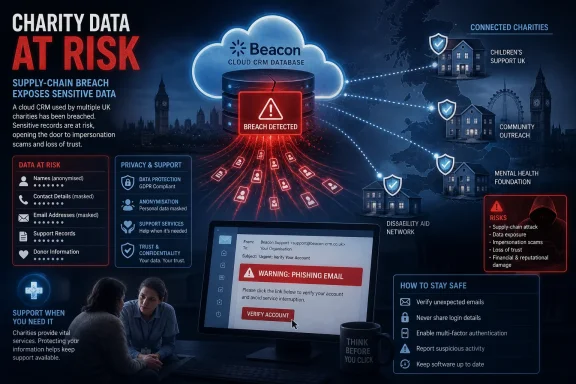 The Beacon breach appears broader than the first warnings suggested
The early public language around Beacon’s incident left room for uncertainty over whether data had merely been accessed or actually removed. Subsequent notices published by Beacon customers, including the British Deaf Association and the bereavement charity Let’s Talk About Loss, make the position much clearer: Beacon’s external forensic investigation assessed that the attacker likely exported the database containing customer data, including attachments.
Those same notices identify the likely initial route as a compromised Amazon Web Services access key. The British Deaf Association said Beacon identified the earliest malicious activity on July 27, while other charity disclosures say Beacon became aware of the incident on July 29 and notified customers on August 3. The activity reportedly lasted roughly an hour and a half, which is long enough for an attacker with broad cloud permissions to copy large datasets without needing to compromise each charity separately.
This is the material technical issue behind the story. A CRM provider may segment tenants logically for day-to-day use, but a compromised cloud credential with access to central backups or production data can turn those tenant boundaries into an administrative convenience rather than a security boundary. Encryption at rest does not solve that problem if an attacker has obtained credentials that can request the data through the provider’s own cloud environment and receive it in readable form.
Beacon customers were initially advised to treat data held in their accounts as potentially compromised. By August 12, several organisations said the vendor’s forensic findings had led them to treat all data stored in their Beacon records at the time of the intrusion as affected. For IT administrators, that is the operational lesson: where a provider cannot demonstrate a narrow, record-level scope after an export event, the prudent assumption is that the whole accessible data set left the environment.
George House Trust faces a different level of personal risk
George House Trust’s warning is especially consequential because its records may include addresses, emails, phone numbers, and notes concerning a person’s engagement with HIV-related support services. The BBC reported that the charity was told about the Beacon breach on August 3 but contacted affected users roughly three weeks later, saying it had waited for a fuller understanding of the incident and had reviewed the data Beacon held.
The record does not establish that George House Trust breached its notification duties. Under UK data-protection rules, a controller must assess the likely risk to individuals, and the ICO says it must notify people directly without undue delay when a breach is likely to create a high risk to their rights and freedoms. A fuller technical investigation can be necessary to identify who needs to be contacted and what information was involved.
But the interval matters. With health-related and potentially stigmatizing information, a notification is not merely a compliance letter. It gives people time to anticipate highly tailored scams, to decide how they want to handle communications from unknown callers, and to be alert if a message suggests knowledge of private circumstances. The ICO’s own guidance uses the exposure of confidential medical details as an example of information that can materially increase risk to affected people.
George House Trust said there was no sign that the stolen data had been misused or published. That remains the best available status, and there is no public indication that the attackers have made a ransom demand or listed the data for sale. Yet “no evidence of misuse” means investigators have not found misuse; it does not prove that copies were destroyed or that criminal actors will not use them later.
The risk also varies sharply among individuals. A donor record containing an email address and newsletter preference has a different threat profile from an account containing service notes, referrals, attendance records, or correspondence. Charities should resist the temptation to send one generic reassurance to everyone. The notification and support offered should reflect the most sensitive fields held in each person’s record.
The practical threat is impersonation, not a password reset
There is no indication that Beacon’s incident exposed passwords for unrelated services, and affected people should not be told to reset every account as if credential theft had been confirmed. But contact information, charity affiliation, and engagement history can make social engineering much more credible.
An attacker who knows someone has interacted with George House Trust could impersonate the charity, a healthcare service, a benefits adviser, a fundraiser, or a related support organisation. They may claim that a person needs to “verify” their details after the breach, offer supposed compensation, direct them to a fake counselling or appointment portal, or request a payment to preserve a service. In a breach involving sensitive health-related associations, recipients may feel pressure to respond quickly and privately.
Affected people should therefore verify unexpected contact independently, using a known official contact route rather than a telephone number or link supplied in the message. They should be cautious of messages that reveal an accurate detail and then ask for more information; the accurate detail may be precisely what was taken in the breach. They should also be wary of callers requesting a one-time code, a bank transfer, a password, a new address, or a copy of identification.
For George House Trust, the most useful follow-up would be a clear explanation of the categories of data held for each affected group, whether attachments or free-text case notes were included, and a dedicated route for people who cannot safely receive breach correspondence at a shared address, email account, or phone number. The public warning confirms that some sensitive engagement records were in scope, but it does not yet say how many people were affected or how detailed those records were.
What Beacon customers should check now
The incident is a reminder that SaaS platforms cannot be treated as someone else’s security problem. Charities remain responsible for understanding what they upload, what a provider can access, which integrations have privileged access, and how quickly they can reconstruct their data inventory after an incident.
Administrators using Beacon or similar hosted CRMs should use this event to validate a few controls:
- They should identify every category of special-category, safeguarding, health, case-management, and free-text data held in the CRM, including document attachments and historical exports.
- They should establish whether cloud access keys, API tokens, service accounts, integrations, and backup processes follow least-privilege principles and are routinely rotated.
- They should preserve relevant audit logs and provider correspondence before retention windows close, then document the incident timeline, the data-risk assessment, and decisions about regulatory and individual notification.
- They should prepare communications for beneficiaries that explain specific risks in plain language rather than relying on a generic “watch for scams” message.
- They should assess whether their current CRM permits the retention and separation rules appropriate for service-user notes, particularly where a fundraising system and sensitive support records share the same vendor environment.
The Charity Commission has urged affected trustees to consider serious-incident reporting and relevant ICO obligations. The ICO, meanwhile, stresses that organisations should report qualifying personal-data breaches within 72 hours of becoming aware of them where feasible, then provide further information as the investigation develops. “Report early, update later” is the right mindset when the facts are incomplete; delaying a regulator report until every technical detail is known can compound a breach response failure.
For the people affected by George House Trust’s disclosure, the central fact is that their data may have been copied from a platform used by their support provider. For the thousands of other organisations using Beacon, the incident is now a test of whether they know exactly what sensitive information they entrusted to a shared CRM — and whether their breach plans work when the compromised system belongs to someone else.