
DSOGaming’s report of 90–110 FPS at native 4K on a GeForce RTX 5090 is an encouraging early signal for Beast of Reincarnation, but it is not a retail PC performance verdict—and its own findings undercut the “with ray tracing” framing in the headline.
The report says Game Freak’s action RPG reached that range at maximum settings in a tutorial-area test on a Ryzen 9 7950X3D, 32GB of DDR5-6000 memory, Windows 10, and NVIDIA’s latest drivers. Yet DSOGaming also says enabling the game’s Ray Tracing option changed neither visuals nor frame rate. If that observation holds, the 4K result is effectively a benchmark of the game’s conventional rendering path, with a non-functioning—or at least non-observable—ray-tracing toggle present in the menu.
There is a more immediate problem with treating the numbers as buying guidance: DSOGaming tested a leaked pre-release build rather than the version Game Freak and publisher Fictions will distribute through official PC storefronts. As of August 3, official platform pages have not been consistent about the launch date either. Steam’s store listing displays August 3 in some regions, while Steam community announcements, Xbox, and PlayStation list August 4, 2026. Xbox and PlayStation also identify the game as a PC release alongside Xbox Series X|S and PlayStation 5, with Xbox including it in PC Game Pass.
That conflicting calendar matters because a day-one patch can alter executable code, shader caches, driver profiles, asset streaming, and even which graphics features are exposed. The practical takeaway is straightforward: the RTX 5090 result suggests Beast of Reincarnation may avoid the catastrophic 4K performance sometimes associated with Unreal Engine 5 releases, but it does not establish how the shipped version performs, whether ray tracing works, or what owners of mainstream GPUs should expect.
The report’s central technical discrepancy is unusually clear. DSOGaming says the game supports ray tracing, then says it tested the setting and found no visible or performance difference with it enabled or disabled. A functioning ray-traced lighting, shadow, reflection, or ambient-occlusion mode should normally impose at least some measurable GPU cost at native 4K on an RTX 5090, particularly at maximum settings.
There are several possible explanations. The leaked build may contain an unfinished or disabled implementation; the menu control may not apply its change until a restart; the feature could affect a narrow visual effect not encountered in the test route; or the setting could simply be broken. What cannot be supported by the evidence supplied is the stronger claim that the game is delivering 90–110 FPS with working ray tracing enabled.
For PC players, that distinction is more than semantic. Ray tracing is one of the settings most likely to separate an impressive flagship-GPU result from a difficult experience on cards further down the stack. A title running at 90–110 FPS at 4K without active RT may be in reasonable shape; the same title with properly enabled ray-traced effects could produce a materially different performance profile.
Game Freak and Fictions have not, in their public storefront descriptions, detailed what ray-tracing effects Beast of Reincarnation is supposed to use, at what quality levels, or on which PC hardware tiers. Until the retail build arrives and the option can be verified with captured settings, side-by-side image comparisons, and frame-time data, players should regard the RT menu entry as unvalidated rather than as a confirmed feature.
That recommended profile is significant. “1080p” combined with Performance-mode upscaling ordinarily means a considerably lower internal render resolution before reconstruction. It is a legitimate technique, especially for lower-end hardware, but it is a radically different workload from native 3840×2160 rendering at maximum quality. The RTX 5090 benchmark does not contradict the official requirements; it occupies a completely different class of PC.
The requirements also make 12GB of VRAM a recommended-level baseline through the named RTX 3060 and RX 6700 XT models. That does not prove the game consumes 12GB at all times, but it does indicate that owners of 8GB cards should not assume a comfortable experience merely because the minimum-spec list includes older 8GB hardware. Asset quality, resolution, traversal, background applications, and driver behavior can all change the margin.
There is also no official preset-to-performance matrix for 1440p, 4K, or native rendering. Game Freak has not published the kind of detail that would let users determine whether Medium is the real intended PC baseline, whether High and Maximum presets are tuned primarily for premium GPUs, or whether the launch build carries separate texture-memory limits. The official specifications are useful, but they are not a substitute for broad GPU testing.
That is the performance issue worth watching. Average frame rates tell players how much rendering headroom they have; frame-time spikes determine whether movement through a new area feels smooth. A game can sustain 90 FPS or more in a static combat sequence and still feel disruptive if streaming new geometry, shadows, effects, or textures produces hitches during traversal.
The submitted test uses only a tutorial section, which DSOGaming describes as more demanding than the following mission. That is useful as an early repeatable location, but it is still one route in an action RPG designed around a changing post-apocalyptic Japan. It cannot establish behavior in later combat arenas, larger outdoor areas, boss encounters, cutscenes, or the transitions most likely to trigger streaming stalls.
No independent outlet has yet published a comparable retail-build benchmark suite for the game. There is therefore no corroborated data on 1% lows, stutter frequency, VRAM allocation, CPU scaling, upscaler image quality, or performance on AMD and Intel graphics hardware. DSOGaming says it plans a wider GPU analysis later in the week; that will be more useful than the initial flagship-card result if it includes consistent routes, frame-time measurements, and explicit RT verification.
The apparent absence of frame generation is notable only because the game’s early performance discussion is centered on high-resolution rendering. Frame generation can make a high-refresh display readout look much better, but it does not cure traversal hitches or low base frame rates. Its omission means performance evaluations will rest more directly on the game’s native rendering, CPU behavior, and upscaling quality rather than interpolated frames.
That may be the cleaner outcome for benchmarking. It also makes the official 1080p Performance-mode recommendations more consequential. If Game Freak’s target for RTX 3060-class hardware requires aggressive upscaling at Medium settings, buyers should wait for tests on their own GPU tier instead of using a 4K RTX 5090 number as a proxy.
Beast of Reincarnation is due across PC, PlayStation 5, and Xbox Series X|S on August 4, with PC Game Pass availability confirmed by Xbox. The first trustworthy PC verdict will come after the official build is live: whether the ray-tracing toggle actually changes the renderer, whether shader preparation prevents in-game stutter, and whether the modest official 1080p targets translate into stable play on the GPUs most players actually own.
There is a more immediate problem with treating the numbers as buying guidance: DSOGaming tested a leaked pre-release build rather than the version Game Freak and publisher Fictions will distribute through official PC storefronts. As of August 3, official platform pages have not been consistent about the launch date either. Steam’s store listing displays August 3 in some regions, while Steam community announcements, Xbox, and PlayStation list August 4, 2026. Xbox and PlayStation also identify the game as a PC release alongside Xbox Series X|S and PlayStation 5, with Xbox including it in PC Game Pass.
That conflicting calendar matters because a day-one patch can alter executable code, shader caches, driver profiles, asset streaming, and even which graphics features are exposed. The practical takeaway is straightforward: the RTX 5090 result suggests Beast of Reincarnation may avoid the catastrophic 4K performance sometimes associated with Unreal Engine 5 releases, but it does not establish how the shipped version performs, whether ray tracing works, or what owners of mainstream GPUs should expect.
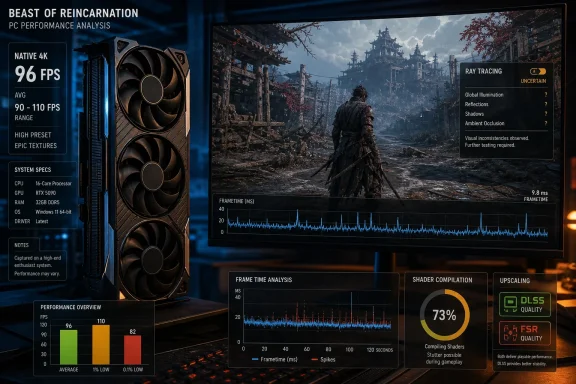 The ray-tracing claim does not survive the test description
The report’s central technical discrepancy is unusually clear. DSOGaming says the game supports ray tracing, then says it tested the setting and found no visible or performance difference with it enabled or disabled. A functioning ray-traced lighting, shadow, reflection, or ambient-occlusion mode should normally impose at least some measurable GPU cost at native 4K on an RTX 5090, particularly at maximum settings.There are several possible explanations. The leaked build may contain an unfinished or disabled implementation; the menu control may not apply its change until a restart; the feature could affect a narrow visual effect not encountered in the test route; or the setting could simply be broken. What cannot be supported by the evidence supplied is the stronger claim that the game is delivering 90–110 FPS with working ray tracing enabled.
For PC players, that distinction is more than semantic. Ray tracing is one of the settings most likely to separate an impressive flagship-GPU result from a difficult experience on cards further down the stack. A title running at 90–110 FPS at 4K without active RT may be in reasonable shape; the same title with properly enabled ray-traced effects could produce a materially different performance profile.
Game Freak and Fictions have not, in their public storefront descriptions, detailed what ray-tracing effects Beast of Reincarnation is supposed to use, at what quality levels, or on which PC hardware tiers. Until the retail build arrives and the option can be verified with captured settings, side-by-side image comparisons, and frame-time data, players should regard the RT menu entry as unvalidated rather than as a confirmed feature.
A 4K RTX 5090 result says little about the published PC target
The official Steam specifications paint a much less demanding target than DSOGaming’s test machine, but they also reveal why the RTX 5090 figure cannot be extrapolated downward. Steam lists a GeForce GTX 1070 8GB or Radeon RX 580 8GB as the minimum GPU, aimed at Low settings, 1080p, 40 FPS, with DLSS or FSR1 set to Performance mode. The recommended target is Medium settings, 1080p, 60 FPS, using a GeForce RTX 3060 12GB or Radeon RX 6700 XT 12GB and DLSS or FSR 3 Performance mode.That recommended profile is significant. “1080p” combined with Performance-mode upscaling ordinarily means a considerably lower internal render resolution before reconstruction. It is a legitimate technique, especially for lower-end hardware, but it is a radically different workload from native 3840×2160 rendering at maximum quality. The RTX 5090 benchmark does not contradict the official requirements; it occupies a completely different class of PC.
The requirements also make 12GB of VRAM a recommended-level baseline through the named RTX 3060 and RX 6700 XT models. That does not prove the game consumes 12GB at all times, but it does indicate that owners of 8GB cards should not assume a comfortable experience merely because the minimum-spec list includes older 8GB hardware. Asset quality, resolution, traversal, background applications, and driver behavior can all change the margin.
There is also no official preset-to-performance matrix for 1440p, 4K, or native rendering. Game Freak has not published the kind of detail that would let users determine whether Medium is the real intended PC baseline, whether High and Maximum presets are tuned primarily for premium GPUs, or whether the launch build carries separate texture-memory limits. The official specifications are useful, but they are not a substitute for broad GPU testing.
Shader compilation and traversal stutter remain the real PC questions
DSOGaming reports that the build compiles shaders during its first launch without showing a conventional progress indicator, leaving the display black for several minutes. If the behavior is present in the release build, it is a poor first-run experience but potentially preferable to allowing compilation to spill into active gameplay. The report says it still encountered traversal stutter, however, even after that initial compilation stage.That is the performance issue worth watching. Average frame rates tell players how much rendering headroom they have; frame-time spikes determine whether movement through a new area feels smooth. A game can sustain 90 FPS or more in a static combat sequence and still feel disruptive if streaming new geometry, shadows, effects, or textures produces hitches during traversal.
The submitted test uses only a tutorial section, which DSOGaming describes as more demanding than the following mission. That is useful as an early repeatable location, but it is still one route in an action RPG designed around a changing post-apocalyptic Japan. It cannot establish behavior in later combat arenas, larger outdoor areas, boss encounters, cutscenes, or the transitions most likely to trigger streaming stalls.
No independent outlet has yet published a comparable retail-build benchmark suite for the game. There is therefore no corroborated data on 1% lows, stutter frequency, VRAM allocation, CPU scaling, upscaler image quality, or performance on AMD and Intel graphics hardware. DSOGaming says it plans a wider GPU analysis later in the week; that will be more useful than the initial flagship-card result if it includes consistent routes, frame-time measurements, and explicit RT verification.
DLSS and FSR are present, but frame generation is absent
DSOGaming says the pre-release build offers NVIDIA DLSS and AMD FSR 3, while lacking Intel XeSS and frame generation. The official Steam requirements separately mention DLSS and FSR support, including FSR 3 in the recommended target, but do not identify precise versions, quality modes, or whether the retail build will expose additional options at launch.The apparent absence of frame generation is notable only because the game’s early performance discussion is centered on high-resolution rendering. Frame generation can make a high-refresh display readout look much better, but it does not cure traversal hitches or low base frame rates. Its omission means performance evaluations will rest more directly on the game’s native rendering, CPU behavior, and upscaling quality rather than interpolated frames.
That may be the cleaner outcome for benchmarking. It also makes the official 1080p Performance-mode recommendations more consequential. If Game Freak’s target for RTX 3060-class hardware requires aggressive upscaling at Medium settings, buyers should wait for tests on their own GPU tier instead of using a 4K RTX 5090 number as a proxy.
Beast of Reincarnation is due across PC, PlayStation 5, and Xbox Series X|S on August 4, with PC Game Pass availability confirmed by Xbox. The first trustworthy PC verdict will come after the official build is live: whether the ray-tracing toggle actually changes the renderer, whether shader preparation prevents in-game stutter, and whether the modest official 1080p targets translate into stable play on the GPUs most players actually own.
References
- Primary source: DSOGaming
Published: 2026-08-03T20:13:00+00:00
Loading…
www.dsogaming.com - Related coverage: store.steampowered.com
Loading…
store.steampowered.com - Related coverage: store.steampowered.com
Loading…
store.steampowered.com - Related coverage: xbox.com
Beast of Reincarnation, coming to XBOX and with Game Pass | XBOX
Pre-order Beast of Reincarnation, coming to XBOX Series X|S and XBOX on PC August 4, 2026. Play it day one with Game Pass.www.xbox.com - Related coverage: gamespot.com
Pokemon Studio Announces Post-Apocalyptic Game Beast Of Reincarnation - GameSpot
The Game Freak-developed action-RPG Beast of Reincarnation, set in a post-apocalyptic Japan, was announced at the Xbox Games Showcase.www.gamespot.com - Related coverage: pcgamesn.com
Beast of Reincarnation release date, trailers, story, and gameplay
Beast of Reincarnation is Game Freak's ambitious action RPG, and its release date is set to reveal a new side to the Pokemon developer.www.pcgamesn.com - Related coverage: pcgamingwiki.com
- Related coverage: gamespot.com
Loading…
www.gamespot.com - Related coverage: playstation.com
Loading…
www.playstation.com - Related coverage: windowscentral.com
Loading…
www.windowscentral.com - Related coverage: techradar.com
Beast of Reincarnation director says Game Freak's priority is delivering a quality 'gameplay experience' rather than graphical fidelity — but the game still certainly appears to be a visual upgrade compared to Pokémon | TechRadar
Beast of Reincarnation game director Kota Furushima has said Game Freak is more focused on delivering on the gameplay experience rather than graphical fidelity.www.techradar.com - Related coverage: as.com
Game Freak ‘congela’ Pokémon para mostrar al mundo Beast of Reincarnation, un RPG que pinta espectacular - Meristation
Beast of Reincarnation es el nuevo trabajo de los creadores de Pokémon. Un RPG centrado en el combate que pinta fantástico.as.com - Related coverage: gadgets360.com
Beast of Reincarnation (2026) | Price, Review, System Requirements, Download
Beast of Reincarnation is an upcoming game. See rumoured price as on 2nd August 2026, full specifications, expert reviews, user ratings, and more. Beast of Reincarnation expected released date is 04th August 2026.www.gadgets360.com - Related coverage: pc.nkbgaming.com
Can My PC Run Beast of Reincarnation? System Requirements Checker 2026
Check if your PC meets Beast of Reincarnation minimum and recommended requirements. Enter your GPU, CPU, and RAM to get instant pass/fail results and upgrade suggestions.pc.nkbgaming.com - Related coverage: tech.sportskeeda.com
Loading…
tech.sportskeeda.com - Related coverage: thegameswiki.com
Loading…
thegameswiki.com - Related coverage: allnewgames.net
Beast of Reincarnation PC System Requirements
Here’s what’s known so far about the PC system requirements for Beast of Reincarnation.www.allnewgames.net
- Related coverage: beastofreincarnationwiki.wiki
Beast of Reincarnation: Pre-Order Bonus & Edition Comparison Guide - Beast of Reincarnation Wiki
Discover all pre-order bonuses, edition differences, and essential launch details for Beast of Reincarnation. Plan your journey today.www.beastofreincarnationwiki.wiki - Related coverage: esrb.org
Loading…
www.esrb.org - Related coverage: vandal.elespanol.com
Loading…
vandal.elespanol.com - Related coverage: leveluptalk.com
Loading…
leveluptalk.com - Related coverage: windowsforum.com
Beast of Reincarnation PC Requirements: 45GB SSD, 16GB RAM | Windows Forum
Beast of Reincarnation is rapidly approaching its August 2026 launch, and early storefront information now paints a clearer picture of what players should...windowsforum.com - Related coverage: pcgamer.com
Loading…
www.pcgamer.com - Related coverage: tomshardware.com
Loading…
www.tomshardware.com
