
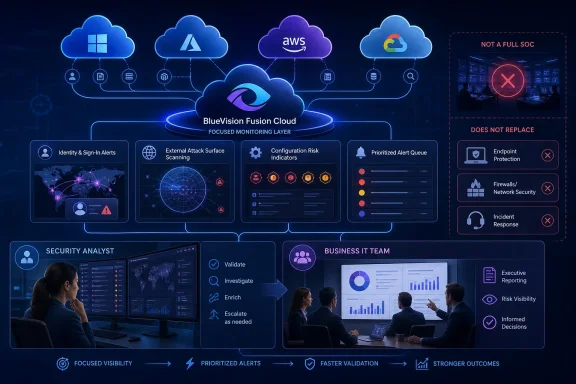
BlueVision has launched Fusion Cloud, a managed monitoring service aimed at Microsoft 365, Azure, AWS and, in its top tier, Google Cloud customers that want continuous visibility without operating a full security operations centre. The practical catch is in BlueVision’s own description: Fusion Cloud is not a traditional SOC, does not indiscriminately ingest every log line, and does not replace endpoint protection, firewalls, or the customer’s IT support team.
The announcement, published by ITWeb, presents Fusion Cloud as an always-on layer for external attack-surface exposure, suspicious Microsoft 365 identity activity, cloud configuration risk and cross-platform correlation. BlueVision says its analysts validate alerts before escalation, while customers receive monthly executive reports intended for leadership teams and auditors.
That is a useful packaging exercise for organisations that have Microsoft 365 and Azure but lack 24-hour security staff. But buyers should read the service boundary more closely than the launch copy invites them to. Fusion Cloud appears designed to identify and prioritize material signals for an existing IT team, managed service provider, or incident-response partner—not to assume all the operational and response functions of a fully staffed managed detection and response service.
This is not an entirely new market entry. IT-Online reported on July 3 that Cloud On Demand had signed a distribution agreement to sell BlueVision’s Fusion Cloud service through its channel-partner network, with a stated focus on South Africa’s mid-market.
Cloud On Demand’s current Fusion Cloud material makes the channel model explicit: BlueVision provides the cyber-security expertise and Cloud On Demand handles procurement, billing, partner enablement and onboarding. For managed service providers, that may be the more consequential part of the launch. Rather than building a SOC, maintaining a detection engineering team and operating a security platform internally, an MSP can attach BlueVision’s monitoring and reporting to its cloud-management offer.
The result is a service built around a familiar commercial premise: make managed security easier to resell. That can reduce the barrier for an organisation that has no in-house security analysts, but it also means the handoff matters. A partner or internal IT department still needs a defined process for who acts when BlueVision sends a contextual alert, who can disable an account, revoke a session, block an IP address, investigate endpoints, preserve evidence and communicate with affected users.
BlueVision says its cloud-to-cloud integrations can have customers operational within five business days of signing. IT-Online, in its earlier reporting on the distribution agreement, described onboarding as taking under 10 days. The difference is minor, but it highlights that neither public description defines the preconditions that determine deployment time: required administrative consent, supported licence levels, log-source availability, access to AWS or Google Cloud accounts, or the state of the customer’s existing identity configuration.
Essentials is the most limited offering. It covers continuous external domain and exposure monitoring, security incident alerting and a monthly executive report. It does not list cloud-posture monitoring or identity-and-access anomaly detection. For a smaller business, that may be an appropriate starting point, but it is not equivalent to monitoring Microsoft 365 sign-in risk or cloud configuration drift.
Standard is positioned for organisations with 50 or more users on Microsoft 365 Business or Enterprise plans. BlueVision lists Microsoft 365 and Azure posture monitoring, identity and access anomaly detection, targeted alerts and AI-assisted detection with human analyst oversight. Premium adds Azure, AWS and Google Cloud monitoring, plus cross-platform correlation with the customer’s existing security stack.
That tiering changes the reading of the launch’s broad “multi-cloud” message. An organisation with a small Microsoft 365 tenant and a modest AWS footprint should not assume that a low-cost entry package includes either identity monitoring or AWS oversight. The published comparison says it does not.
BlueVision has also not published actual subscription prices, analyst response-time commitments, incident-severity definitions, supported Microsoft 365 logs, retention periods, or a list of integrations covered under “existing security stack.” Fixed pricing controls bill shock; it does not by itself establish whether the service has enough telemetry to see an attack or enough staffing to respond at the required speed.
That limitation should not be treated as a defect. Collecting every log from every endpoint, cloud workload, identity provider, firewall, SaaS service and email system is expensive, operationally complicated and often unnecessary for a smaller organisation. The security problem for many IT teams is not a shortage of security telemetry; it is too much poorly prioritized telemetry and nobody assigned to investigate it.
But targeted monitoring has trade-offs. A detection service only sees the sources it integrates with and the activity it has been configured to recognize. A compromised unmanaged endpoint, an unsupported SaaS tenant, a poorly logged AWS workload or lateral movement that never reaches its monitored sources may remain outside Fusion Cloud’s view. Board-ready reports can translate observed risk into business language, but they are not proof that every security control and every system has been assessed.
Microsoft’s 2025 Digital Defense Report supports the need for better identity and external-exposure monitoring. Microsoft Incident Response found phishing or social engineering initiated 28% of breaches it investigated, unpatched web assets accounted for 18%, and exposed remote services accounted for 12%. The same report says data collection featured in nearly 80% of Microsoft incident-response engagements during the year.
Those figures make BlueVision’s combination of identity monitoring, cloud posture and external attack-surface checks sensible. A stolen Microsoft 365 credential is more dangerous when it can be paired with weak conditional-access policies, a lingering privileged account, an exposed administration interface or a cloud workload with an avoidable configuration flaw. Seeing the connections between those conditions is more useful than receiving isolated alerts from several consoles.
Before signing, an IT team should establish what data BlueVision receives from the tenant and what it can actually do after a high-confidence event. The questions are operational rather than marketing-oriented:
Fusion Cloud’s value will therefore depend less on its promise of always-on monitoring than on whether the buyer turns validated alerts into timely action. BlueVision has productized security visibility for organisations that cannot justify a full SOC; it has not removed the need for accountable administrators, tested access controls, endpoint coverage and an incident-response owner when an alert arrives.
That is a useful packaging exercise for organisations that have Microsoft 365 and Azure but lack 24-hour security staff. But buyers should read the service boundary more closely than the launch copy invites them to. Fusion Cloud appears designed to identify and prioritize material signals for an existing IT team, managed service provider, or incident-response partner—not to assume all the operational and response functions of a fully staffed managed detection and response service.
 Fusion Cloud’s launch follows a channel rollout
This is not an entirely new market entry. IT-Online reported on July 3 that Cloud On Demand had signed a distribution agreement to sell BlueVision’s Fusion Cloud service through its channel-partner network, with a stated focus on South Africa’s mid-market.Cloud On Demand’s current Fusion Cloud material makes the channel model explicit: BlueVision provides the cyber-security expertise and Cloud On Demand handles procurement, billing, partner enablement and onboarding. For managed service providers, that may be the more consequential part of the launch. Rather than building a SOC, maintaining a detection engineering team and operating a security platform internally, an MSP can attach BlueVision’s monitoring and reporting to its cloud-management offer.
The result is a service built around a familiar commercial premise: make managed security easier to resell. That can reduce the barrier for an organisation that has no in-house security analysts, but it also means the handoff matters. A partner or internal IT department still needs a defined process for who acts when BlueVision sends a contextual alert, who can disable an account, revoke a session, block an IP address, investigate endpoints, preserve evidence and communicate with affected users.
BlueVision says its cloud-to-cloud integrations can have customers operational within five business days of signing. IT-Online, in its earlier reporting on the distribution agreement, described onboarding as taking under 10 days. The difference is minor, but it highlights that neither public description defines the preconditions that determine deployment time: required administrative consent, supported licence levels, log-source availability, access to AWS or Google Cloud accounts, or the state of the customer’s existing identity configuration.
The service has three tiers, and “per-seat” is only part of the pricing model
The launch announcement describes Fusion Cloud as a fixed-price, per-seat subscription that avoids billing by alert volume or log ingestion. BlueVision’s published tier comparison adds a material qualification: Fusion Cloud Essentials is priced per domain, while Standard and Premium are priced per seat and require a minimum of 50 seats.Essentials is the most limited offering. It covers continuous external domain and exposure monitoring, security incident alerting and a monthly executive report. It does not list cloud-posture monitoring or identity-and-access anomaly detection. For a smaller business, that may be an appropriate starting point, but it is not equivalent to monitoring Microsoft 365 sign-in risk or cloud configuration drift.
Standard is positioned for organisations with 50 or more users on Microsoft 365 Business or Enterprise plans. BlueVision lists Microsoft 365 and Azure posture monitoring, identity and access anomaly detection, targeted alerts and AI-assisted detection with human analyst oversight. Premium adds Azure, AWS and Google Cloud monitoring, plus cross-platform correlation with the customer’s existing security stack.
That tiering changes the reading of the launch’s broad “multi-cloud” message. An organisation with a small Microsoft 365 tenant and a modest AWS footprint should not assume that a low-cost entry package includes either identity monitoring or AWS oversight. The published comparison says it does not.
BlueVision has also not published actual subscription prices, analyst response-time commitments, incident-severity definitions, supported Microsoft 365 logs, retention periods, or a list of integrations covered under “existing security stack.” Fixed pricing controls bill shock; it does not by itself establish whether the service has enough telemetry to see an attack or enough staffing to respond at the required speed.
The strongest part of the pitch is prioritization, not blanket visibility
BlueVision’s public product page is unusually direct about the service model. Fusion Cloud is positioned as focused monitoring, detection and alerting rather than a service that collects every possible event. It says analysts validate real alerts to avoid customers chasing false positives, and it describes the product as an alerting service rather than a breach-prevention guarantee.That limitation should not be treated as a defect. Collecting every log from every endpoint, cloud workload, identity provider, firewall, SaaS service and email system is expensive, operationally complicated and often unnecessary for a smaller organisation. The security problem for many IT teams is not a shortage of security telemetry; it is too much poorly prioritized telemetry and nobody assigned to investigate it.
But targeted monitoring has trade-offs. A detection service only sees the sources it integrates with and the activity it has been configured to recognize. A compromised unmanaged endpoint, an unsupported SaaS tenant, a poorly logged AWS workload or lateral movement that never reaches its monitored sources may remain outside Fusion Cloud’s view. Board-ready reports can translate observed risk into business language, but they are not proof that every security control and every system has been assessed.
Microsoft’s 2025 Digital Defense Report supports the need for better identity and external-exposure monitoring. Microsoft Incident Response found phishing or social engineering initiated 28% of breaches it investigated, unpatched web assets accounted for 18%, and exposed remote services accounted for 12%. The same report says data collection featured in nearly 80% of Microsoft incident-response engagements during the year.
Those figures make BlueVision’s combination of identity monitoring, cloud posture and external attack-surface checks sensible. A stolen Microsoft 365 credential is more dangerous when it can be paired with weak conditional-access policies, a lingering privileged account, an exposed administration interface or a cloud workload with an avoidable configuration flaw. Seeing the connections between those conditions is more useful than receiving isolated alerts from several consoles.
Microsoft 365 customers should verify what remains their responsibility
For Windows and Microsoft 365 administrators, Fusion Cloud should be treated as an added monitoring and reporting layer, not an alternative to Entra ID hardening, Defender configuration, patch management or tested incident response.Before signing, an IT team should establish what data BlueVision receives from the tenant and what it can actually do after a high-confidence event. The questions are operational rather than marketing-oriented:
- The customer should determine whether the service monitors Entra ID sign-in logs, audit logs, risky-user and risky-sign-in detections, mailbox rules, OAuth application consent, privileged-role changes and Microsoft Defender signals.
- The customer should define whether BlueVision only notifies a named contact or can request, recommend, or directly trigger actions such as disabling a user, revoking sessions, resetting credentials or blocking indicators.
- The customer should establish the after-hours escalation path, response-time target, evidence-retention period and responsibility for endpoint containment and forensic investigation.
- The customer should confirm which cloud accounts, subscriptions, tenants, domains and regions are included in the subscription rather than assuming a “multi-cloud” label covers them all.
Fusion Cloud’s value will therefore depend less on its promise of always-on monitoring than on whether the buyer turns validated alerts into timely action. BlueVision has productized security visibility for organisations that cannot justify a full SOC; it has not removed the need for accountable administrators, tested access controls, endpoint coverage and an incident-response owner when an alert arrives.
References
- Primary source: itweb.co.za
Published: 2026-08-03T06:32:00+00:00
Loading…
www.itweb.co.za - Related coverage: bluevision.co
Loading…
bluevision.co - Related coverage: bluevision.co
Loading…
bluevision.co - Related coverage: cloudondemand.co.za
Loading…
www.cloudondemand.co.za - Related coverage: it-online.co.za
Loading…
it-online.co.za - Related coverage: microsoft.com
Loading…
www.microsoft.com - Related coverage: techcommunity.microsoft.com
Loading…
techcommunity.microsoft.com - Related coverage: microsoft.com
Loading…
www.microsoft.com - Related coverage: cdn-dynmedia-1.microsoft.com
Loading…
cdn-dynmedia-1.microsoft.com - Related coverage: cdn-dynmedia-1.microsoft.com
Loading…
cdn-dynmedia-1.microsoft.com - Related coverage: news.microsoft.com
Loading…
news.microsoft.com - Related coverage: itpro.com
Loading…
www.itpro.com - Related coverage: techradar.com
Loading…
www.techradar.com - Related coverage: itpro.com
Loading…
www.itpro.com - Related coverage: axios.com
Phishing attack spoofs Microsoft tool, targets businesses and schools
A years-long phishing attack is tricking employees into handing over login credentials.www.axios.com