
boAt says selected audio products in India will now include a four-month Spotify Premium entitlement, with the first 12 weeks free. The practical catch is in the wording: this is not an unqualified four months at no cost, and neither boAt nor Spotify has yet published the terms customers need to know before treating the bundle as part of a device’s value.
The partnership was reported by IT Voice on August 4 and centers on a digital campaign called “HALF the Experience,” featuring musician Chaar Diwari. boAt’s pitch is straightforward: pair its headphones and speakers with ad-free Spotify listening, downloads, and better audio settings rather than sell the hardware as a standalone commodity.
For prospective buyers, the promotion is a subscription acquisition offer attached to an accessory purchase. It may be useful, but the announcement leaves its most consequential details unstated: the qualifying boAt models, the redemption deadline, the Spotify Premium tier, eligibility for existing subscribers, the price after week 12, and whether a payment method or auto-renewal is required.
The release describes a “four-month Spotify Premium subscription” that is “free for the first 12 weeks.” Twelve weeks is 84 days—roughly three months—not four. Unless boAt intends “four-month subscription” to mean a four-month promotional access window with a paid final month, the language is internally imprecise.
Spotify’s standard trial terms for India have historically required a valid payment method and state that eligible customers are charged the prevailing monthly subscription price when the free period ends unless they cancel beforehand. Those terms are not necessarily the terms for boAt’s promotion, but they establish why the missing redemption conditions matter. A complimentary device bundle can turn into a recurring billing arrangement; buyers should not assume otherwise without seeing the actual offer page.
The difference is material. A buyer who reads “four-month Spotify Premium subscription” may reasonably understand that as four free months of service. The text boAt supplied says only the first 12 weeks are free. If the fourth month is chargeable, the bundle’s no-cost period is three months and the remaining month is part of an offer whose pricing has not been disclosed.
As of August 4, no public boAt or Spotify customer-facing offer page located for this launch spells out what happens after the 12th week. That makes the claim of a four-month bundled subscription less useful than it appears in the headline.
Spotify’s India Premium Standard plan advertises very-high audio quality of up to roughly 320 kbps, along with ad-free listening, downloads, unlimited skips, and on-demand playback. Spotify Premium Platinum, meanwhile, advertises lossless audio up to 24-bit/44.1 kHz FLAC as well as additional service features. The boAt announcement calls the entitlement “Spotify Premium,” not Premium Standard or Premium Platinum.
That does not mean boAt customers are being denied a promised feature; the release never promises lossless playback. It means readers should not translate the campaign’s “high-quality audio” language into a guarantee of lossless streaming. The most defensible reading is that boAt is bundling the usual paid-tier benefits, particularly removal of ads and offline downloads, while using the device itself as the hardware component of the experience.
The hardware also cannot create detail absent from the stream. A good set of headphones can improve fit, isolation, tuning, and perceived clarity, but it cannot make a compressed stream lossless. Conversely, a lossless stream does not guarantee a meaningful improvement through every Bluetooth earbud, codec, or listening environment. boAt’s marketing joins two related but separate purchases: an audio device and a streaming subscription. The campaign deliberately treats them as one proposition.
It is a sharp message for a category where feature lists have become interchangeable. Many entry-level wireless earbuds now advertise similar basics—Bluetooth, microphones, touch controls, battery life and some form of noise reduction. A bundled service creates a more immediate reason to choose one brand at checkout, particularly for customers who have not previously paid for streaming.
But the ad’s argument also merges two independent variables. Spotify Free’s advertising and playback constraints are service limitations. Generic headphones are hardware limitations, if they are limitations at all. A listener with excellent non-boAt headphones and Spotify Free has an interrupted streaming experience; a listener with boAt earbuds and a competing paid music service may have uninterrupted playback without this bundle. The campaign is selling a package, not demonstrating that one component inherently resolves the other’s shortcomings.
This is a familiar tactic in consumer electronics, but it is worth stating plainly: the subscription may be the more valuable part of the offer than the hardware differentiation, depending on the product’s price and the customer’s existing music service. That is why the eligible-product list and the post-trial price should have been central to the launch rather than an afterthought.
Existing Spotify Premium users should therefore assume nothing. They may be excluded entirely, unable to stack the offer onto an active plan, or required to use a different account. The announcement does not answer any of those questions.
There is another unresolved point for buyers who purchase boAt products through marketplaces or offline retail. The release says “select products,” but does not name SKUs, retail channels, purchase dates, or whether the code is supplied in-box, through registration, or via a purchase invoice. A partnership is not yet a usable consumer offer until the redemption path is published.
For IT administrators and procurement teams, this is mostly a consumer promotion rather than a workplace audio development. Still, it is a useful example of the growing number of hardware bundles that attach personal subscription benefits to devices. Organizations buying headsets in volume should not count this Spotify entitlement as a universally transferable commercial benefit. It may depend on individual accounts, payment cards, regional availability, and consumer-tier eligibility rules.
Spotify has recently used Indian partnerships to place Premium trials in other distribution channels, including telecom offers. The boAt arrangement extends that strategy into a highly competitive audio-accessory market, where a time-limited service benefit can help move hardware without requiring a permanent device-price cut.
boAt’s announcement makes the commercial logic clear, even if its terms do not. The company gets a campaign built around culture and a recognizable independent artist; Spotify gets new paid-tier prospects at the moment a listener buys a device intended for music. Consumers receive three clearly free months and potentially a fourth month under conditions that have not yet been published.
Until boAt and Spotify release the qualifying product list, account rules, redemption mechanics, and final-month pricing, buyers should evaluate the device on its own merits and treat the Spotify access as a conditional three-month trial, not as four free months of Premium.
For prospective buyers, the promotion is a subscription acquisition offer attached to an accessory purchase. It may be useful, but the announcement leaves its most consequential details unstated: the qualifying boAt models, the redemption deadline, the Spotify Premium tier, eligibility for existing subscribers, the price after week 12, and whether a payment method or auto-renewal is required.
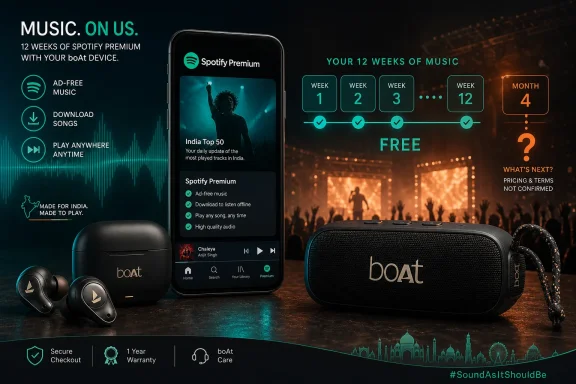 The offer is three free months, not four
The release describes a “four-month Spotify Premium subscription” that is “free for the first 12 weeks.” Twelve weeks is 84 days—roughly three months—not four. Unless boAt intends “four-month subscription” to mean a four-month promotional access window with a paid final month, the language is internally imprecise.Spotify’s standard trial terms for India have historically required a valid payment method and state that eligible customers are charged the prevailing monthly subscription price when the free period ends unless they cancel beforehand. Those terms are not necessarily the terms for boAt’s promotion, but they establish why the missing redemption conditions matter. A complimentary device bundle can turn into a recurring billing arrangement; buyers should not assume otherwise without seeing the actual offer page.
The difference is material. A buyer who reads “four-month Spotify Premium subscription” may reasonably understand that as four free months of service. The text boAt supplied says only the first 12 weeks are free. If the fourth month is chargeable, the bundle’s no-cost period is three months and the remaining month is part of an offer whose pricing has not been disclosed.
As of August 4, no public boAt or Spotify customer-facing offer page located for this launch spells out what happens after the 12th week. That makes the claim of a four-month bundled subscription less useful than it appears in the headline.
Spotify Premium tier decides whether “high-quality” means anything new
boAt’s announcement repeatedly connects “premium audio” and “enhanced audio quality,” but it does not identify which Spotify plan the buyer receives. That omission matters more in 2026 than it would have a few years ago because Spotify India now differentiates between its conventional Premium listening quality and its higher-end lossless offering.Spotify’s India Premium Standard plan advertises very-high audio quality of up to roughly 320 kbps, along with ad-free listening, downloads, unlimited skips, and on-demand playback. Spotify Premium Platinum, meanwhile, advertises lossless audio up to 24-bit/44.1 kHz FLAC as well as additional service features. The boAt announcement calls the entitlement “Spotify Premium,” not Premium Standard or Premium Platinum.
That does not mean boAt customers are being denied a promised feature; the release never promises lossless playback. It means readers should not translate the campaign’s “high-quality audio” language into a guarantee of lossless streaming. The most defensible reading is that boAt is bundling the usual paid-tier benefits, particularly removal of ads and offline downloads, while using the device itself as the hardware component of the experience.
The hardware also cannot create detail absent from the stream. A good set of headphones can improve fit, isolation, tuning, and perceived clarity, but it cannot make a compressed stream lossless. Conversely, a lossless stream does not guarantee a meaningful improvement through every Bluetooth earbud, codec, or listening environment. boAt’s marketing joins two related but separate purchases: an audio device and a streaming subscription. The campaign deliberately treats them as one proposition.
“HALF the Experience” is aimed at conversion, not audio engineering
The Chaar Diwari campaign visualizes incomplete music consumption with intentionally unfinished concert elements: “Do Diwari” in place of the artist’s name, half-applause, reduced instruments, and partial stage production. The joke is that generic headphones plus Spotify’s free tier amount to an incomplete version of listening.It is a sharp message for a category where feature lists have become interchangeable. Many entry-level wireless earbuds now advertise similar basics—Bluetooth, microphones, touch controls, battery life and some form of noise reduction. A bundled service creates a more immediate reason to choose one brand at checkout, particularly for customers who have not previously paid for streaming.
But the ad’s argument also merges two independent variables. Spotify Free’s advertising and playback constraints are service limitations. Generic headphones are hardware limitations, if they are limitations at all. A listener with excellent non-boAt headphones and Spotify Free has an interrupted streaming experience; a listener with boAt earbuds and a competing paid music service may have uninterrupted playback without this bundle. The campaign is selling a package, not demonstrating that one component inherently resolves the other’s shortcomings.
This is a familiar tactic in consumer electronics, but it is worth stating plainly: the subscription may be the more valuable part of the offer than the hardware differentiation, depending on the product’s price and the customer’s existing music service. That is why the eligible-product list and the post-trial price should have been central to the launch rather than an afterthought.
The deal has clear limits for existing Spotify users
Spotify trial offers are commonly restricted to people who have not previously used a Premium trial or paid Premium service. Spotify’s published trial terms make that restriction explicit for its standard three-month offer. boAt’s announcement says only that “eligible” customers can receive the offer; it does not say whether eligibility is determined by the boAt product, the Spotify account, or both.Existing Spotify Premium users should therefore assume nothing. They may be excluded entirely, unable to stack the offer onto an active plan, or required to use a different account. The announcement does not answer any of those questions.
There is another unresolved point for buyers who purchase boAt products through marketplaces or offline retail. The release says “select products,” but does not name SKUs, retail channels, purchase dates, or whether the code is supplied in-box, through registration, or via a purchase invoice. A partnership is not yet a usable consumer offer until the redemption path is published.
For IT administrators and procurement teams, this is mostly a consumer promotion rather than a workplace audio development. Still, it is a useful example of the growing number of hardware bundles that attach personal subscription benefits to devices. Organizations buying headsets in volume should not count this Spotify entitlement as a universally transferable commercial benefit. It may depend on individual accounts, payment cards, regional availability, and consumer-tier eligibility rules.
Spotify has recently used Indian partnerships to place Premium trials in other distribution channels, including telecom offers. The boAt arrangement extends that strategy into a highly competitive audio-accessory market, where a time-limited service benefit can help move hardware without requiring a permanent device-price cut.
boAt’s announcement makes the commercial logic clear, even if its terms do not. The company gets a campaign built around culture and a recognizable independent artist; Spotify gets new paid-tier prospects at the moment a listener buys a device intended for music. Consumers receive three clearly free months and potentially a fourth month under conditions that have not yet been published.
Until boAt and Spotify release the qualifying product list, account rules, redemption mechanics, and final-month pricing, buyers should evaluate the device on its own merits and treat the Spotify access as a conditional three-month trial, not as four free months of Premium.
References
- Primary source: IT Voice Media Pvt. Ltd.
Published: 2026-08-04T12:10:26+00:00
Loading…
www.itvoice.in - Related coverage: spotify.com
Loading…
www.spotify.com - Related coverage: spotify.com
Loading…
www.spotify.com - Related coverage: community.spotify.com
Loading…
community.spotify.com - Related coverage: cdbaby.com
Loading…
cdbaby.com - Related coverage: open.spotify.com
Loading…
open.spotify.com - Related coverage: searchengineinsight.com
Loading…
www.searchengineinsight.com - Related coverage: open.spotify.com
Loading…
open.spotify.com - Related coverage: petematheson.com
Loading…
www.petematheson.com - Related coverage: developer.spotify.com
Loading…
developer.spotify.com - Related coverage: smallpdfs.buddhistuniversity.net
Loading…
smallpdfs.buddhistuniversity.net - Related coverage: musicbusinessworldwide.com
Loading…
www.musicbusinessworldwide.com - Related coverage: tataplay.com
Loading…
www.tataplay.com - Related coverage: newsroom.spotify.com
Loading…
newsroom.spotify.com - Related coverage: music.amazon.in
Loading…
music.amazon.in - Related coverage: podcasts.apple.com
Loading…
podcasts.apple.com - Related coverage: indulgexpress.com
Loading…
www.indulgexpress.com