
The Bosgame M5 arrives with Windows 11 Pro installed, a Ryzen AI Max+ 395, Radeon 8060S graphics, 128GB of soldered LPDDR5X memory, and a 2TB NVMe SSD. AMD specifies the chip as a 16-core, 32-thread Zen 5 part with a 40-compute-unit RDNA 3.5 GPU and an XDNA 2 NPU rated for up to 50 TOPS. Its real appeal is the unified-memory design: a system with 128GB of RAM can reserve far more memory for the integrated GPU than conventional mini PCs, making locally run language models feasible without a discrete Nvidia card.
ServeTheHome’s reporting adds the important physical detail missing from many retailer listings. The M5’s rear I/O aligns with the GMKtec EVO-X2 because both are based on Sixunited’s AXB35 platform, although ServeTheHome says its Bosgame sample uses a newer board revision. The M5 therefore is not a clean-sheet alternative to the EVO-X2; it is a different enclosure and sales channel built around closely related underlying hardware.
That is a solid foundation for a compact Windows workstation. It is not, by itself, a reason to treat every AXB35-based machine as interchangeable.
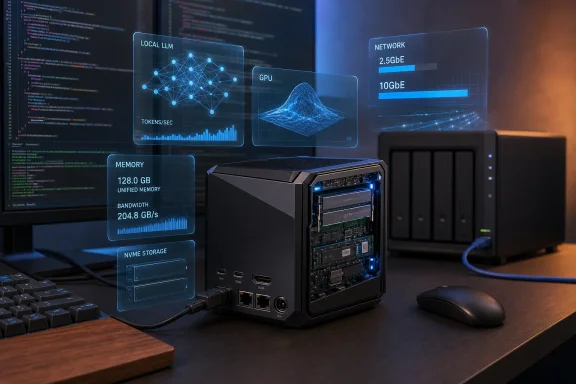 The 128GB configuration is the product
The Ryzen AI Max+ 395’s CPU performance is high-end for a mini PC, and its Radeon 8060S can provide graphics performance in the range normally associated with midrange gaming laptops. But the reason these systems attract developers is memory capacity, not the NPU badge printed on the spec sheet.
AMD says the platform can allocate up to 96GB of unified memory to graphics. That changes the practical ceiling for local inference: larger quantized models can remain in memory rather than being split across system RAM, a GPU with limited VRAM, and slow storage. It also makes the M5 potentially appealing for Windows users experimenting with LM Studio, llama.cpp front ends, image-generation workloads, and development environments that can use AMD’s GPU stack.
ServeTheHome found the M5 performed in the expected range for Ryzen AI Max+ 395 systems in CPU and GPU testing, and reported that it beat AMD’s more expensive Ryzen AI Halo developer box in its Qwen comparisons. That result should be read narrowly. It does not make the Bosgame a substitute for a workstation with a discrete CUDA GPU, nor does it erase the software advantage Nvidia retains in many AI tools. It does show that the physical size of the box is no longer the primary constraint for local models; the 128GB memory pool is.
The M5’s memory is soldered. Buyers are choosing the capacity they will keep for the life of the device, and there is no later upgrade from 96GB to 128GB. Storage is more forgiving: ServeTheHome found two M.2 slots, one occupied by a 2TB PCIe 4.0 drive using YMTC NAND, with the second available for expansion.
Shared board, separate support obligations
The rear comparison that prompted ServeTheHome’s review is more consequential than it first appears. A common motherboard can bring familiar Linux behavior, similar port layouts, and a larger pool of community experience. It can also tempt buyers into assuming that firmware and support are portable across brands.
They are not.
A community-maintained AXB35 hardware record lists both the Bosgame M5 and GMKtec EVO-X2 under the same board family, while an independent Linux embedded-controller driver also names both systems as supported hardware. Community documentation further lists Bosgame AXB35 firmware dated May 8, 2026. Those are useful signals that the systems have related internals, but they are not a vendor authorization to install another brand’s BIOS.
One GitHub issue filed against AMD’s legacy ROCm build records a Bosgame M5 user encountering a repeatable HSA memory fault under large PyTorch/HIP model-loading workloads. The reporter identified an older Bosgame BIOS in that test setup and stated that GMKtec firmware had been cross-flashed by community members. That is a support warning, not a cross-flashing guide. One user report cannot establish a platform-wide defect, and a BIOS borrowed from a different vendor can disable recovery paths, invalidate support, or leave a machine unbootable.
For Windows buyers, the practical implication is straightforward: purchase the M5 for the firmware and support Bosgame actually ships, not for an assumed ability to inherit the EVO-X2’s software path. Bosgame advertises a one-year warranty, but it does not publicly promise a long BIOS-update cadence or enterprise-style lifecycle support. That matters more on a soldered-memory machine than on a standard desktop, where motherboard and RAM replacements are routine.
The networking compromise is real
The M5 has two USB4 ports, HDMI, DisplayPort, Wi-Fi 7, an SD card reader, five USB-A ports across the front and rear, and 2.5GbE Ethernet. That is an unusually practical I/O selection for a small AI-focused desktop, especially compared with compact systems that devote most expansion to USB-C.
The Ethernet port is nevertheless the configuration’s obvious omission. ServeTheHome calls out the Realtek 2.5GbE controller as its biggest hardware miss, arguing that 10GbE would have made the system more competitive with other Strix Halo boxes. AMD’s Ryzen AI Halo developer platform, the product ServeTheHome uses as a pricing comparison, includes 10GbE as standard.
That difference is not cosmetic for the audience most likely to use 128GB of unified memory. A local-model box often pulls checkpoints, datasets, container images, and backups from a NAS. At 2.5GbE, large transfers remain workable; at 10GbE, they become much less intrusive in a development workflow. The M5 can add faster networking through a USB 10GbE adapter, as ServeTheHome notes, but that consumes a high-value port and adds another device, power draw, driver dependency, and point of failure.
For a desk-bound Windows PC handling office work, occasional gaming, and locally stored models, 2.5GbE is sufficient. For a machine intended to live beside a 10GbE NAS or act as a small inference node, it is a cost-saving decision the buyer will notice long after the initial benchmark results.
Performance mode is a daily-use choice
Bosgame includes a physical selector for low, normal, and performance modes. ServeTheHome measured the low-power mode settling below 100W for the whole system and found it barely audible at one meter, while normal mode was about 38 dBA and performance mode about 45 dBA. The reviewer’s conclusion was practical: normal mode offered the best balance for routine use, reserving the loudest setting for workloads that justify it.
That matches the character of the hardware. Many local AI workloads are limited by memory bandwidth, model format, or software implementation rather than raw CPU clocks. A louder 140W burst mode will not turn the Radeon 8060S into a discrete RTX workstation, and it will not resolve gaps in a toolchain built around CUDA. On Windows 11, the M5 is best viewed as a high-memory compact desktop that can run local models and GPU-accelerated workloads—not as an all-purpose replacement for every AI development machine.
The current Bosgame store listing identifies 96GB and 128GB configurations with a 2TB SSD and advertises a $2,999 list price for the 128GB model, while ServeTheHome’s review discusses discounts relative to AMD’s Halo machine and points readers to marketplace listings whose pricing can move quickly. That makes the checkout price especially important. A substantial discount may justify accepting 2.5GbE and less certain firmware support; paying close to a better-supported 128GB alternative does not.
The M5’s strongest case is therefore specific: it offers a Windows-ready Ryzen AI Max+ 395 system with 128GB of unified memory, flexible storage, and unusually complete desktop I/O in a compact enclosure. Its shared AXB35 roots with the GMKtec EVO-X2 make it familiar, but they do not make vendor support, firmware policy, or network capability interchangeable.