Background and industry context
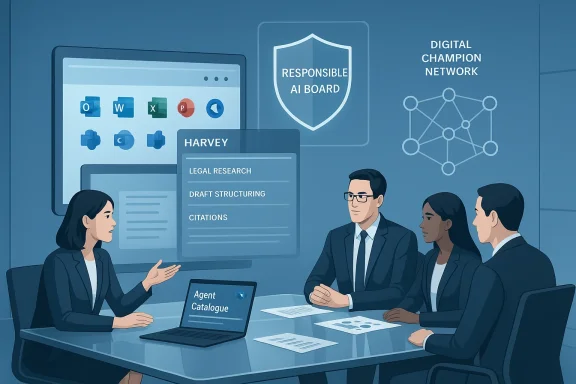
Legal services and the broader professional services sector have rapidly moved from curiosity to pragmatic deployment of generative AI over the last two to three years. Early pilots focused on legal research, contract review and drafting assistance; more recent programmes emphasise integrated agents, document‑centric workflows and enterprise security. Two parallel trends define the space today:
- A shift towards platformed productivity — Microsoft 365 Copilot and equivalent assistants provide a secure, centrally managed way to surface AI capabilities across email, documents, meetings and collaboration tools.
- A proliferation of legal‑specialist models and platforms — vendors such as Harvey tailor generative AI for legal research, document analysis and matter workflows, integrating with document stores, Word and legal research databases.
Burges Salmon’s approach — a firmwide Copilot baseline plus practice‑level deployment of Harvey — mirrors how many organisations intend to balance scale, usability and legal specificity. Importantly, the firm’s public statements emphasise that the Harvey adoption followed a structured internal trial and evaluation period and that deployment will be practice‑led and governed.
What Burges Salmon announced (summary of the update)
Burges Salmon’s recent communication about the next phase of its Digital Enablement Programme contains several concrete elements:
- Firmwide Copilot deployment: The firm reports that Microsoft 365 Copilot has been rolled out across the organisation and is embedded through the Digital Champion Network that supports adoption and knowledge sharing.
- Usage metrics the firm disclosed: approximately 1,300 enabled people, about 700,000 prompts issued to Copilot to date, and 4,000 agent tasks completed across research and analysis agents.
- Harvey selected for matter‑specific workflows: Following trialling, the firm will introduce Harvey into practice‑led use cases (Real Estate is cited as an early beneficiary).
- Agent expansion: The firm has launched a “Facilitator” agent to Business Services teams and aims to expand an ecosystem of agents for research, analysis and facilitation.
- Responsible AI Board created: A cross‑firm board will embed responsible AI across policy, process and training, reporting into existing governance structures.
- External engagement: Ongoing participation at events like Microsoft Ignite to inform the DEP roadmap and maintain vendor/technology awareness.
These points are consistent with the firm’s own digital enablement and responsible AI content published by the firm, and were reiterated in the recent public announcement that outlines the DEP’s next steps.
Verifying the claims: what’s firm‑stated and what independent reporting shows
A journalist’s duty is to verify. The key numerical and governance claims above fall into two classes:
- Claims that come directly from Burges Salmon’s own communications (usage counts, internal programmes and the creation of a Responsible AI Board). These figures are publicly stated by the firm and by partners relaying the announcement. They are best understood as firm‑reported operational metrics — useful and indicative, but reliant on internal telemetry and definitions that the firm controls.
- Claims that are independently verifiable by cross‑reference with wider market reporting and vendor documentation (the existence and growth of Harvey, its enterprise partnerships, Microsoft’s Copilot strategy, and general observations on legal AI adoption). These are corroborated by multiple external sources and vendor/customer stories.
Where numbers such as 700,000 prompts and 4,000 agent tasks are cited, they appear in the firm’s external announcement. Independent outlets and vendor materials confirm Burges Salmon’s technology choices (Microsoft Copilot and the legal AI platform Harvey) and show similar patterns at other firms: law firms are pairing Copilot for general productivity with legal‑specific platforms for matter work. Because prompt counts and agent tasks are internally generated metrics, they should be treated as firm‑reported operational statistics — valuable, but not independently audited unless the firm publishes raw telemetry or an audit.
The technical architecture implied by Burges Salmon’s approach
Burges Salmon’s strategy layers capabilities and controls. The high‑level architecture implied is:
- Platform layer (foundation): Microsoft 365 + Copilot
- Copilot operates inside Word, Outlook, Teams, Excel and SharePoint, giving firm users AI assistance without forcing data out of the tenant.
- This foundation benefits from Microsoft’s enterprise security, compliance tooling and identity controls (SAML/SSO, conditional access, DLP).
- Legal‑specialist layer: Harvey
- Harvey provides legal‑centric models and workflows (research, clause searching, due diligence summarisation) and integrates into document and matter systems.
- Many deployments of Harvey in the market run on or integrate with Azure infrastructure and with document systems like SharePoint and Word, allowing tighter data residency and compliance.
- Agent/automation layer
- Copilot Studio agents and/or vendor agents orchestrate repeated tasks (research tasks, meeting summaries, checklists).
- Burges Salmon’s “Facilitator” agent for Business Services is an example: a targeted agent that automates routine non‑legal workflows.
- Governance, logging and human review
- Responsible AI Board, training, policy enforcement, change management, and mandatory human validation before outputs enter a client deliverable.
This layered pattern minimises single‑point failure and allows teams to choose the right tool for the task: Copilot for integrated productivity and context extraction, and a speciality legal model where domain accuracy, legal recall and matter context are paramount.
What the metrics mean — interpretation and caveats
The headline numbers invite analysis. Using the figures the firm published:
- Approximately 1,300 enabled people and ~700,000 prompts implies an average of ~538 prompts per enabled user since the rollout (700,000 ÷ 1,300 ≈ 538). That average shows frequent engagement among enabled users, but averages mask distribution: a minority of “power users” can generate a bulk of prompts.
- 4,000 agent tasks completed suggests agents are being used in focused scenarios. On a per‑enabled‑user basis this is roughly 3 agent tasks per person, but in practice agents tend to be used by a smaller group (e.g., research teams or legal assistants).
- Rapidly rising prompt counts alongside formal governance shows the firm has progressed from early pilots into sustained, monitored use.
Important caveats:
- These are firm‑reported counters. Different organisations count “prompts” differently — e.g., does a multi‑turn agent conversation equal one prompt or many? Are system‑initiated queries included? Burges Salmon has published the numbers publicly, but the raw telemetry definitions are internal.
- Prompt counts alone are a weak proxy for value. The true business signal is time saved, error rates caught in review, client satisfaction changes and measurable reduction in repetitive tasks.
Governance and security: what Burges Salmon is doing and what it implies
Burges Salmon has taken several governance steps that align with best practice for professional services:
- Responsible AI Board: cross‑disciplinary oversight including Legal, Risk, Responsible Business, Innovation, IT and InfoSec. Embedding senior representation is essential for aligning ethical, regulatory and operational controls.
- Data residency and tooling choices: the firm endorses licensed tools with technical and organisational measures and states that Copilot telemetry is protected by Microsoft enterprise controls. It also says that client information will not be sent to third‑party models unless strictly managed.
- Certifications and security posture: the firm declares ISO 27001 and other certifications, signalling structured security management that auditors and clients can review.
- Human‑in‑the‑loop policy: any output that forms part of the work product will be reviewed and approved by a lawyer — an indispensable control given professional duties and regulatory expectations.
Why this matters: law firms face dual obligations — to innovate and to manage client confidentiality and legal professional duties. A responsible AI board and explicit policies (data handling, training, mandatory review) are the baseline regulators and clients increasingly expect.
Risks and mitigations — a balanced view
Adopting AI in legal workflows offers obvious efficiency upside, but it carries concrete risks that Burges Salmon and peers must address:
- Accuracy and “hallucination”
- Risk: generative outputs can assert incorrect facts or mis‑cite authorities.
- Mitigation: enforce human validation, use conservative prompting strategies, and prefer specialist legal models trained/instructed to cite primary sources.
- Data leakage and model training exposure
- Risk: sending client data to a vendor model that may persist or be used to train general models.
- Mitigation: select enterprise deployments with contractual data protections, prefer private instances or on‑tenant hosting, and restrict PII and sensitive client data in prompts.
- Regulatory and professional risk
- Risk: regulators may scrutinise how advice is generated; lawyers retain responsibility for output.
- Mitigation: documented review trails, training, and firm policies that make the role of AI explicit in client communications.
- Vendor lock‑in and integration complexity
- Risk: layering multiple vendors creates operational complexity and potential lock‑in.
- Mitigation: adopt interoperable integrations, clear exit strategies, and multi‑model architectures where feasible.
- Overreliance and deskilling
- Risk: junior lawyers may underdevelop legal judgement if they rely excessively on AI.
- Mitigation: embed AI as an assistant, not a replacement; use AI for lower‑value drafting and let senior lawyers focus on training and review.
- Auditability and recordkeeping
- Risk: inability to reproduce or audit AI generation paths.
- Mitigation: retain prompt/response logs, system metadata and human review records for key deliverables.
Burges Salmon’s approach — combining certified infrastructure, explicit policy and a Responsible AI Board — addresses these areas. Nonetheless, independent auditing of outputs and periodic red‑teaming will remain necessary as capabilities evolve.
Practical use cases and early ROI signals
Harvey and Copilot are complementary in typical firm deployments. Use cases that Burges Salmon and other firms report or pilot include:
- Research and analysis: rapid scoping of issues, case law summaries, and identification of relevant authorities.
- Contract review and clause extraction: automated flagging of risky clauses, clause libraries and drafting first drafts.
- Due diligence and document summarisation: folding multiple documents into short, structured outputs for review.
- Closing checklists and transactional boilerplate: faster generation of standard lists and repetitive documents.
- Business Services automation: the “Facilitator” agent is likely automating administrative tasks like meeting summaries, scheduling, and action item extraction.
Early ROI signals reported by vendors and customers in the market include time savings (some customer narratives suggest hours regained per week), more consistent first drafts, and faster turnaround on high‑volume tasks. Firms must, however, translate time saved into fee model innovation or reallocated lawyer time for higher‑value work to realise economic benefit.
Change management: how Burges Salmon is progressing adoption
The announcement highlights several change management elements that underpin successful deployments:
- Digital Champion Network: internal champions accelerate adoption, surface use cases and build confidence.
- Practice‑led pilots: piloting in a practice area like Real Estate allows targeted measurement and iterative process redesign.
- Training and skills: investing in workflow training and responsible AI education reduces misuse and increases value capture.
- Metrics and measurement: counting prompts and agent tasks is one piece; the firm will need deeper KPIs (error corrections prevented, time saved validated by time‑tracking, client satisfaction).
- Vendor collaboration: partnering closely with vendors and attending industry events provides forward visibility on product roadmaps.
For other firms, Burges Salmon’s mix of central coordination (Copilot baseline, Responsible AI Board) plus decentralised pilots is a pragmatic blueprint.
The vendor landscape and strategic trade‑offs
Choosing a specialist vendor like Harvey versus relying solely on general platform assistants involves trade‑offs:
- Benefits of legal‑specialist platforms:
- Better legal ontology, citation behaviours and workflows tailored to matter work.
- Pre‑built legal templates, training on legal corpora and integrations with legal databases.
- Benefits of platform assistants (Copilot):
- Deep integration into everyday productivity tools (Word, Outlook, Teams), strong enterprise controls, and more predictable data handling under a single tenancy.
- Trade‑offs:
- Adding specialist vendors increases integration effort and vendor management overhead.
- Specialist models may offer superior legal recall but require careful controls around data ingress/egress and source authoritativeness.
Harvey’s market position — enterprise traction across large law firms and a cloud relationship with major providers — makes it a credible complement to Copilot. Market dynamics also feature partnerships (for example, legal database integrations with major research services) that affect value for law‑firm users.
What this means for clients and client relationships
Clients will take two assessments from this update:
- Will AI lower cost or improve speed without compromising quality? If Burges Salmon’s pilots deliver measurable time savings and quality controls, clients stand to benefit from faster turnaround and better use of senior lawyer time.
- Will client confidentiality remain secure? The firm’s stated policies — not uploading client data to open models, using enterprise‑grade vendors and retaining ISO/secure hosting — aim to reassure clients. But transparency is key: firms should discuss AI usage on matters and obtain client consent where appropriate.
Firms that adopt AI responsibly can offer clients new service models: accelerated due diligence, more iterative drafting cycles and value‑added analytics on matter portfolios. But transparency, documented review and contractual safeguards must accompany any such claims to clients.
Recommendations for other law firms thinking about the same path
- Establish an enterprise baseline first:
- Deploy a centrally governed assistant (Copilot or equivalent) for firmwide productivity and secure integration with identity and DLP tooling.
- Pilot specialist tools where they map to high‑volume work:
- Run practice‑led pilots (Real Estate, Corporate, Litigation) and measure before‑and‑after time and quality metrics.
- Create multidisciplinary governance:
- Form a Responsible AI Board with Legal, Risk, IT, InfoSec and Operations representation to set policy, audit usage and sign off on client communications.
- Insist on human‑in‑the‑loop for all client deliverables:
- Maintain mandatory legal review and retention of review trails and prompt/response logs for key outputs.
- Build change management and champion networks:
- Train users, share successful prompts and playbooks, and rotate champions to maintain momentum and guardrails.
- Prepare vendor exit and audit plans:
- Ensure contractual rights to data export and independent audit options for critical tooling.
- Use measured KPIs:
- Track time saved, review corrections, client satisfaction and adoption distribution (not just raw prompt counts).
Final assessment — strengths, risks and the likely path ahead
Burges Salmon’s announcement is a credible example of a measured, pragmatic approach to legal AI adoption. Strengths include:
- A clear two‑layer strategy (Copilot foundation + Harvey for matter workflows) that balances broad productivity gains with domain‑specific capability.
- Formal governance via a Responsible AI Board and strong information security posture.
- Practice‑led pilots and a digital champion network that drive real behaviour change rather than top‑down diktat.
Key risks to monitor:
- Overreliance on vendor claims and internal metrics without independent audit of outcomes.
- The perennial accuracy and hallucination risk in generative models; pushing outputs into client work without sufficient review would be professionally hazardous.
- Integration complexity and potential lock‑in as the firm layers multiple AI vendors.
Where this initiative is strongest is in its emphasis on behaviour change and operational practices: the technology itself is a tool, but value is realised when workflows, human judgement and governance evolve together. For clients and peers in the market, Burges Salmon’s DEP progression offers a tested pattern: secure the platform, pilot the specialist, govern with purpose, and measure what matters. That path won’t eliminate risk, but it does make mitigation systematic — and that is what professional services clients and regulators will expect as AI becomes part of the standard toolkit.
In short, the firm’s announcement is a significant step for a major independent UK firm: it signals movement from isolated experiments to structured, governed deployment of AI at scale, while acknowledging the importance of responsible use, human oversight and operational maturity. The coming months will tell whether the reported prompt volumes and agent tasks convert into durable client value and measurable changes in how legal work is priced and delivered.