 Overview
The benchmark that sparked this discussion came from NJ Tech and was summarized by Notebookcheck on March 31, 2026. The test pitted Windows 11 against CachyOS, a performance-oriented Arch-based Linux distribution, on the same hardware: a Ryzen 5 5600X, Radeon RX 6700 XT, 16GB of DDR4 memory, and a 2TB NVMe SSD. The Windows side used AMD Adrenalin 26.3.1, while CachyOS ran Mesa 26.0.3, which matters because driver stack differences can have a very real effect in modern DirectX 12 workloads. (notebookcheck.net)
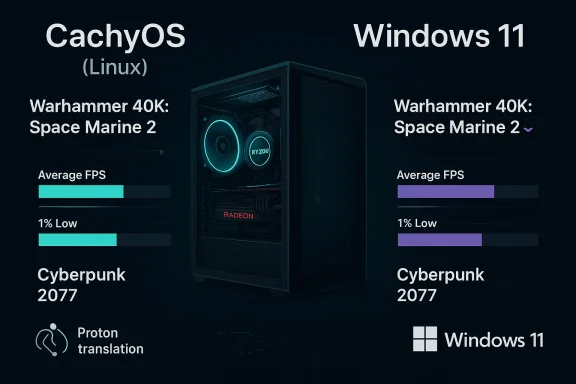
The headline numbers are straightforward. Crimson Desert ran at 59 FPS on Windows 11 and 63 FPS on CachyOS at 1080p Ultra without upscaling. Space Marine 2 widened the gap to 68 FPS versus 81 FPS, while Red Dead Redemption 2 and Cyberpunk 2077 also favored CachyOS by meaningful margins. Those are not tiny fluctuations from run-to-run noise; they are the sort of differences that users actually notice when frame pacing is involved. (notebookcheck.net)
The interesting nuance is that Windows 11 was not uniformly slower. In The First Descendant with FSR 3 Native, Windows 11 came out ahead at 63 FPS versus 54 FPS on CachyOS, and The Division 2 ended in a tie at 128 FPS, although Windows posted slightly stronger 1% lows. That is a useful reminder that Linux’s advantage is real but selective, not absolute. Game engine, anti-cheat stack, upscaling method, and translation path all matter. (notebookcheck.net)
Still, the fact that these games ran through Proton rather than native Linux ports is what makes the result more impressive. Proton is doing the heavy lifting here, translating Windows API calls into Linux-friendly behavior in real time, and Valve’s continual work on compatibility and performance has been central to Linux gaming’s rise. Steam’s February 2026 hardware survey also shows Linux sitting at 2.23% of Steam users, a small share but enough to matter when that audience is growing and increasingly vocal. (notebookcheck.net)
What the Test Actually Shows
This benchmark should be read as a performance snapshot, not a universal verdict on operating systems. A single hardware pairing, one set of drivers, one GPU vendor, and one game build can all shape the result. But the consistency of CachyOS’s lead across multiple titles suggests this is more than a one-off anomaly. (notebookcheck.net)
The pattern also matters. Linux often gets dismissed as “good enough” for older games or indie titles, yet here it performed well in games that demand modern graphics pipelines and frequently stress shader compilation, asset streaming, and CPU scheduling. When Linux can compete in the kind of games that formerly favored Windows by default, the conversation changes from compatibility to optimization. (notebookcheck.net)
The big takeaway
The best interpretation is that CachyOS is demonstrating how much Linux gaming performance depends on distribution choices, not just the kernel or the desktop environment. CachyOS is tuned for speed, and its positioning as a lightweight, performance-focused distro likely plays into the result. Windows 11, meanwhile, carries a broader compatibility burden and more background services by design, which can become visible in frame-time-sensitive workloads. (notebookcheck.net)
- Linux can now win real AAA benchmarks
- Driver and runtime choices matter more than old stereotypes suggest
- Windows remains strong, but not automatically faster
- Frame pacing is as important as peak FPS
- Per-game results still dominate the outcome (notebookcheck.net)
The real importance of this test is that it captures a maturing ecosystem. Linux gaming is no longer only about whether a title launches; it is about whether Linux can deliver better gameplay in practical conditions. That is a dramatic shift from the early Proton era, when success was measured in “platinum” compatibility badges rather than raw performance. (notebookcheck.net)
Why Proton Matters More Than Ever
Proton is the key enabler behind this story. It is the compatibility layer that lets Windows games run on Linux through translation of Windows API calls, and Valve’s release notes continue to show active work on performance, input, windowing, memory allocation, video playback, and game-specific fixes. That constant tuning is one reason Linux gaming is now measured in FPS deltas instead of launch failures. (notebookcheck.net)
What makes Proton strategically important is that it reduces the cost of platform transition for players. If a large and growing share of a user’s library works on Linux with little friction, the operating system choice becomes less of a locked-in ecosystem decision and more of a preference about performance, privacy, and control. That is exactly why each incremental Proton improvement can have outsized effects on adoption.
Compatibility is no longer the only metric
For years, Linux gaming was judged by whether a title ran at all. That benchmark is now insufficient. A game that launches but stutters, has weak 1% lows, or suffers from bad shader behavior is still a second-class experience, which is why these CachyOS versus Windows 11 comparisons are important: they test quality, not just functionality. (notebookcheck.net)
- Proton reduces friction for Windows game libraries
- Valve continues to ship game-specific fixes
- Translation overhead is increasingly being offset by system-level tuning
- Compatibility and performance now move together
- Linux gaming has entered a more mature phase
There is also a broader industry implication. As Proton gets better, game studios face less pressure to justify native Linux ports for every title, because the compatibility layer itself is increasingly credible. That is good for consumers in the short term, but it also means Linux gaming’s growth may depend more on Valve and distribution maintainers than on direct developer support.
The Hardware and Driver Layer
The hardware in this comparison is itself a clue. AMD Ryzen and Radeon hardware tend to be an especially strong pairing on Linux, and that has been true for years because of the open-source Mesa stack and mature kernel integration. The Windows side, of course, benefits from AMD’s proprietary driver package, but Linux has closed the gap so much that the old assumption of Windows superiority no longer holds by default. (notebookcheck.net)
The specific driver versions also matter. Windows 11 used AMD Adrenalin 26.3.1, while CachyOS relied on Mesa 26.0.3. In a Vulkan-heavy ecosystem, Mesa can be exceptionally competitive, especially on AMD, and that often translates into smoother frame pacing or better shader behavior in supported games. Those differences are subtle at the software level but very visible when measured in 1% lows. (notebookcheck.net)
Why AMD often favors Linux
Linux’s AMD story has long been stronger than its NVIDIA story. The combination of kernel support, Mesa development, and the way Proton interfaces with Vulkan frequently produces excellent results on Radeon cards. That does not mean AMD on Linux is always faster than Windows, but it does mean the ceiling is high enough that well-tuned distros can surprise people. (notebookcheck.net)
- AMD + Linux remains a particularly strong combination
- Mesa continues to be a major performance differentiator
- 1% lows are often where Linux gains become obvious
- GPU vendor choice still influences platform results
- Driver maturity is a strategic advantage, not an afterthought (notebookcheck.net)
For enthusiasts, this should reshape expectations. The question is no longer whether Linux can drive modern gaming hardware efficiently, but which combinations of CPU, GPU, driver branch, and distro tuning produce the best result. That is a far more sophisticated debate than the old “Windows versus Linux” framing, and it is exactly where the Linux gaming community wanted to end up. (notebookcheck.net)
The Games That Mattered Most
The strongest CachyOS wins in this comparison came in the games most people would consider meaningful benchmarks rather than niche showcases. Space Marine 2 is especially notable because its gain was large enough to suggest a genuine frame-time advantage rather than a statistical fluke. A jump from 68 FPS to 81 FPS, paired with a 1% low increase from 58 to 72 FPS, is the kind of result that changes perceived smoothness. (notebookcheck.net)
Cyberpunk 2077 also matters because it remains one of the best-known stress tests for PC gaming performance. CachyOS reaching 98 FPS versus Windows 11 at 91 FPS is a useful signal that Linux is not merely keeping up in lightweight workloads but challenging Windows in a demanding, widely recognized title. The same is true of Red Dead Redemption 2, which is still a strong test of frame pacing and API efficiency. (notebookcheck.net)
Benchmark results in context
It is important not to overread every percentage point. Some game engines favor a particular driver path, some rely heavily on shader compilation, and some expose CPU overhead differently under translation. Yet the breadth of Linux’s gains here suggests a pattern: CachyOS is not winning because of a single trick; it is benefiting from a stack that is increasingly well optimized end to end. (notebookcheck.net)
- Space Marine 2 produced the most convincing Linux lead
- Cyberpunk 2077 reinforced Linux’s credibility in AAA gaming
- Crimson Desert showed a modest but real advantage
- Red Dead Redemption 2 suggests broader consistency
- The First Descendant proved Windows still has strong cases (notebookcheck.net)
The mixed result set is actually a strength of the story, not a weakness. If Linux won every test, skeptical readers would assume cherry-picking. Because Windows remained competitive in some titles, the comparison feels more believable and more representative of the real world, where gaming performance is never governed by a single universal rule. (notebookcheck.net)
Windows 11 Still Has Structural Advantages
Windows 11 is still the default gaming platform for a reason. It offers the broadest compatibility, the largest developer support base, and the least amount of end-user configuration. For many gamers, that practical convenience outweighs any incremental performance edge Linux might show in isolated tests. (notebookcheck.net)
It also remains the safer bet for certain multiplayer ecosystems, especially where anti-cheat or launcher behavior is tightly coupled to Microsoft’s platform expectations. Microsoft’s own documentation makes clear that anti-malware and anti-cheat scenarios depend on Windows security and signing mechanisms, which is a reminder that some gaming middleware is still built with Windows assumptions at its core.
Compatibility remains Windows’ moat
This is why a pure FPS comparison can be misleading if it is treated as the entire story. Windows does not need to win every benchmark to stay dominant; it only needs to be broadly good enough across almost everything. In that respect, Windows 11 remains the conservative choice for users who care more about certainty than experimentation. (notebookcheck.net)
- Windows 11 still offers the widest game compatibility
- Anti-cheat and launcher support are often easier on Windows
- Consumers prioritize stability and predictability
- Enterprise familiarity also reinforces Windows’ position
- Performance leadership in a few titles does not erase ecosystem depth
Still, Microsoft should not ignore these results. Every time a Linux distribution posts credible wins in mainstream games, Windows loses a little bit of its aura of inevitability. The danger for Microsoft is not an immediate exodus; it is a slow erosion of the perception that Windows is always the fastest and best-supported gaming platform. (notebookcheck.net)
What This Means for Linux Gaming Adoption
Linux gaming’s growth is no longer purely ideological. It is becoming practical. Steam’s February 2026 survey placed Linux at 2.23% of users, which is still small but meaningfully above the “vanishingly niche” category that used to define Linux on Steam. Growth at that scale signals a platform that is no longer merely tolerated by the market, but actively used.
What matters next is momentum. Each benchmark victory, each Proton fix, and each community guide lowers the perceived risk of switching. That can create a compounding effect, where performance wins encourage curiosity, curiosity leads to experimentation, and successful experimentation leads to genuine adoption.
Consumer and enthusiast impact
For enthusiasts, the appeal is obvious: more control, less background cruft, and the possibility of better gaming performance on the same hardware. For average consumers, the calculus is more cautious, because they care less about tuning and more about whether every favorite title, peripheral, and launcher works as expected. The two audiences are not interchangeable, and Linux still has to prove itself to both. (notebookcheck.net)
- Linux is increasingly viable for serious gaming
- Steam survey data shows real, if modest, uptake
- Community knowledge now reduces migration friction
- Performance and compatibility are both improving
- Curiosity is becoming a driver of adoption
There is also a branding issue. Distro choice now matters in ways that casual users may not appreciate. A performance-tuned Linux build like CachyOS can present a very different gaming experience from a general-purpose distro, which means Linux adoption may increasingly split between “gaming-focused” and “general desktop” use cases. That would be a healthy sign of maturity, even if it makes the platform look less uniform from the outside. (notebookcheck.net)
The Role of Distribution Tuning
CachyOS is not just “Linux” in the abstract. It is a carefully tuned Arch-based distribution that leans into performance optimization, and that matters because Linux distributions can vary significantly in kernel configuration, scheduling behavior, package versions, and desktop overhead. When a distro is tuned with gaming in mind, it can extract more from the same hardware than a general-purpose install. (notebookcheck.net)
That is part of the reason these results are so useful. They demonstrate that Linux gaming performance is increasingly a distribution-level optimization problem rather than a binary compatibility question. In other words, the performance frontier has moved upward, and distros compete on how much they can squeeze out of the stack. (notebookcheck.net)
Why tuning changes the outcome
If Windows is a broad, general-purpose operating system, CachyOS is a more opinionated performance environment. That can mean leaner defaults, more aggressive compiler flags in some packages, and less background interference. It does not guarantee victory, but it helps explain why a distro like this can beat Windows in several modern games while still losing in others. (notebookcheck.net)
- Distro tuning is now a legitimate gaming variable
- Arch-based systems often ship newer software stacks quickly
- Performance distros may reduce overhead in measurable ways
- The best Linux gaming results are increasingly configuration-dependent
- User choice matters more than old platform stereotypes (notebookcheck.net)
That also changes how benchmarks should be reported. “Linux” is no longer a monolith. A result on CachyOS is informative, but it should not be casually generalized to every distribution. The more precise and honest framing is that optimized Linux gaming stacks are now capable of beating Windows in selected scenarios, especially on hardware that aligns well with the driver ecosystem. (notebookcheck.net)
Strengths and Opportunities
This comparison highlights a genuinely exciting moment for PC gaming. Linux no longer looks like a compromise platform, and in the right circumstances it can be the faster one. The opportunity is not just for enthusiasts who enjoy tinkering, but for the entire ecosystem of vendors, distributors, and compatibility maintainers who now have proof that their work can translate into tangible performance gains.
- Linux can win in mainstream AAA games
- Proton continues to mature at a visible pace
- AMD hardware pairing looks especially strong
- CachyOS shows the value of performance-focused distros
- 1% lows suggest smoother play, not just higher peaks
- Steam’s Linux share indicates a real, growing user base
- The market now has a credible alternative to Windows for gaming (notebookcheck.net)
Risks and Concerns
There is a danger in turning this benchmark into a victory lap for Linux. Real-world gaming remains messy, with launcher issues, anti-cheat compatibility, driver regressions, and per-title performance swings still very much part of the Linux experience. Windows also remains the safer choice for most casual users because it minimizes friction and preserves broad software compatibility.
- Results are hardware- and title-dependent
- Some multiplayer games still favor Windows by design
- Linux setup quality can vary dramatically between distros
- Performance claims can be distorted by cherry-picked tests
- Driver updates can change outcomes quickly
- New users may still face troubleshooting overhead
- Windows remains the default for good reasons (notebookcheck.net)
The biggest risk for Linux is complacency. If the community assumes that a few benchmark wins mean the battle is over, it could lose focus on the practical issues that still stop mainstream users from switching. The ecosystem is improving, but it is not yet self-sustaining without continued attention to compatibility and polish. (notebookcheck.net)
Looking Ahead
The next phase of Linux gaming will be defined less by whether it can launch major titles and more by whether it can deliver stable, reproducible performance across a wider range of games and hardware combinations. If the current trajectory continues, comparisons like CachyOS versus Windows 11 will stop feeling surprising and start feeling routine. That would be the clearest sign that Linux gaming has crossed from hobbyist excitement into durable platform relevance.
There is also a competitive angle. Microsoft will not abandon gaming, but it may have to keep investing in the parts of Windows that directly affect responsiveness, frame pacing, and driver efficiency. Meanwhile, Valve and distribution maintainers will keep iterating on Proton and the Linux graphics stack, which means the contest is likely to be won in small technical increments rather than one dramatic breakthrough.
- More AAA benchmark comparisons will shape perception
- Proton updates may keep narrowing compatibility gaps
- AMD-on-Linux performance will remain a key barometer
- Distros like CachyOS may become reference points for enthusiasts
- Windows will likely respond through incremental platform tuning
- Anti-cheat and multiplayer support will still be decisive (notebookcheck.net)
In the end, the most important thing about this test is not that CachyOS beat Windows 11 in a handful of games. It is that such a result no longer feels implausible, which is a profound change in itself. Linux gaming has reached the point where the argument is about which system wins under which conditions, and that is exactly the kind of maturity a once-marginal platform needs to become a serious contender.
Source: Notebookcheck CachyOS vs Windows 11 gaming test shows Linux leading in Cyberpunk 2077, Space Marine 2 and more