

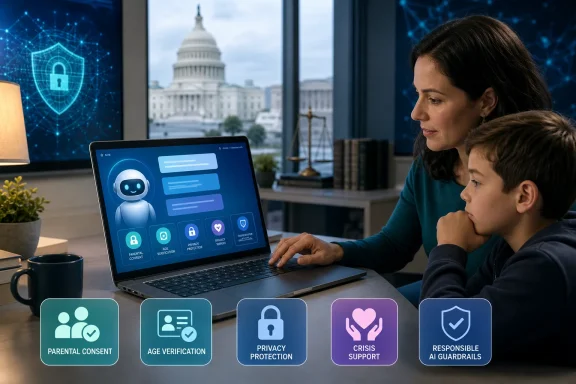
The political message was deliberately balanced. The lawmakers want stricter protections for minors, particularly where a chatbot presents itself as a trusted adviser or where a platform encourages prolonged engagement. But they also want to avoid rules that inadvertently sweep in ordinary business-support bots, education tools, or closed systems built for narrowly defined tasks. That tension—between targeted safeguards and an overly expansive definition of AI—is now central to the emerging AI chatbot regulation debate.
For Windows users, families, schools, developers, and IT administrators, this is not an abstract Capitol Hill conversation. Generative AI is increasingly embedded in browsers, productivity suites, search tools, gaming platforms, education products, customer-service systems, and social services. The question is rapidly becoming not whether children will encounter AI, but what protections exist when they do.
From Social Media Policy to AI Chatbot Safety
Cruz and Hinson’s discussion placed chatbot policy beside established online-safety proposals. Cruz pointed to the TAKE IT DOWN Act, a law that criminalizes certain knowing publication of nonconsensual intimate imagery—including qualifying AI-generated “digital forgeries”—and requires covered platforms to provide a notice-and-removal process. President Trump signed the legislation on May 19, 2025. Congressional Research Service analysis explains that the law’s criminal provisions took effect immediately, while the platform removal-process requirement was scheduled to take effect one year later.
That law is important context, but it solves a different problem. The TAKE IT DOWN Act addresses the distribution and removal of nonconsensual explicit imagery. It is a response to a recognizable category of digital harm: intimate images shared without consent, including images created or altered through AI.
Chatbots present a more complicated regulatory challenge. A general-purpose AI assistant may help a student brainstorm, summarize a document, write code, translate a passage, or answer a factual question. But a conversational interface can also blur the line between a tool and a relationship—especially when it uses humanlike language, remembers prior exchanges, simulates emotional availability, or offers guidance in areas traditionally handled by parents, teachers, counselors, clinicians, or other licensed professionals.
That is why Hinson’s “new frontier” language matters. The policy target is not merely offensive content. It is the nature of the interaction between a minor and an always-on system optimized to respond, continue a conversation, and sometimes encourage more engagement.
The chatbot issue is broader than a single app
The event’s focus on familiar names such as ChatGPT and Claude risks understating the breadth of the issue. AI chat functions can appear in:
- General-purpose AI assistants and search services
- Dedicated “companion” chatbot apps
- School and tutoring products
- Customer-service widgets
- Social media direct-message features
- Multiplayer games and virtual worlds
- Smart devices and voice assistants
- Workplace software accessed on family computers
- Browsers and operating-system-integrated AI tools
That diversity makes a one-size-fits-all ban difficult to design. A chatbot that helps reset a password, for example, is materially different from an AI product marketed around friendship, role-play, emotional support, or extended personal conversations.
Iowa lawmakers confronted that distinction during their own debate. Earlier state proposals raised concerns that broad chatbot restrictions could affect companies using limited, “closed-loop” AI systems for customer service or other narrow functions, according to Iowa Public Radio’s coverage. That concern should inform federal legislation: regulation needs a precise scope if it is to protect children without treating every automated conversational interface as an AI companion.
Cruz’s “Chatbot KOSMA” Has a Legislative Foundation
At the Iowa event, Cruz called his approach “chatbot KOSMA,” invoking the Kids Off Social Media Act, or KOSMA. The chatbot legislation already has a formal vehicle: the bipartisan CHATBOT Act, introduced by Cruz and Sen. Brian Schatz in April 2026. The bill’s full name is the Children’s Health, Advancement, Trust, Boundaries, and Oversight in Technology Act. Schatz’s announcement describes it as an effort to place parents, rather than platform operators, in charge of how children access and use covered AI chatbots.
The proposal would require covered providers to create family accounts for children. Those accounts would be mandatory for users under 13 and optional for teenagers, with protective safety settings enabled by default. The measure would also require age classification, parental consent for children’s chatbot use, limits on manipulative design, and a prohibition on targeted advertising to children. The bill text specifies that covered entities would need user accounts and age-verification processes designed to classify users as minors or adults.
This is more consequential than a generic parental-control checkbox. The proposal points toward a system in which a child’s access level, settings, and potentially usage oversight are tied to an adult-managed account structure.
A meaningful change in policy direction
For years, federal youth-safety proposals have focused on social-media platforms. KOSMA, formally S. 278, would bar social-media platforms from knowingly allowing children under 13 to create or maintain accounts. It would also restrict platforms from using a child’s or teen’s personal data in a personalized recommendation system to display content, and it would connect school filtering requirements to federal E-Rate broadband support. The Senate Commerce Committee report lays out those provisions and the bill’s enforcement structure.
The move from KOSMA to chatbot rules recognizes that the risks are not identical.
A conventional social-media feed typically presents content created or uploaded by others, ordered and amplified by recommendation systems. A chatbot generates a tailored response to the user, in real time, often in a warm and conversational style. It can be prompted repeatedly, challenged, trusted, treated as an authority figure, or used privately at hours when no parent, teacher, or friend is nearby.
That does not mean every chatbot is inherently unsafe. It does mean the policy model should reflect a different technical and behavioral environment.
The House Framework: Professional Impersonation and Crisis Safeguards
Hinson said the House-passed Kids Internet and Digital Safety Initiative includes provisions aimed at chatbot risks, including situations in which an AI system masquerades as a professional or provides guidance to minors on suicide-related concerns or medical matters. The initiative’s published framework calls for access to mental-health resources for minors, restrictions on deceptive professional advice, and safeguards against obscene and unlawful material.
The language is significant because it targets a specific problem rather than merely demanding generic “AI safety.” A chatbot should not imply that it is a doctor, therapist, lawyer, crisis counselor, or other licensed professional when it is not. Clear disclosures are necessary, but they are not sufficient if the product’s design, persona, or conversation flow encourages a vulnerable user to treat the tool as a substitute for qualified human care.
A sound federal framework should therefore distinguish among several different cases:
- Disclosure: The system must clearly say that it is AI and not a human or licensed professional.
- Representation: The system must not falsely claim professional credentials, clinical authority, or a human identity.
- Behavior: The system must avoid generating harmful advice or reinforcing self-harm, abuse, exploitation, or dangerous dependency.
- Escalation: When a minor signals imminent danger or self-harm, the service should provide clear routes to immediate human help.
- Accountability: Providers should maintain safety procedures, audit them, and face meaningful consequences for repeated violations.
This approach is far more practical than treating every AI output as equally risky. It concentrates oversight on the products and interactions most likely to create serious harm.
Iowa Offers an Early Case Study
The federal debate is developing alongside state action. Iowa lawmakers advanced chatbot guardrails for minors that would require chatbots to disclose that they are not human at the beginning of an online conversation with an Iowa minor and again at regular intervals. The state measure also requires an AI service to direct a child to a human suicide hotline when mental-health concerns arise. Radio Iowa’s report described a proposed $1,000 penalty per violation, with higher aggregate exposure for multiple violations.
The disclosure requirement may sound basic, but it speaks to a genuine design issue. In the most immersive chatbot experiences, users can quickly stop thinking of the system as a software interface and instead approach it as a confidant, coach, or peer. Regular reminders cannot solve every problem, but they can interrupt that illusion and establish an important baseline: an AI response is generated output, not human judgment or human care.
Iowa’s earlier proposed language also illustrates how demanding compliance can become. The draft defined a chatbot as AI that simulates human conversation, required harm-detection and mitigation protocols, limited unnecessary collection and storage of user information, and contemplated “reasonable age verification.” The introduced House Study Bill 647 included government identification, financial documents, or widely accepted age-evidencing practices among potential verification methods.
That is where the policy trade-offs sharpen.
Age assurance cannot become a new privacy hazard
If a platform must reliably determine whether someone is a child, it will need some form of age assurance. But the strongest forms of age verification can require sensitive information: government IDs, facial-age estimation, payment credentials, or third-party identity checks.
Those systems create their own risks:
- Sensitive identity data can be breached or misused.
- Families without standard documentation may be disadvantaged.
- Privacy-conscious adults may be forced to surrender more information than necessary.
- A broad identity system could become a de facto gatekeeper for legitimate online speech and services.
- Small developers may struggle with the compliance cost of high-assurance verification.
The House framework explicitly acknowledges this tension, calling for age-verification and age-assurance practices while also stating that there should be privacy and data-security protections and no requirement to hand over government-issued identification. Its policy outline is directionally right: age assurance should be proportionate, privacy-preserving, and tied to the risk level of the product.
A basic customer-service bot should not trigger the same verification burden as an AI companion product designed to sustain emotionally intimate conversations with minors.
Gaming, Social Interaction, and the “Any Place” Problem
Hinson also raised concerns about children encountering predators or harmful actors on gaming platforms such as Roblox. Her larger point was that regulation cannot stop at the traditional social-media category: any technology that enables social interaction can become a venue for risk. KCCI’s account of the roundtable reported that Hinson said lawmakers may need to consider age limits and other protections across both major technology and gaming companies.
This is an important observation, but policymakers should avoid collapsing several distinct problems into one catch-all rule.
Online games can involve:
- User-generated content
- Voice and text communication
- Friend requests and direct messages
- Digital purchases and virtual economies
- Community servers and external links
- AI moderation and recommendation systems
- AI-generated characters or non-player dialogue
A game platform’s principal challenge may be child-to-child communication, adult-to-child contact, or moderation of user-created worlds. A chatbot platform’s central risk may instead be persistent one-to-one interaction with an AI system. Both require safety work, but the tools should not be identical.
For gaming environments, practical protections can include stronger defaults for direct messages, age-appropriate communication settings, friction around contact with unknown users, reliable reporting systems, human moderation, and parent-visible controls. For chatbots, the priorities may be disclosures, crisis escalation, limits on manipulative engagement, parental account controls, and safeguards against professional impersonation.
The common principle is straightforward: the safety obligation should match the capability and foreseeable risk of the service.
Innovation and Safety Are Not Opposing Goals
Cruz argued that the United States must win the global AI competition, emphasizing both economic stakes and the values that could shape the technology. That argument is politically familiar, but it carries a practical lesson for technology policy: safety regulation that is vague, inconsistent, or technically uninformed can create barriers that favor the largest incumbents while failing to protect users.
A compliance regime designed only for the biggest AI labs could lock smaller firms, schools, open-source communities, and specialist developers out of the market. Conversely, a laissez-faire approach could externalize costs onto families and children, leaving companies to treat meaningful safeguards as optional until litigation, public pressure, or catastrophe forces change.
The better route is a tiered model.
What a workable AI chatbot safety regime could look like
A federal law could create different obligations based on the role and risk profile of a system:
- Low-risk, task-limited bots could face baseline disclosure, privacy, and security requirements.
- General-purpose AI assistants could require clear age-appropriate settings, reporting tools, and safeguards for dangerous content categories.
- Companion-style AI products could face stronger requirements around age assurance, parental control, anti-manipulation standards, recurring AI disclosures, and crisis protocols.
- Products presenting health, legal, financial, or psychological guidance could face heightened restrictions against deceptive representation and stronger referral obligations.
- Platforms serving children at scale could be required to conduct independent safety assessments and publish meaningful transparency reports.
This model would be more compatible with innovation than broad definitions that treat every conversational interface as a high-risk companion system. It would also respond to the concern raised in Iowa that rules aimed at emotionally engaging chatbots should not accidentally impair closed-loop business systems.
What Parents and Windows Households Can Do Now
Legislation takes time, and even enacted rules need enforcement. Families do not need to wait for Washington to adopt sensible practices around AI chatbot use.
On Windows PCs, the most effective immediate approach is not a single setting; it is a combination of account separation, application control, conversation, and predictable household rules.
Practical safeguards for AI use at home
- Use separate child accounts.
Avoid giving children unrestricted access through a parent’s Windows account, browser profile, or AI-service login. Separate accounts make it easier to apply age-appropriate settings and prevent access to adult work files, payment methods, saved credentials, and private conversations. - Review browser and app permissions.
Check whether AI extensions, desktop apps, or browser sidebars can access page content, microphone input, files, clipboard data, or browsing history. Disable permissions that are not necessary. - Treat AI chats as potentially shareable data.
Children should understand that they should not enter addresses, school schedules, passwords, medical information, financial details, private photos, or identifying information about other people into a chatbot. - Explain that chatbots can sound confident and still be wrong.
A fluent answer is not evidence of expertise. This is especially important for medical, legal, mental-health, relationship, and safety-related questions. - Set a rule for serious topics.
If a child encounters self-harm, threats, sexual content, grooming behavior, abuse, or frightening material, the next step should be a trusted adult or qualified human resource—not continued private conversation with an AI tool. - Avoid “secret relationship” dynamics.
Parents should be alert to products that encourage secrecy, exclusivity, guilt, emotional dependency, or the idea that an AI system is more trustworthy than family, friends, teachers, or clinicians. - Keep devices and browsers updated.
Security patches do not solve every AI safety concern, but current Windows, browser, and application updates reduce exposure to known vulnerabilities, malicious extensions, and account-compromise risks.
These steps respect the reality that AI can be useful. The goal is not to turn a child’s computer into a locked-down appliance. It is to ensure that experimentation with new technology occurs within sensible boundaries.
The Critical Test: Can Policymakers Define the Harm Precisely?
The strongest part of the Cruz-Hinson approach is its recognition that online child safety must evolve with the technology. Rules written only for social-media feeds will not adequately address a world in which children can privately converse with systems that generate tailored, persuasive, and emotionally responsive text.
The potentially weak point is definitional overreach. “Chatbot” is a broad technical label, and a regulation that treats a password-reset assistant, a classroom tutor, a retail support bot, and an AI companion as equivalent will produce confusion, compliance costs, and loopholes. It may also encourage companies to relabel products rather than improve them.
The legislative focus should remain on capabilities and conduct:
- Does the product simulate a personal relationship?
- Is it intended to keep a user engaged over time?
- Does it market itself as emotional support or expert guidance?
- Can it interact privately with minors?
- Does it collect sensitive personal data?
- Does it offer or imply medical, psychological, legal, or financial expertise?
- Does it provide meaningful parental controls and safety escalation?
- Does it deploy age-appropriate defaults rather than shifting every burden to families?
Those questions lead to more defensible rules than attempting to regulate all AI through a single label.
A Necessary Next Stage for Online Safety
The Ankeny roundtable reflects a broader realization: AI safety for kids is becoming a mainstream child-protection issue, not a niche technology-policy topic. The same families who worry about social-media algorithms, harassment, grooming, explicit content, and online privacy are now confronting AI systems that can generate personalized answers at any hour, in any browser window, and increasingly inside the platforms children already use.
Cruz’s CHATBOT Act provides one emerging federal blueprint, centered on family accounts, age classification, parental consent, limits on manipulative design, and protections for young users. The House’s wider digital-safety initiative points toward additional safeguards around deceptive professional advice, mental-health resources, social gaming, privacy, and parental controls. The House framework makes clear that AI chatbots are now part of the same policy landscape as social media and app-store safety.
Hinson is right that policymakers are struggling to keep pace. But the answer is neither to ignore the risks nor to impose a blunt freeze on a rapidly developing field. Effective AI chatbot regulation for minors should be targeted, privacy-conscious, technically literate, and enforceable. It should empower parents, require companies to take responsibility for foreseeable harms, preserve legitimate educational and business uses, and keep human support at the center whenever a child faces a serious crisis.
References
- Hinson says chatbots are the 'new frontier' for protecting kids - KCCI KCCI · 2026-07-26T18:51:00+00:00