
Parade’s July 31 comparison of ChatGPT, Claude and Gemini declared ChatGPT the winner in a deliberately narrow test: each chatbot was asked for the single most important cognitive habit of successful people, excluding familiar answers such as waking up early. The practical takeaway for Windows users and IT professionals is less about which bot “won” than about the surprising consensus underneath the answers: seek disconfirming evidence, examine assumptions, and turn mistakes into feedback before they become recurring operational problems.
The three replies used different language. ChatGPT emphasized seeking feedback that challenges one’s thinking; Claude called for deliberate, structured reflection; Gemini chose metacognition, or the practice of observing and questioning one’s own reasoning. But all three landed in the same territory: avoid defending an initial position merely because it is yours.
Parade gave ChatGPT the edge because its answer was clearer, more actionable, and supplied a daily routine: identify an assumption that may have been wrong, notice feedback that triggered resistance, and choose one change for the next day. That is a useful prompt pattern, but it is not evidence that ChatGPT is universally better at advice—or that any chatbot should be treated as an authority on career, health, financial, or management decisions.
ChatGPT’s response framed success as a willingness to ask, “What am I missing?” rather than “Did I do a good job?” That is a recognizably useful habit in technology work. A sysadmin investigating repeated authentication failures, for example, gets further by attempting to falsify the first theory than by repeatedly collecting logs that confirm it.
Claude’s “structured reflection” covered much of the same ground with more explicit decision tools. Its answer included a premortem: imagine that a planned project has failed, then work backward to identify the causes that could have produced the outcome. It also separated decision quality from outcome quality, an important distinction in environments where a sound migration plan can still be disrupted by a vendor outage, a bad patch, or a late business requirement.
Gemini’s “metacognition” was the broadest label. Its proposed techniques—looking for disconfirming evidence, conducting premortems, and auditing thoughts—are all mechanisms for interrupting overconfidence. In the context of IT, that could mean asking whether a proposed Intune policy is based on current device telemetry or on a previous deployment’s assumptions; whether a security exception has a documented expiration date; or whether a pilot succeeded because the configuration was sound rather than because its test group was unusually cooperative.
The terms are not interchangeable in a strict academic sense, but Parade’s comparison correctly identified their shared center of gravity. Each answer treats reflection not as vague self-improvement but as a repeatable process for correcting a model of reality.
That is why ChatGPT’s answer read as the most immediately useful. It translated an abstract cognitive principle into behavior that can be performed at the end of a workday, after an incident review, or before a consequential technical decision.
A chatbot’s answer can vary based on the exact model selected, whether web access and memory are enabled, hidden product-level instructions, the conversational context, and ordinary response variability. Asking the same question again may produce a different hierarchy of habits, different examples, or a different degree of certainty. A comparison based on one answer from each service is therefore better understood as a comparison of three generated responses, not a benchmark of the platforms’ reasoning capability.
The user’s wording also did much of the intellectual steering. “The number one habit of successful people” is a broad, subjective prompt. By excluding generic advice and asking for a cognitive habit, Parade effectively constrained all three models toward a family of familiar concepts: feedback, bias reduction, reflection, learning loops, and decision review.
That does not make the exercise worthless. On the contrary, it shows a point that matters to people increasingly using AI as a work companion: a tightly framed prompt often produces more useful output than a broad request for wisdom. OpenAI’s own guidance for workplace writing stresses that users should provide context and constraints and treat the resulting material as a draft to review, not a final authority. Anthropic has likewise promoted reflection-oriented uses of Claude, emphasizing that users can step back and consider how AI fits into their work and skill development.
The experiment’s real finding is that the leading chatbots are very good at packaging established decision-making practices into accessible language. They can make a postmortem template less intimidating, turn a fuzzy concern into a decision journal, or generate counterarguments against an early proposal. That is different from proving they can independently determine the best personal or professional habit for every user.
But there is a built-in paradox in using an AI assistant to combat confirmation bias. If the user asks the model to validate a preferred conclusion, the model may produce polished support for it. If the prompt asks it to critique the conclusion, identify missing evidence, propose rival explanations, and state what would change its recommendation, the tool becomes substantially more useful.
The quality of the AI interaction depends on whether the human is willing to invite disagreement. That is exactly the cognitive habit Parade’s comparison surfaced, and it is more important than the branding of the chatbot delivering the answer.
For a Windows administrator, the practical application might look like this:
Still, Claude’s distinction between a good decision and a good outcome may be the most valuable idea in the entire comparison. Organizations routinely reward lucky outcomes and punish well-reasoned decisions that encountered unforeseen conditions. Over time, that encourages teams to hide uncertainty, avoid escalation, and optimize for appearing right rather than becoming more accurate.
Gemini’s focus on metacognition adds the other necessary layer: people need to inspect not only the result but the mental shortcuts used to reach it. Did the team trust a familiar vendor because the evidence was compelling? Did it reject an alert because the prior five were false positives? Did it extend a deadline because the plan remained viable—or because too much reputation had already been invested in it?
The next useful step for readers is not switching chatbots based on this one comparison. It is building a small, repeatable habit around critical decisions: record the assumption, name the evidence that could disprove it, define what would trigger a reversal, and review the result afterward. ChatGPT may have won Parade’s single-answer contest, but the more durable winner is the team or individual willing to let better evidence change their mind.
Parade gave ChatGPT the edge because its answer was clearer, more actionable, and supplied a daily routine: identify an assumption that may have been wrong, notice feedback that triggered resistance, and choose one change for the next day. That is a useful prompt pattern, but it is not evidence that ChatGPT is universally better at advice—or that any chatbot should be treated as an authority on career, health, financial, or management decisions.
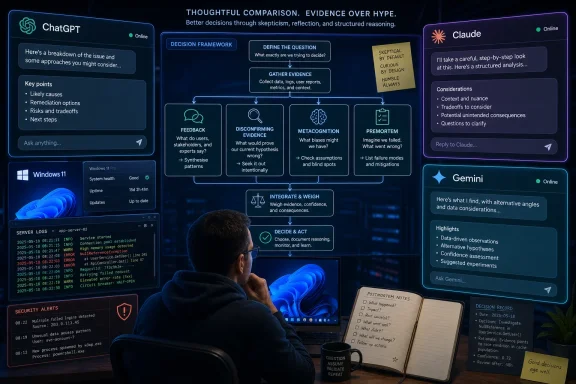 Three Names for the Same Operating Discipline
ChatGPT’s response framed success as a willingness to ask, “What am I missing?” rather than “Did I do a good job?” That is a recognizably useful habit in technology work. A sysadmin investigating repeated authentication failures, for example, gets further by attempting to falsify the first theory than by repeatedly collecting logs that confirm it.Claude’s “structured reflection” covered much of the same ground with more explicit decision tools. Its answer included a premortem: imagine that a planned project has failed, then work backward to identify the causes that could have produced the outcome. It also separated decision quality from outcome quality, an important distinction in environments where a sound migration plan can still be disrupted by a vendor outage, a bad patch, or a late business requirement.
Gemini’s “metacognition” was the broadest label. Its proposed techniques—looking for disconfirming evidence, conducting premortems, and auditing thoughts—are all mechanisms for interrupting overconfidence. In the context of IT, that could mean asking whether a proposed Intune policy is based on current device telemetry or on a previous deployment’s assumptions; whether a security exception has a documented expiration date; or whether a pilot succeeded because the configuration was sound rather than because its test group was unusually cooperative.
The terms are not interchangeable in a strict academic sense, but Parade’s comparison correctly identified their shared center of gravity. Each answer treats reflection not as vague self-improvement but as a repeatable process for correcting a model of reality.
That is why ChatGPT’s answer read as the most immediately useful. It translated an abstract cognitive principle into behavior that can be performed at the end of a workday, after an incident review, or before a consequential technical decision.
The Winner Is Really a Prompt Winner
There is an important limitation to the head-to-head result: Parade did not publish the model versions, account tiers, system settings, dates and times of each query, or full chat transcripts. Those details matter because ChatGPT, Claude, and Gemini are services, not fixed products with one unchanging response style.A chatbot’s answer can vary based on the exact model selected, whether web access and memory are enabled, hidden product-level instructions, the conversational context, and ordinary response variability. Asking the same question again may produce a different hierarchy of habits, different examples, or a different degree of certainty. A comparison based on one answer from each service is therefore better understood as a comparison of three generated responses, not a benchmark of the platforms’ reasoning capability.
The user’s wording also did much of the intellectual steering. “The number one habit of successful people” is a broad, subjective prompt. By excluding generic advice and asking for a cognitive habit, Parade effectively constrained all three models toward a family of familiar concepts: feedback, bias reduction, reflection, learning loops, and decision review.
That does not make the exercise worthless. On the contrary, it shows a point that matters to people increasingly using AI as a work companion: a tightly framed prompt often produces more useful output than a broad request for wisdom. OpenAI’s own guidance for workplace writing stresses that users should provide context and constraints and treat the resulting material as a draft to review, not a final authority. Anthropic has likewise promoted reflection-oriented uses of Claude, emphasizing that users can step back and consider how AI fits into their work and skill development.
The experiment’s real finding is that the leading chatbots are very good at packaging established decision-making practices into accessible language. They can make a postmortem template less intimidating, turn a fuzzy concern into a decision journal, or generate counterarguments against an early proposal. That is different from proving they can independently determine the best personal or professional habit for every user.
Where AI Advice Can Sharpen—or Distort—Judgment
The appeal of these tools is obvious. A user can ask for an alternate view at 11 p.m., request a list of failure modes before a change window, or have a draft proposal challenged without involving a colleague prematurely. For independent professionals and small IT teams, that availability has real value.But there is a built-in paradox in using an AI assistant to combat confirmation bias. If the user asks the model to validate a preferred conclusion, the model may produce polished support for it. If the prompt asks it to critique the conclusion, identify missing evidence, propose rival explanations, and state what would change its recommendation, the tool becomes substantially more useful.
The quality of the AI interaction depends on whether the human is willing to invite disagreement. That is exactly the cognitive habit Parade’s comparison surfaced, and it is more important than the branding of the chatbot delivering the answer.
For a Windows administrator, the practical application might look like this:
- Before deploying a Windows 11 feature update, ask the assistant to generate a premortem based on known dependencies, rollback constraints, driver risk, help-desk capacity, and business-critical applications.
- After resolving a Microsoft 365 or Active Directory incident, use the chatbot to draft questions for a blameless postmortem—but validate every technical claim against logs, vendor documentation, and the people who handled the outage.
- When reviewing a security control exception, require the model to argue both for and against the exception, identify evidence it lacks, and propose a concrete expiry or compensating control.
- When a project goes well, ask what conditions made the result possible and which may not be reproducible at larger scale.
Postmortems Matter More Than Personality Tests
Parade’s verdict in favor of ChatGPT rests mostly on communication quality. The response was concrete, readable, and ended with an exercise rather than a slogan. That is a fair editorial judgment, and ChatGPT’s emphasis on separating criticism of work from criticism of self is particularly relevant to incident response and engineering culture.Still, Claude’s distinction between a good decision and a good outcome may be the most valuable idea in the entire comparison. Organizations routinely reward lucky outcomes and punish well-reasoned decisions that encountered unforeseen conditions. Over time, that encourages teams to hide uncertainty, avoid escalation, and optimize for appearing right rather than becoming more accurate.
Gemini’s focus on metacognition adds the other necessary layer: people need to inspect not only the result but the mental shortcuts used to reach it. Did the team trust a familiar vendor because the evidence was compelling? Did it reject an alert because the prior five were false positives? Did it extend a deadline because the plan remained viable—or because too much reputation had already been invested in it?
The next useful step for readers is not switching chatbots based on this one comparison. It is building a small, repeatable habit around critical decisions: record the assumption, name the evidence that could disprove it, define what would trigger a reversal, and review the result afterward. ChatGPT may have won Parade’s single-answer contest, but the more durable winner is the team or individual willing to let better evidence change their mind.
References
- Primary source: aol.com
Published: 2026-07-31T20:13:00+00:00
Loading…
www.aol.com