
OfficeChai, which published the chart and attributed it to Similarweb, reports that Claude Code received more than 200,000 daily visits in early July while ChatGPT Codex was below 100,000. It says Codex then rose above 300,000 visits around July 13–14, briefly overtaking Claude Code, before the two products traded positions through the rest of the month. By August 1, OfficeChai’s chart placed Codex at roughly 213,000 daily visits and Claude Code around 197,000.
The date matters. The article was published on August 9, 2026, yet its final plotted data point is August 1. It therefore documents a July convergence, not a verified August lead or a durable shift in the coding-agent market.
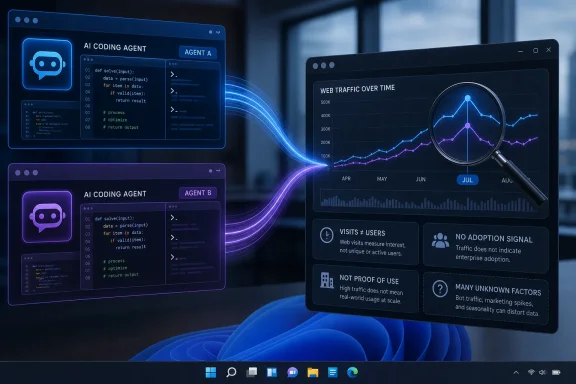 Similarweb traffic is a signal, not a usage leaderboard
The central limitation is the metric itself. Similarweb defines a visit as a web session, rather than a person, paid account, completed coding task, or active software-development seat. The same person can create multiple visits, while a developer using a desktop app, CLI, IDE integration, API, or enterprise-managed deployment may create few or no visits to the specific web pages in question.
That distinction is unusually important here. Claude Code began as a command-line coding agent and is increasingly embedded in team workflows. Codex also spans more than a browser tab: OpenAI positions it across its app, developer workflows, plugins, and business tools. Comparing visits to Claude.ai/Code and ChatGPT.com/Codex can indicate attention and product discovery, but it cannot show how much code either agent wrote, how many repositories they touched, or which tool an engineering organization has standardized on.
OfficeChai also does not publish the Similarweb export, region selection, desktop-versus-mobile split, referral sources, visit duration, unique-visitor counts, or margin of error. Those omissions prevent an independent check of whether the two URLs were measured under identical conditions. Similarweb’s own documentation distinguishes visits from unique visitors and notes that its estimates draw on external data sources rather than a company’s internal product telemetry.
The chart is still meaningful as an attention indicator. It is simply not evidence of market-share parity. Calling it that would turn a narrow web-analytics comparison into a claim the source cannot support.
The July 13 surge coincided with OpenAI’s biggest Codex promotion
The timing does offer a plausible explanation for Codex’s abrupt mid-July climb. OpenAI’s Build Week challenge opened on July 13, with live sessions, Discord office hours, community events, a Codex Sites session on July 16, and a creative-building session on July 21. Those activities gave developers a reason to visit Codex-specific pages, explore features, and share links during the exact period when OfficeChai’s chart shows the traffic line rising almost vertically.
OpenAI had also spent June broadening Codex beyond traditional software development. Its June 2 announcement described role-specific plugins, annotations, and a preview feature for building and sharing interactive sites and apps within Business and Enterprise workspaces. OpenAI said at the time that Codex had surpassed 5 million weekly users, though that figure covers the overall product and cannot be compared directly with the web-path visits in OfficeChai’s chart.
This is the most consequential context missing from the traffic story. A campaign, challenge, product tutorial, or launch-week event can generate an enormous burst of web visits without producing a matching change in retained engineering usage. It may still be strategically valuable—developers have to discover a tool before they can adopt it—but the surge should be read as a successful distribution moment, not proof that long-term preference changed overnight.
For Windows users, the practical implication is familiar. A browser-based coding agent can be compelling because it is easy to trial on a managed Windows 11 PC without changing an IDE installation or requesting a new developer-tool deployment. That lowers the barrier to evaluation. It does not eliminate the questions IT teams must answer before wider use: source-code access, connector permissions, identity controls, audit logs, data retention, spending limits, and whether the agent can act autonomously on repositories or cloud resources.
Anthropic was shipping during the same period, but through different channels
Claude Code did not stand still while Codex traffic grew. Anthropic’s own newsroom shows several relevant moves around the same timeframe: a July 6 feature on the making of Claude Code, a June 30 model release and restoration of global access to Claude Code for eligible users, and the July 24 launch of Claude Opus 5, which Anthropic said improves long-running agents and coding work.
More importantly for organizations, Anthropic introduced Claude Tag on June 23. The Slack-based beta lets Enterprise and Team customers assign Claude access to selected channels, tools, data, and codebases, with administrators able to scope those permissions and set token-spend limits. Anthropic describes the product as an evolution of Claude Code toward collaborative, asynchronous agent work.
That is a different adoption route from an individual developer arriving at Claude.ai/Code. A company deploying Claude Tag inside Slack may be using Claude extensively without repeatedly visiting the public Claude Code page. Likewise, a user arriving at the page may be browsing documentation, checking availability, or trying a free workflow rather than committing it to production.
The comparison therefore has a structural bias: both products have web surfaces, but their product strategies increasingly extend beyond those surfaces. Codex is leaning into broader knowledge-work and app-building workflows, while Claude is leaning into collaborative agent access and administrator-controlled team contexts. A single URL’s daily visit count captures only one doorway into each vendor’s platform.
What IT teams should measure instead
The traffic convergence is useful for one conclusion: OpenAI has made Codex impossible to dismiss as a distant follower in public developer attention. Claude Code’s early-July web lead did not hold through the month, and the Codex surge aligned with a serious OpenAI promotional and product push.
It is not enough to choose a coding agent, however. Enterprise buyers should demand measurements closer to operational reality:
- Track weekly active users by role, repository, IDE, CLI, web app, and automation channel rather than relying on vendor web traffic.
- Measure successful task completion, review rework, test-pass rates, rollback frequency, and time saved on bounded work such as test generation or dependency updates.
- Separate exploration from production use by checking which users have connected repositories, enabled tools, or completed governed workflows.
- Review administrative controls before enabling connectors, especially permissions for source-code repositories, ticket systems, cloud consoles, Slack, and shared document stores.
- Establish a spending ceiling and audit process for long-running agent tasks, since autonomous work can consume tokens and access systems long after a user has left the browser.
Those metrics will also expose a trade-off that web charts cannot show. A tool that attracts more curious visitors may be ideal for fast experimentation, while a tool with less visible public traffic may fit a regulated environment better because it integrates with existing identity, logging, approval, and data-boundary controls.
August will test retention, not launch attention
Neither OpenAI nor Anthropic has published directly comparable active-user, retention, paid-seat, or coding-output data for the precise products and period in OfficeChai’s chart. No second outlet appears to have published the underlying Similarweb time series or independently verified its daily figures. The original chart should therefore be treated as a single-source snapshot of estimated web sessions.
The next meaningful evidence will be whether Codex sustains elevated attention after Build Week’s July 13–21 activity, and whether either vendor releases data that separates browser interest from recurring, production-grade agent use. Until then, the defensible conclusion is straightforward: Claude Code’s visible web-traffic advantage narrowed substantially in July, while the larger contest for developer and enterprise adoption remains unmeasured.
References
- Primary source: OfficeChai
Published: August 9, 2026 at 7:48 AM UTC
Loading…
officechai.com - Related coverage: anthropic.com
UST is bringing Claude to physical AI \ Anthropic
Anthropic is an AI safety and research company that's working to build reliable, interpretable, and steerable AI systems.www.anthropic.com - Related coverage: anthropic.com
Introducing Claude for Teachers \ Anthropic
Anthropic is an AI safety and research company that's working to build reliable, interpretable, and steerable AI systems.www.anthropic.com - Related coverage: openai.com
Codex for every role, tool, and workflow | OpenAI
Discover new Codex plugins, sites, and annotations that help analysts, marketers, designers, investors, and other teams get more done with AI.openai.com - Related coverage: openai.com
Codex is becoming a productivity tool for everyone | OpenAI
The Next Era of Knowledge Work report explores how Codex is transforming productivity through AI-powered research, data analysis, workflow automation, and content creation.openai.com - Related coverage: similarweb.com
Loading…
www.similarweb.com - Related coverage: support.similarweb.com
Loading…
support.similarweb.com - Related coverage: support.similarweb.com
Loading…
support.similarweb.com