
For Windows users running the ChatGPT desktop app—or using ChatGPT in a browser—the practical effect is straightforward: ordinary back-and-forth text work such as drafting, troubleshooting, explaining PowerShell output, revising documents, or iterating on code should no longer consume a visible message allowance. But “unlimited” has a narrow definition here. Uploading a file, adding an image, generating images, and using other tools will still be subject to separate quotas, and OpenAI says the text access remains subject to abuse guardrails.
That distinction is the story. OpenAI has eliminated the limit on the cheapest and most frequent form of ChatGPT use, while retaining limits on the actions that cost more compute or involve more infrastructure. It has also made no announcement that advertisements, already being tested for Free and Go users in the United States, are going away.
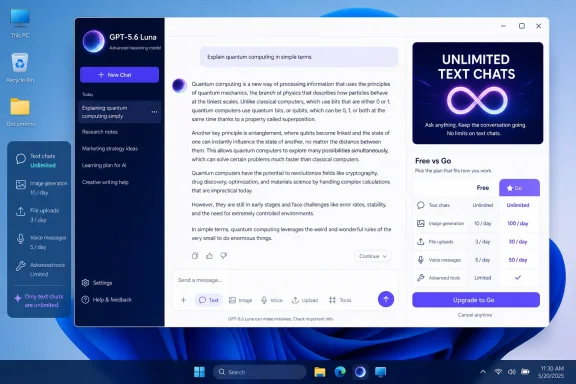 GPT-5.6 Luna Becomes the Free Default
OpenAI is replacing GPT-5.5 Instant with GPT-5.6 Luna as the default model for ChatGPT Free and Go accounts this week. Luna is the fast, lower-cost member of the GPT-5.6 family, and OpenAI says it will provide unlimited text chats starting next week. Free and Go users will also receive a new Think button intended to give Luna more time to reason through harder prompts.
The model change matters as much as the quota change. Previously, a free user who reached the current text limit could be blocked from continuing with the main model until a reset time, while access to GPTs was tied to that same model allowance. OpenAI’s existing Free Tier FAQ still describes model usage as limited and says ChatGPT will notify users when they reach the current cap. That Help Center page was last updated before this week’s announcement, so it reflects the outgoing policy rather than evidence that OpenAI has reversed course.
The new policy does not mean every ChatGPT function has become limitless. OpenAI’s August 6 post specifically retains caps for file uploads, images, and other tools. Engadget adds that image creation and the recently updated voice experience remain separately constrained. A conversation that starts as ordinary text may therefore still encounter a limit once it becomes multimodal—such as attaching a Windows Event Viewer export, uploading a screenshot of an error dialog, or asking the service to generate an image.
OpenAI has not published a numerical replacement schedule for those remaining limits, nor has it provided a platform-by-platform rollout timetable for GPT-5.6 Luna on web, Windows, macOS, iOS, and Android. Its July desktop-app update confirms that ChatGPT and Codex experiences are available across Windows and macOS plans, but the August announcement only says Luna becomes the default for Free and Go users “this week.” Users should treat the in-app model behavior and account notices as the operational record until the rollout finishes.
The Word “Unlimited” Still Has a Guardrail Attached
OpenAI’s announcement is unusually clear about the boundary but less specific about enforcement. The company says unlimited text chats are “subject to abuse guardrails,” without defining the thresholds, patterns, or remediation process. That leaves the usual caveat attached to virtually every consumer AI product advertised as unlimited: there may be no ordinary hourly prompt counter, but automated anti-abuse systems can still intervene.
For normal interactive use, that wording should not change much. It is aimed at sustained automated, scripted, spam-like, account-sharing, or otherwise abusive behavior—not a person asking for twenty rounds of edits to a deployment script. Still, it means OpenAI has not promised infinite throughput, no service throttling, or unrestricted use of the model for machine-driven workloads.
The policy also does not turn ChatGPT into an API substitute. ChatGPT plans and API billing are separate products with separate controls, and OpenAI has not announced unlimited GPT-5.6 API access. IT teams should not interpret this as permission to shift batch summarization, log parsing, or application integrations from API workflows into consumer chat sessions. Aside from governance and privacy concerns, that would run directly into product terms and the undefined abuse safeguards.
The more immediate benefit is to individual users whose work is conversational by nature: troubleshooting a sequence of Windows failures, refining a script across multiple iterations, walking through a configuration problem, or developing documentation without preserving messages for later. The removal of the prompt counter will make those sessions feel more continuous, even though they can still be interrupted by a tool-specific limit.
ChatGPT Go Loses Its Cleanest Selling Point
The Free-versus-Go wording deserves scrutiny because OpenAI’s public materials are not equally precise. The headline and early sections of the August 6 post say OpenAI is expanding access for Free users; the formal availability section later says GPT-5.6 Luna will be the default for Free and Go accounts and that both will receive unlimited text chats next week. The Verge and Engadget independently reported the same Free-and-Go scope.
That leaves little doubt about eligibility, but it changes the economics of ChatGPT Go. When OpenAI launched Go globally in January, it positioned the $8 monthly plan around more messages, more file uploads, and more image creation than the Free tier. Its launch material cited ten times more messages, uploads, and images than Free, while advertising would still be present on Go.
Once Free accounts receive unlimited plain-text conversations with the same default GPT-5.6 Luna model, message volume is no longer the simple reason to pay for Go. Go can still be valuable for users who hit tool limits, need more uploads or image generation, or want expanded access beyond text prompts. But OpenAI has not stated what happens to the old “ten times more messages” comparison now that plain text itself becomes unlimited on both plans.
That missing detail is more than a marketing footnote. Existing Go subscribers are paying for a tier that also may show advertisements, and OpenAI has not said whether it will alter pricing, benefits, tool quotas, or ad treatment following this change. The company’s current ad documentation says ads may appear on Free and Go plans, while Plus, Pro, Business, Enterprise, and Education accounts do not receive them.
In other words, Go becomes primarily a multimodal-capacity plan rather than a text-chat plan. That may be a reasonable product split, but OpenAI has not yet laid it out in a revised plan comparison.
Ads Remain the Likely Trade for Free Access
OpenAI introduced ChatGPT advertising tests for Free and Go users in the United States on February 9, 2026. Its earlier explanation of the program linked ads directly to broader access and fewer usage limits, saying advertising could help support a faster, more capable service without requiring every user to pay. The August 6 announcement now delivers the largest of those reduced-limit promises for text prompts.
OpenAI says ads are placed below ChatGPT responses and should not affect the model’s answer. Its advertising FAQ says ads can be informed by the current conversation and, when personalization is enabled, certain signals from a user’s wider ChatGPT experience. Advertisers are not supposed to receive users’ chat histories, memories, or personal information.
The unlimited-text announcement does not mention advertising once. It does not say whether the rollout will expand the ad test beyond its existing territories, whether more ads will appear as text use rises, or whether Free users who select an ads-free, lower-limit option will retain unlimited text chats. That last point is particularly important because OpenAI’s ads-free control for Free accounts has been described as a trade: no ads in exchange for reduced message limits and reduced feature access.
Until OpenAI updates that policy, users should not assume that “unlimited text chats” overrides every other account-level choice. The company’s own documentation now needs to reconcile an ads-free option built around fewer messages with a Free tier marketed as having no text-chat limit.
Plus and Pro Receive a Different Upgrade
While Free and Go accounts gain access and volume, Plus and Pro accounts receive an update to GPT-5.6 Sol, OpenAI’s more capable ChatGPT model. OpenAI says Sol should provide more focused answers, use less unnecessary formatting, and make fewer factual mistakes where dates, numerical claims, sources, rules, and assumptions matter.
The company’s internal evaluation claims responses with at least one factual error were 62 percent less common with GPT-5.6 Luna and 68 percent less common with GPT-5.6 Sol than with GPT-5.5 Instant on financial, medical, and legal prompts requiring factual detail. Those are OpenAI’s own test results, not an independently replicated benchmark, and they should be read as a product claim rather than a guarantee that ChatGPT is safe for high-stakes decisions.
Plus and Pro subscribers also gain a slider that controls how much “thought” ChatGPT applies to an answer, available on web, mobile, and desktop. OpenAI says the updated Sol and slider are available now, while the Free and Go unlimited-text rollout is scheduled for next week.
The immediate takeaway for Windows users is simple: use Free ChatGPT for ongoing text conversations without treating it as an unlimited image, file-analysis, voice, or automation service. For Go subscribers, check actual upload and image usage before renewing—the plan’s old message-limit advantage is about to disappear, while its ads and tool quotas remain.
References
- Primary source: The Verge
Published: August 6, 2026 at 5:00 PM UTC
OpenAI is giving ChatGPT free users unlimited text chats | The Verge
ChatGPT free and Go users will be able to have unlimited text chats with the chatbot starting next week. Plus and Pro subscribers are getting an updated GPT-5.6 Sol model and a new slider.www.theverge.com
- Independent coverage: Engadget
Published: August 6, 2026 at 5:01 PM UTC
OpenAI Will No Longer Limit How Many Texts Free Accounts Can Send To ChatGPT
There will still be limits on image generation, voice mode usage and other features.www.engadget.com - Related coverage: axios.com
OpenAI makes major upgrades for ChaptGPT. What to know
The upgrades will help both paid and free users.www.axios.com
- Related coverage: engadget.com
OpenAI is bringing ads to ChatGPT
OpenAI plans to start testing ads inside of ChatGPT "in the coming weeks."www.engadget.com - Related coverage: help-lb.openai.com
The ChatGPT home page | OpenAI Help Center
Try ChatGPT before creating an account. help-lb.openai.com
- Related coverage: help.openai.com
ChatGPT Free Tier FAQ | OpenAI Help Center
ChatGPT is free to use. Free tier users have access to a range of chat capabilities, tools, and GPTs. The default model and available limits can change over time. help.openai.com
- Related coverage: axios.com
OpenAI brings ads to ChatGPT Go and Free tiers
OpenAI says it is starting to test ads for its Free and Go subscription tiers. - Related coverage: help.openai.com
ChatGPT — Release Notes | OpenAI Help Center
A changelog of the latest updates and release notes for ChatGPT
help.openai.com
- Related coverage: searchenginejournal.com
OpenAI Begins Testing Ads In ChatGPT For Free And Go Users
OpenAI is testing ads in ChatGPT for free and Go tiers in the U.S. Ads appear below responses, labeled as sponsored. Paid tiers remain ad-free.www.searchenginejournal.com - Related coverage: searchengineland.com
- Related coverage: macrumors.com
ChatGPT Now Has Ads for Free and Go Tier Users
U.S. ChatGPT users who have a free account or a low-cost Go subscription will start seeing ads starting today, according to OpenAI. Ads will be limited to the Free and Go subscription tiers, and will be shown to logged-in adult users. OpenAI does not plan to show ads to minors, and the company...www.macrumors.com - Related coverage: theregister.com
ChatGPT will get ads. Free and Go users first
: Gotta pay for those datacenter buildouts somehowwww.theregister.com - Related coverage: sfchronicle.com
- Related coverage: deploymentsafety.openai.com
- Related coverage: cdn.openai.com
- Related coverage: cdn.openai.com
- Related coverage: tomsguide.com
ChatGPT confirms ads are coming to the AI chatbot — plus ChatGPT Go unveiled for $8 a month | Tom's Guide
OpenAI announced two big changes coming to ChatGPT in the form of advertisments and a new subscription tier.www.tomsguide.com - Related coverage: androidcentral.com
OpenAI says yes to ads, testing begins soon as cheaper 'ChatGPT Go' tier debuts | Android Central
ChatGPT continues to evolve, as OpenAI's cheapest tier gives more people access to its GPT‑5.2 Instant model.www.androidcentral.com - Related coverage: techradar.com
Free ChatGPT for teachers launches with unlimited GPT-5.1 access and collaboration features changing classroom workflows forever | TechRadar
OpenAI expands ChatGPT into classroomswww.techradar.com - Related coverage: about.chat
ChatGPT Is Now Running Ads: What You Need to Know | About.chat
ChatGPT now shows ads to free and Go tier users. Here is what the ads look like, which plans are ad-free, and what to expect next. about.chat
- Related coverage: openai.com
Our approach to advertising and expanding access to ChatGPT | OpenAI
OpenAI plans to test advertising in the U.S. for ChatGPT’s free and Go tiers to expand affordable access to AI worldwide, while protecting privacy, trust, and answer quality.openai.com - Related coverage: humai.blog
ChatGPT Ads: What's Actually Changing for Free Users, and What's Hidden in the Fine Print
ChatGPT's advertising launch changed more than most users realize. What the free plan experience looks like, what the privacy policy update actually says, and what your real options are. www.humai.blog
- Related coverage: techcrunch.com
ChatGPT rolls out ads | TechCrunch
OpenAI faced a backlash late last year when it tested app suggestions that looked like unwanted ads. Still, the AI company needs to generate revenue from its popular chatbot to cover the costs of developing its technology and growing the business.techcrunch.com - Related coverage: thesummerai.com
What ChatGPT Ads Would Change for Free Users and What Probably Will Not
ChatGPT ads are now rolling out for some Free and Go users. This guide explains where ads appear, what stays unchanged, and what OpenAI says about privacy, personalization, and paid plans.thesummerai.com - Related coverage: adthena.com
- Related coverage: mavgpt.ai
- Related coverage: intuitionlabs.ai
chatgpt plans compared free vs plus 20 vs pro 200 vs business vs enterprise 2026
PDF documentintuitionlabs.ai
- Related coverage: techxplore.com
- Related coverage: openai.com
Introducing ChatGPT Go, now available worldwide | OpenAI
ChatGPT Go is now available worldwide, offering expanded access to GPT-5.2 Instant, higher usage limits, and longer memory—making advanced AI more affordable globally.openai.com - Related coverage: zapier.com
What is ChatGPT Go—and is it worth it?
Here's what you get with ChatGPT Go, how it stacks up against free and Plus, and how to decide if it's worth the subscription.zapier.com
