
CNBC’s review of House disbursement records shows that OpenAI’s ChatGPT accounted for roughly $100,580 of $113,740 in identifiable House spending on AI tools between April 2025 and March 2026. That is about 88% of the measured dollars and 96% of the recorded transactions, leaving Anthropic’s Claude and other directly identifiable tools far behind.
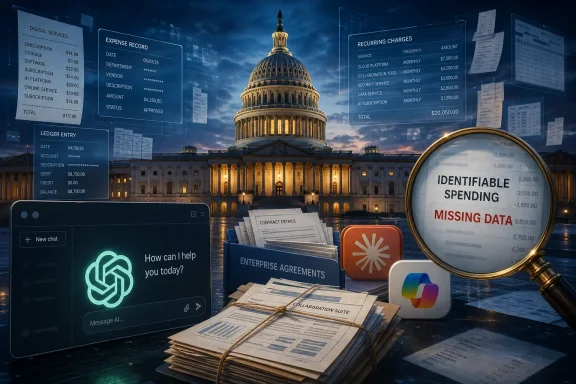
The numbers are striking, but the more consequential finding is narrower than the headline suggests. This is a measure of named, separately billed purchases visible in House spending records—not a complete census of what Congress uses, which model performs best, or which company has the broadest operational reach across the legislative branch. CNBC explicitly notes that free accounts, most Senate activity, and Microsoft Copilot features bundled into broader software agreements are outside its tally.
For Windows administrators and IT buyers, that distinction is familiar: a monthly SaaS charge is easy to find in a card ledger; an AI feature folded into Microsoft 365, Azure, endpoint management, or a larger enterprise agreement may be effectively invisible without examining the contract and tenant configuration. Congress is discovering the same asset-management problem while debating how the industry should be governed.
The House’s public Statements of Disbursements independently confirm the underlying pattern of recurring ChatGPT charges. The records include a long run of entries described as “OPENAI CHATGPT SUBSCR,” commonly categorized as software costing less than $1,000. Individual amounts include $21.20 monthly charges, $63.60 charges that resemble multiple seats or months, and larger annualized payments, including one $1,590 entry.
Those entries support CNBC’s conclusion that ChatGPT is the leading identifiable AI purchase in House records. They also reveal why treating the result as an adoption leaderboard would overstate the evidence. A $21.20 card charge may represent a single staff subscription. A larger payment may cover a different plan, multiple users, or an annual term. The public record identifies the merchant and the expense category, but it does not consistently state the office’s use case, seat count, model version, security controls, prompts submitted, or whether the service remained active.
The 96% transaction share especially needs context. Many low-dollar recurring subscriptions will naturally produce far more line items than a single annual purchase, a consolidated invoice, or a tool included in an existing enterprise bundle. Transaction volume therefore says more about billing mechanics than it does about the number of congressional workers relying on a product.
CNBC’s accounting also ends in March 2026. It is a useful snapshot of the first year in which individual offices and committees visibly spent money on generative AI, but it cannot establish a current total for August 2026 or forecast which tools will dominate the next appropriation cycle.
The material conclusion is still clear: ChatGPT has become the default separately purchased generative-AI service in the House. But the public records cannot tell taxpayers whether it is the default AI service overall.
Axios reported in June 2023 that the House had authorized the paid ChatGPT Plus service for staff use while barring the free service and other large language models at the time. The stated rationale was privacy: the paid version was deemed to include controls needed to protect House data. That early decision mattered because it gave offices a permitted, familiar purchase option while many competitors had no equivalent House-wide authorization.
The House Administration Committee’s more recent AI-use reporting indicates that offices remain authorized to use ChatGPT Plus, while committees and member offices that want the software fund it directly. The same report urged the Chief Administrative Officer to collect AI use-case data regularly, an acknowledgement that procurement records alone do not provide a reliable inventory.
That arrangement explains both the proliferation of small charges and the gaps in oversight. Decentralized purchasing lowers the barrier for a legislative office that wants drafting help, summarization, research support, constituent-response templates, translation, coding assistance, or document cleanup. It also means the House does not necessarily have one central contract, one unified audit trail, or a clean answer to the basic question: which AI systems are used for which kinds of congressional work?
For a Windows shop, this is the classic shadow IT problem in a more politically sensitive form. An organization can publish approved-use guidance, but if each department buys its own subscriptions, the security team still has to discover accounts, enforce identity controls, define data classifications, and prevent staff from treating a consumer-style chat interface as a repository for restricted material.
The House’s existing guardrails address part of that risk by steering staff away from the free service. The spending documents do not show whether every paid account is configured under a centrally managed organizational workspace, whether multifactor authentication is mandatory, whether retention policies are enforced, or how offices distinguish public legislative material from internal drafts and constituent information. Those are the controls that determine whether “authorized” becomes defensible operational practice.
Microsoft sells AI capabilities through several paths: Copilot subscriptions, Microsoft 365 plans, Azure services, developer tooling, security products, and broader enterprise agreements. A House office may also use AI-adjacent features without a credit-card transaction that says “Copilot” in a public spending ledger. In contrast, ChatGPT’s direct subscription billing creates a conspicuous merchant name.
That makes the House records a poor instrument for answering whether ChatGPT, Claude, Copilot, Gemini, or another system has the greatest share of actual workload. A staff member can use ChatGPT for standalone drafting while relying on Microsoft 365 for Outlook, Word, Teams, SharePoint, identity, document storage, and endpoint controls. The public ledger would display the ChatGPT charge but may not expose the AI capability embedded in the Microsoft stack.
This is not an argument that Copilot secretly leads the House. The public record does not establish that, and CNBC correctly avoids claiming it. It is an argument that the $113,740 denominator is much too small to represent all congressional AI spending or usage.
The Senate is another missing institution. House records are public and structured enough for this sort of analysis; the Senate’s purchasing patterns are not captured in CNBC’s review. Combining both chambers without comparable data would be misleading, but calling the House result “Congress’ top AI tool” compresses a meaningful distinction. The evidence supports “House’s top directly identifiable AI purchase” more precisely.
Congress has not yet produced a single comprehensive AI statute that resolves those disputes. The live argument is not merely whether AI should be regulated; it is whether federal rules should displace state laws, what safety duties should apply to advanced models, and how enforcement should work when systems make or influence consequential decisions.
OpenAI has publicly supported a national approach that incorporates parts of emerging state safety laws. Other policy proposals, including legislation discussed on Capitol Hill, take differing approaches to preserving or preempting state authority. The political stakes are therefore larger than a subscription leaderboard: the company whose interface legislators and staff see every day is also a central participant in the policy debate.
Familiarity is not proof of improper influence, and the spending records provide no evidence that ChatGPT purchases affected any lawmaker’s regulatory position. But familiarity shapes practice. When an institution standardizes informally around one conversational tool, that tool’s workflow, safeguards, failure modes, and product assumptions can become the practical reference point for people writing rules meant to apply across an entire market.
The immediate governance task is more basic than choosing a winner. House leadership needs a meaningful AI inventory that records approved products, plan types, managed versus individual accounts, data-handling rules, and actual work categories—not merely merchant charges. Until that exists, Congress can quantify how often it pays OpenAI, but not reliably how deeply artificial intelligence has entered its own work.
For Windows administrators and IT buyers, that distinction is familiar: a monthly SaaS charge is easy to find in a card ledger; an AI feature folded into Microsoft 365, Azure, endpoint management, or a larger enterprise agreement may be effectively invisible without examining the contract and tenant configuration. Congress is discovering the same asset-management problem while debating how the industry should be governed.
 The receipts show a buying pattern, not a whole-of-Congress standard
The House’s public Statements of Disbursements independently confirm the underlying pattern of recurring ChatGPT charges. The records include a long run of entries described as “OPENAI CHATGPT SUBSCR,” commonly categorized as software costing less than $1,000. Individual amounts include $21.20 monthly charges, $63.60 charges that resemble multiple seats or months, and larger annualized payments, including one $1,590 entry.Those entries support CNBC’s conclusion that ChatGPT is the leading identifiable AI purchase in House records. They also reveal why treating the result as an adoption leaderboard would overstate the evidence. A $21.20 card charge may represent a single staff subscription. A larger payment may cover a different plan, multiple users, or an annual term. The public record identifies the merchant and the expense category, but it does not consistently state the office’s use case, seat count, model version, security controls, prompts submitted, or whether the service remained active.
The 96% transaction share especially needs context. Many low-dollar recurring subscriptions will naturally produce far more line items than a single annual purchase, a consolidated invoice, or a tool included in an existing enterprise bundle. Transaction volume therefore says more about billing mechanics than it does about the number of congressional workers relying on a product.
CNBC’s accounting also ends in March 2026. It is a useful snapshot of the first year in which individual offices and committees visibly spent money on generative AI, but it cannot establish a current total for August 2026 or forecast which tools will dominate the next appropriation cycle.
The material conclusion is still clear: ChatGPT has become the default separately purchased generative-AI service in the House. But the public records cannot tell taxpayers whether it is the default AI service overall.
House rules helped make ChatGPT the low-friction choice
ChatGPT’s lead is not simply a market-vote by congressional staff. House policy gave the product an early institutional pathway.Axios reported in June 2023 that the House had authorized the paid ChatGPT Plus service for staff use while barring the free service and other large language models at the time. The stated rationale was privacy: the paid version was deemed to include controls needed to protect House data. That early decision mattered because it gave offices a permitted, familiar purchase option while many competitors had no equivalent House-wide authorization.
The House Administration Committee’s more recent AI-use reporting indicates that offices remain authorized to use ChatGPT Plus, while committees and member offices that want the software fund it directly. The same report urged the Chief Administrative Officer to collect AI use-case data regularly, an acknowledgement that procurement records alone do not provide a reliable inventory.
That arrangement explains both the proliferation of small charges and the gaps in oversight. Decentralized purchasing lowers the barrier for a legislative office that wants drafting help, summarization, research support, constituent-response templates, translation, coding assistance, or document cleanup. It also means the House does not necessarily have one central contract, one unified audit trail, or a clean answer to the basic question: which AI systems are used for which kinds of congressional work?
For a Windows shop, this is the classic shadow IT problem in a more politically sensitive form. An organization can publish approved-use guidance, but if each department buys its own subscriptions, the security team still has to discover accounts, enforce identity controls, define data classifications, and prevent staff from treating a consumer-style chat interface as a repository for restricted material.
The House’s existing guardrails address part of that risk by steering staff away from the free service. The spending documents do not show whether every paid account is configured under a centrally managed organizational workspace, whether multifactor authentication is mandatory, whether retention policies are enforced, or how offices distinguish public legislative material from internal drafts and constituent information. Those are the controls that determine whether “authorized” becomes defensible operational practice.
The Copilot omission is the largest blind spot for Microsoft users
CNBC’s caveat about Microsoft Copilot is the most important limitation for anyone trying to compare AI platforms in government.Microsoft sells AI capabilities through several paths: Copilot subscriptions, Microsoft 365 plans, Azure services, developer tooling, security products, and broader enterprise agreements. A House office may also use AI-adjacent features without a credit-card transaction that says “Copilot” in a public spending ledger. In contrast, ChatGPT’s direct subscription billing creates a conspicuous merchant name.
That makes the House records a poor instrument for answering whether ChatGPT, Claude, Copilot, Gemini, or another system has the greatest share of actual workload. A staff member can use ChatGPT for standalone drafting while relying on Microsoft 365 for Outlook, Word, Teams, SharePoint, identity, document storage, and endpoint controls. The public ledger would display the ChatGPT charge but may not expose the AI capability embedded in the Microsoft stack.
This is not an argument that Copilot secretly leads the House. The public record does not establish that, and CNBC correctly avoids claiming it. It is an argument that the $113,740 denominator is much too small to represent all congressional AI spending or usage.
The Senate is another missing institution. House records are public and structured enough for this sort of analysis; the Senate’s purchasing patterns are not captured in CNBC’s review. Combining both chambers without comparable data would be misleading, but calling the House result “Congress’ top AI tool” compresses a meaningful distinction. The evidence supports “House’s top directly identifiable AI purchase” more precisely.
Congress is regulating an industry it is already using
The adoption story lands during an unresolved federal policy fight over how—and how much—to regulate AI developers and deployers. The White House released its National Policy Framework for Artificial Intelligence in March, urging Congress to build federal rules while also pressing for limits on state-level AI regulation. Associated Press reporting described the framework as a light-touch approach that covers child safety, intellectual property, free speech, workforce issues, and federal preemption.Congress has not yet produced a single comprehensive AI statute that resolves those disputes. The live argument is not merely whether AI should be regulated; it is whether federal rules should displace state laws, what safety duties should apply to advanced models, and how enforcement should work when systems make or influence consequential decisions.
OpenAI has publicly supported a national approach that incorporates parts of emerging state safety laws. Other policy proposals, including legislation discussed on Capitol Hill, take differing approaches to preserving or preempting state authority. The political stakes are therefore larger than a subscription leaderboard: the company whose interface legislators and staff see every day is also a central participant in the policy debate.
Familiarity is not proof of improper influence, and the spending records provide no evidence that ChatGPT purchases affected any lawmaker’s regulatory position. But familiarity shapes practice. When an institution standardizes informally around one conversational tool, that tool’s workflow, safeguards, failure modes, and product assumptions can become the practical reference point for people writing rules meant to apply across an entire market.
The immediate governance task is more basic than choosing a winner. House leadership needs a meaningful AI inventory that records approved products, plan types, managed versus individual accounts, data-handling rules, and actual work categories—not merely merchant charges. Until that exists, Congress can quantify how often it pays OpenAI, but not reliably how deeply artificial intelligence has entered its own work.
References
- Primary source: tippinsights
Published: 2026-08-03T12:09:36+00:00
ChatGPT Becomes Congress' Top AI Tool Amid Regulation Debate
According to CNBC's analysis of House spending records, ChatGPT accounted for about $100,580 of the $113,740 spent on identifiable AI tools between April 2025 and March 2026 tippinsights.com
- Related coverage: techcrunch.com
Anthropic's Claude is winning over paid consumers, a market owned by ChatGPT | TechCrunch
Despite ChatGPT's commanding market lead, consumers who pay for AI have been increasingly choosing Anthropic's Claude, data shows.techcrunch.com - Related coverage: texastribune.org
AI super PAC money floods Texas congressional races
Groups funded by artificial intelligence industry leaders have spent more than $2.8 million in the state, mostly on U.S. House GOP candidates who favor a light regulatory touch.www.texastribune.org - Related coverage: axios.com
Scoop: Congress sets limits on staff ChatGPT use
Congressional offices were told only to use the paid version of the AI chatbot.www.axios.com
- Related coverage: congress.gov
- Related coverage: congress.gov
“America’s AI Moonshot: The Economics of AI, Data Centers, and Power Consumption” | Congress.gov | Library of Congress
“America’s AI Moonshot: The Economics of AI, Data Centers, and Power Consumption”www.congress.gov - Related coverage: openai.com
How ChatGPT adoption has expanded | OpenAI
New OpenAI Signals data shows how ChatGPT adoption is growing globally, with users increasing usage, exploring more capabilities, and driving growth across regions and languages.openai.com