
But the available record supports a narrower conclusion than the headline implies. China is demonstrably producing and shipping far more semiconductors, and local suppliers are becoming more important in parts of the manufacturing stack. The NDRC has not published a measure of self-sufficiency, a breakdown of which tools and materials have displaced imports, or evidence that China has closed the gaps that matter for the most advanced AI processors, memory, lithography, and chip-design software.
The practical read is that China’s chip sector is gaining resilience at the mature and midrange end of the market while its exposure at the leading edge remains substantial.
 What Beijing actually claimed
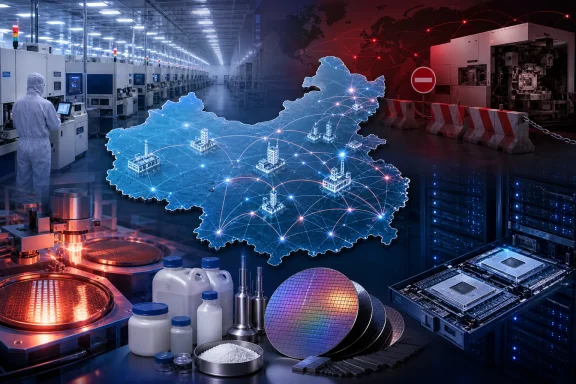
Li described a move from isolated technical wins to “full-chain industrial synergy,” saying domestic equipment and materials categories were broadening and seeing growing deployment. That wording matters. It is less a declaration that every component of a semiconductor supply chain is now Chinese than a claim that more locally made tools, chemicals, wafers, and services are being used together in production.
The NDRC’s own announcement confirms that Li addressed integrated circuits at the August 28 briefing. A separate account published by China’s Central Commission for Discipline Inspection repeated the core substance: domestic equipment and material offerings are increasing, their application scale is growing, and the industry is moving toward broader coordination across the chain.
Beijing also tied the effort to its 15th five-year-plan period, which runs from 2026 through 2030. Li said the country would use a whole-nation approach to seek breakthroughs in core technologies. That is a promise of continued coordination among state planners, local governments, research organizations, banks, equipment suppliers, foundries, and large chip customers.
What is missing is as important as what was said. The NDRC did not identify domestic market-share figures for chipmaking equipment or materials, name the process generations at which local supply is sufficient, publish yield or reliability data, or specify which imported technologies can now be replaced. It also offered no timetable for replacing foreign electronic design automation software or advanced lithography systems.
Those omissions prevent the statement from being treated as proof of end-to-end technological independence.
Exports show industrial scale, not independence
The strongest public evidence behind Beijing’s confidence is the surge in chip trade and production. Chinese customs data reported by Cailian Press put integrated-circuit exports at $216 billion in the first seven months of 2026, up 99.5 percent year over year. China’s Ministry of Industry and Information Technology had already reported that domestic integrated-circuit production rose 23.1 percent in the first half, reaching 279.8 billion units.
Those are substantial numbers, and they reinforce the NDRC’s argument that China’s semiconductor industry is no longer defined solely by small pilot projects. More wafer capacity, packaging and testing, mature-node logic, power semiconductors, microcontrollers, memory-related production, and components feeding global electronics supply chains all make a country less vulnerable to a disruption in a single foreign supply channel.
Still, export value is a poor proxy for semiconductor sovereignty. A customs total does not reveal whether chips were designed in China, fabricated using Chinese-owned tools, packaged in China after overseas wafer production, or exported as part of a multinational supply chain. It also does not show the process node, performance class, profit margin, or strategic importance of the parts involved.
The sharp increase in dollar value also arrives during a period of unusually strong global demand for AI-related electronics and memory. China’s government said integrated-circuit export value rose 88.7 percent in yuan terms in the first half of 2026, while the Associated Press reported that booming demand for electronics and high-tech products lifted China’s broader export performance. High prices and a favorable product mix can raise export value faster than physical technological capability.
For Windows PC buyers and IT departments, this distinction is concrete. A secure supply of power-management chips, display controllers, connectivity silicon, storage components, industrial controllers, and mature-node processors can reduce disruption risk for ordinary PCs, peripherals, networking equipment, and embedded systems. It does not automatically mean China can independently supply the highest-performing accelerators used to train frontier AI models or every advanced component inside a premium server.
Export controls have changed the incentives
The NDRC statement arrives after years of progressively tighter U.S. controls on advanced chips and chipmaking technology. In August 2025, the U.S. Commerce Department ended a license-free pathway that had allowed certain foreign-owned chip factories in China to receive many U.S.-origin tools and technology. Commerce said the former participants could seek licenses to keep existing factories running, but that it did not intend to approve licenses for capacity expansions or technology upgrades.
That policy design is intended to constrain China’s ability to advance at the frontier rather than halt all chip production. It also creates a durable commercial incentive for Chinese customers to qualify domestic alternatives wherever they can, even when foreign equipment remains technically superior. A fab that cannot assume it will receive an upgrade, spare part, software update, or future-generation process tool has reason to diversify before a restriction becomes an operational outage.
The result is a split market. China can build more capability in categories where established manufacturing methods, local demand, policy support, and enough domestic supplier depth coincide. Mature-node manufacturing is economically important: it supplies cars, appliances, telecom equipment, industrial systems, PCs, and much of the everyday hardware that enterprises deploy at scale.
At the leading edge, the obstacles are different. The Associated Press reported in June that China remained barred from purchasing ASML’s extreme ultraviolet lithography systems and that Chinese AI developers still sought Nvidia hardware for high-end workloads. AP also noted that domestic production capacity for advanced chips falls short of Chinese demand.
That is the central limitation on the NDRC’s message. Supply-chain security is not the same thing as parity at the technological frontier. A country can reduce disruption risk for a wide range of chips while still depending on foreign technology for the most efficient advanced AI compute and the equipment used to make it.
Huawei’s gains do not settle the supply-chain question
China’s domestic AI-chip push has produced visible commercial consequences. The Associated Press reported that Huawei has gained ground in China’s AI-chip market as export controls limited Nvidia’s access and Beijing encouraged domestic alternatives. The report cited Bernstein estimates that put Nvidia and Huawei at roughly comparable shares of China’s AI-chip market in 2025, with Huawei expected to lead in 2026.
For software teams, this means compatibility work around Chinese AI hardware is becoming a business requirement inside China rather than a speculative future exercise. Model developers, cloud providers, and enterprise buyers may increasingly optimize for Huawei Ascend and other domestic accelerators, particularly where procurement policy or supply assurance outweighs a preference for Nvidia’s CUDA stack.
Yet hardware substitution carries a systems cost. Moving an AI service from Nvidia hardware is not a swap of one PCIe card for another. It can involve recompiling models, replacing kernels, validating numerical behavior, adapting monitoring tools, retraining operations staff, and accepting differences in frameworks, libraries, interconnects, driver maturity, and available capacity.
That makes the NDRC’s emphasis on “full-chain” coordination more credible as a strategic goal than as a finished achievement. The hard work is not limited to placing Chinese silicon in a server. It is making the toolchain, software support, production yields, packaging, memory supply, networking, cloud service, and developer ecosystem reliable enough that enterprises can operate without a foreign fallback.
The near-term consequence for IT buyers
The immediate consequence is a less binary hardware market. China is likely to become a more self-reliant supplier in mainstream and industrial semiconductor categories, while leading-edge AI hardware remains contested and constrained. Companies selling Windows PCs, servers, storage, networking hardware, or factory systems into China should expect procurement scrutiny to expand beyond the final device and into the origin of the processors, controllers, firmware, and supporting software stack.
Global IT buyers should avoid reading the export figures as evidence that supply risk has disappeared. The more realistic conclusion is that risk is being redistributed: China’s dependence on some foreign inputs is declining, while vendors and customers outside China face a larger, increasingly capable alternative supply base shaped by state policy and trade restrictions.
Beijing has set the next benchmark itself. By 2030, its five-year-plan push will need to show more than rising output and export receipts. It will need to demonstrate which critical tools, materials, design systems, and advanced chips can be supplied domestically at commercial yields—because that is where the claim of a safer semiconductor chain will be tested.