
As reported by The Decoder, Hausfather logged eight weeks of his own Claude Code use: 1,138 prompts from him triggered more than 14,000 model calls and processed 3.2 billion tokens. His resulting estimate is 170 kWh of data-center electricity, with a wide 70–330 kWh range. The token counts are directly observable in Claude Code’s local logs; the electricity figure is an estimate derived through multiple modeling approaches, not a meter reading from Anthropic’s servers.
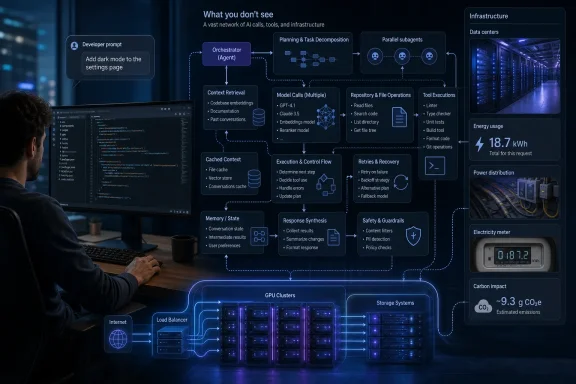
That distinction does not weaken the practical warning for IT departments. It narrows it: organizations should stop treating AI consumption as a per-seat, per-prompt, or even per-conversation problem. The expensive work is increasingly hidden inside agent loops—reading repository files, preserving conversation history, reasoning through plans, running tools, retrying failed actions, and handing work to parallel subagents.
 The 600-times comparison is mathematically sound, but it is not a like-for-like benchmark
Google’s figure is real, and more carefully qualified than much of the reaction to it suggests. Google’s 2025 technical paper put the median Gemini Apps text prompt at 0.24 Wh, including accelerator power, host CPU and memory, provisioned idle capacity, and data-center overhead. That was not simply a chip-power estimate dressed up as full-service energy use.
Hausfather’s reported 150 Wh estimate per typed Claude Code prompt divided by Google’s 0.24 Wh benchmark equals 625. OpenAI CEO Sam Altman’s separate estimate of 0.34 Wh for an average ChatGPT query would produce a smaller, but still substantial, ratio of roughly 440-to-one.
Neither comparison proves that a Claude Code request intrinsically requires hundreds of times the power of Gemini or ChatGPT. Google measured the median of its consumer-facing text-prompt distribution in May 2025. Hausfather measured an unusually intensive personal workflow using a coding agent across weeks of substantive scientific work. A median consumer query is supposed to be small; a coding agent assigned to inspect files, write code, execute commands, revise its own work, and continue through a large repository is supposed to be large.
The discrepancy exposes a communications problem more than it settles a model-efficiency ranking. Vendors can truthfully publish a low median prompt number while enterprise users deploy agents whose real work arrives as a torrent of model calls that customers never see. Both statements can be accurate, and neither answers the question a CIO, sustainability officer, or infrastructure team actually needs answered: how much electricity did this completed task consume?
Claude Code’s own documentation explains why the token total explodes
Anthropic’s current Claude Code documentation lays out the mechanism plainly. Every turn can include the conversation so far, project instructions, files already read, tool definitions, and the user’s new request. The product’s guidance tells users to clear unrelated sessions because prior messages are resent with later turns, and warns that pasted files and oversized project instructions remain in context.
That architecture is useful. A coding agent that cannot retain the repository’s conventions, the test failures it saw earlier, and the plan it already wrote is not much of an agent. But retaining that context means the user’s short instruction—“fix the failing authentication tests,” for example—is only the visible tip of the workload.
Anthropic also explains that the model emits separate tokens for thinking, tool calls, progress messages, and the final response. Each generated token can become part of the next turn’s input. Tool use adds another multiplier: the agent reads files, generates an edit, receives compiler output or test logs, then evaluates that new material before acting again.
Hausfather’s logs reportedly show that 96 percent of the 3.2 billion processed tokens were cache reads. That is a critical nuance. Prompt caching reduces provider cost and avoids recomputing some work from scratch, but it does not mean the data was free to serve or irrelevant to capacity planning. Anthropic itself says cached context still occupies context-window space, while its public guidance treats long sessions as the main driver of unexpectedly high usage.
The text a user sees is therefore a poor proxy for the computation consumed. Hausfather reportedly found that visible model output represented only 0.4 percent of the processed tokens. In agent workflows, the quiet machinery—context replay, hidden reasoning, tool coordination, and retries—can dominate the resource bill.
The number that enterprise IT should track is work completed
For Windows administrators and developers, the immediate lesson is operational rather than moral. An agent that performs a successful code review, closes a reproducible bug, produces a PowerShell migration, or untangles a difficult Windows Server configuration may be worth far more than the electricity it consumes. The problem begins when nobody can distinguish those high-value jobs from agents repeatedly searching the same codebase, regenerating failed edits, or carrying irrelevant context through a session all afternoon.
The same control methods that reduce API spend can reduce electricity demand:
- Start a fresh agent session when moving to an unrelated task instead of allowing old logs, failed experiments, and abandoned plans to remain in the context.
- Use smaller or faster models for mechanical work such as renames, formatting, simple documentation changes, and narrow script edits.
- Reserve high-reasoning models and parallel subagents for problems where a stronger model’s added success rate prevents more expensive rework.
- Require agents to produce a plan before making broad repository changes, so a bad 400-line patch is not generated, tested, reverted, and regenerated.
- Log model, token categories, tool calls, retries, elapsed time, and task outcome—not just the number of employee prompts sent.
That final point is the gap in most current AI governance. Companies often know who has access to a coding assistant and what subscription tier they are on. They often do not know which workflows cause context growth, which agents spin up parallel workers, how frequently code-generation loops fail, or whether a smaller model would have produced the same usable result.
Per-prompt reporting hides all of that. A team can claim it has issued only a few thousand prompts while its agents have made tens of thousands of backend calls. Conversely, a large prompt count can be cheap if users are asking short, bounded questions of a compact model. Counting prompts is becoming as useful as counting mouse clicks in a cloud-cost audit.
The estimate has real limits—and vendors still hold the decisive data
Hausfather’s analysis is valuable precisely because it uses concrete logs rather than generic speculation. Still, the energy conversion cannot be independently verified to the same standard as the token count. Anthropic does not publicly disclose the energy per token of its frontier models, the exact hardware and utilization conditions serving a given request, or the regional electricity mix for a particular Claude Code session.
That missing data matters most for cache reads. A cached token is cheaper than new input in provider billing, but billing rates are not a direct electricity meter. The hardware behavior of long-context inference, memory transfers, batching, utilization, and cache handling is complicated enough that outside estimates must use assumptions.
The reported 70–330 kWh uncertainty range for the eight-week period should be carried alongside the 170 kWh central estimate. It is broad by design, spanning nearly a fivefold difference between the low and high endpoints. It does not support a precise universal rule such as “every agent prompt costs 150 Wh.” It does support the narrower conclusion that sustained agentic coding can land orders of magnitude above the simple-chat figures vendors commonly use in public discussion.
Independent research is heading in the same direction for long and reasoning-heavy workloads. A 2025 infrastructure-aware benchmark of commercial LLM inference estimated that some long prompts to reasoning models consumed more than 33 Wh each, while short GPT-4o prompts came in below 0.5 Wh. The exact values are model- and method-dependent, but the spread confirms the central point: workload shape changes energy use dramatically.
The carbon problem is more about electricity supply than individual restraint
Hausfather’s annualized estimate—about 1.1 MWh of data-center electricity for his level of Claude Code use—is substantial for one heavy user but remains a small part of a typical U.S. household’s total annual electricity demand. The larger climate consequence appears when thousands of employees or millions of users run similar workloads, especially if the serving capacity depends on fossil-fuel generation.
The actionable response is not to ban developers from using capable agents or to shame employees for asking a model to debug a difficult issue. It is to demand better reporting and to make efficiency a procurement requirement. A vendor claim about “energy per query” should be accompanied by model-specific ranges, workload categories, token counts, cache behavior, data-center overhead, regional electricity assumptions, and whether training is excluded.
Google’s disclosure was a meaningful step because it included more than active accelerator power. Anthropic, OpenAI, Microsoft, and other AI suppliers need to go further for agent products: report energy per completed task or per million input, output, and cached tokens, with separate figures for reasoning, tool-using, and multimodal workloads.
Until that happens, organizations deploying coding agents should assume that the visible chat box is not the workload boundary. The agent’s real electricity use is determined by the calls, context, tools, retries, and subagents that the interface conceals—and those are the controls IT teams can already measure.
References
- Primary source: the-decoder.com
Published: August 8, 2026 at 9:44 AM UTC
AI agents use roughly 600 times more energy than a simple chat prompt
Climate scientist Zeke Hausfather tracked his Claude Code usage over eight weeks: 3.2 billion tokens and about 170 kWh of data center electricity. Per prompt, that's roughly 600 times more than a typical AI chat. His data shows how much the low figures reported by Google and OpenAI distort the...the-decoder.com - Related coverage: spectrum.ieee.org
How Much Energy Does It Take to Power Billions of AI Queries?
All generative AI queries could hit 329 billion per day by 2030. See the big picture on AI's energy use, and how it's reshaping our world.spectrum.ieee.org - Related coverage: wired.com
How Much Energy Does AI Use? The People Who Know Aren’t Saying | WIRED
A growing body of research attempts to put a number on energy use and AI—even as the companies behind the most popular models keep their carbon emissions a secret.www.wired.com - Related coverage: techradar.com
Sam Altman thinks ChatGPT’s energy usage is nothing to worry about, but is he right? | TechRadar
How much water is billions of teaspoons?www.techradar.com - Related coverage: tomsguide.com
Google Breaks Down the Environmental Cost of an AI Prompt — Is It Really That Tiny? | Tom's Guide
Google says one Gemini AI prompt uses just drops of water and seconds of power, but experts warn the true environmental impact is far bigger.www.tomsguide.com - Related coverage: lemonde.fr
Artificial intelligence consumes massive amounts of energy. Here's why
From developing models to their everyday use, generative AI has proven to be extremely energy-hungry. Le Monde breaks down the reasons behind this voracious demand, as their user base continues to expand.www.lemonde.fr - Related coverage: aiwiki.ai