
XDA’s case for Claude Code is straightforward: fewer model choices can keep developers focused on the repository instead of turning every prompt into a small procurement exercise. That conclusion holds up for the ordinary Claude Code setup, where Anthropic’s own models dominate the
XDA’s August 5 article correctly identifies the friction in tools such as Cursor and Google Antigravity. Cursor exposes models from Anthropic, OpenAI, Google, xAI, DeepSeek, and Cursor itself, while Google’s Antigravity offers Gemini alongside Claude and GPT-OSS options on eligible plans. Both products frame the breadth as flexibility. The cost is that users must determine, at least implicitly, whether today’s task calls for lower latency, a larger context window, a cheaper model, a deeper reasoning mode, or a particular provider’s strengths.
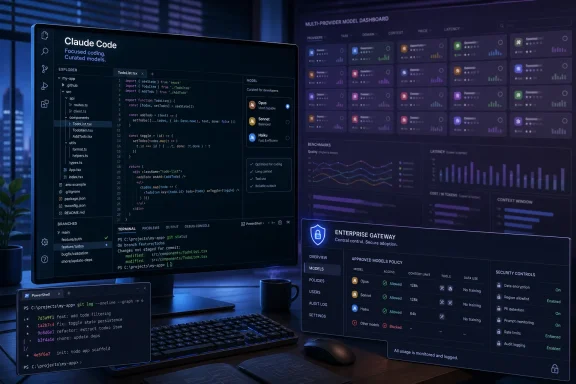
Claude Code presents a narrower decision because Anthropic owns both the harness and the core models. That is an advantage for people who want to settle on a single working method. It is less an argument that three choices are technically sufficient for every codebase than an argument that a default is valuable when the alternatives are difficult to compare under deadline.
Anthropic’s own Claude Code documentation says users can switch models through the
That is already a more nuanced picture than “Claude Code gives me very few models.” The tool does have a model picker; it simply limits the mainstream experience to one vendor’s catalog. The benefit is that the tiers have a stable purpose. A developer can treat Sonnet as the daily driver, reserve a higher-end model for a stubborn refactor or design problem, and use the faster option for lightweight transformations without first comparing five competing labs’ release notes.
Cursor has responded to precisely this problem with its own Auto option, which selects a premium model based on reliability and demand. Its documentation also publishes guidance intended to distinguish more autonomous, planning-heavy models from more directed and predictable ones. In other words, the multi-provider tools recognize that an unconstrained dropdown creates decision overhead; they are trying to automate around it rather than remove it.
The difference is philosophical. Cursor’s approach assumes model competition is useful and that users should retain a route to the best available option. Claude Code assumes that consistent behavior from a smaller set of models has a value of its own. Neither is inherently right, but they favor different types of teams.
A Windows administrator supporting an internal development group should read this as a governance question, not merely a user-interface preference. The more providers a coding tool can call, the more separate commercial terms, data-handling terms, API keys, audit trails, regional processing commitments, and billing paths the organization may need to understand. A restricted model list can reduce that administrative surface area.
Those results are evidence that Anthropic’s leading models are competitive in agentic coding. They are not a universal answer to the picker problem.
CursorBench is maintained by Cursor, which sells a multi-model coding product and controls the task design, harness behavior, scoring setup, and published leaderboard. Cursor itself warns that small differences in benchmark scores may not be statistically meaningful. More importantly, an agent benchmark measures a bundle: the model, tool permissions, context management, retry policy, prompt design, and execution environment. A high score does not guarantee that the same model is the best choice for a company’s C#, PowerShell, WinUI, Windows driver, or legacy .NET work.
The omission matters because coding agents increasingly operate beyond autocomplete. Claude Code can inspect files, modify source, run commands, and iterate against tests. On a Windows workstation or a developer VM, the question is not solely which model creates the strongest patch. It is which model and harness are permitted to see the repository, access developer credentials, read configuration files, or execute commands in the assigned environment.
A smaller choice set reduces selection risk. It does not remove the need for repository-level permissions, least-privilege test environments, branch protection, code review, and secret scanning. A developer who accepts Claude Code’s defaults without those controls has traded a confusing dropdown for a more predictable route to the same operational exposure.
More significantly, Anthropic says Fable 5 has safety safeguards that can route some cybersecurity and biology-related requests to Claude Opus 4.8 instead. Anthropic says these safeguards were tuned conservatively and can catch harmless requests. Its subsequent safeguards update confirmed that classifiers and related controls may change over time.
For normal application development, that may never surface. For security teams, incident responders, vulnerability researchers, and Windows administrators working through PowerShell automation, authentication flaws, endpoint telemetry, or exploit-reproduction questions, it means the model chosen at the start of a session may not be the model that answers every prompt.
That is not a flaw hidden by Anthropic; the company documents the fallback. But it undercuts the simplistic advice to choose the most capable tier whenever work becomes hard. The operational reality is more conditional: higher capability, higher cost, possible safety routing, and potentially different behavior on the exact categories where infrastructure teams may need careful technical assistance.
XDA also describes Mythos as a tier above Fable. Anthropic’s public materials make a sharper distinction. Fable 5 is generally available, while Mythos 5 is reserved for vetted partners in cybersecurity and biology research. For most Claude Code users, Mythos is not another option in the menu at all. It should not be counted as part of the practical consumer or typical enterprise model hierarchy.
In other words, a company running a managed gateway can make Claude Code look less like a closed Anthropic appliance and more like another front end to a centrally approved model catalog. The vendor’s narrow default is therefore a product decision for ordinary accounts, not an immutable technical boundary.
This is useful for organizations that need a single developer interface while retaining control over provider routing. A central platform team can expose approved models, control where requests go, and avoid asking every developer to install and configure separate tools. It also means Claude Code is capable of inheriting the same model-governance complexity that XDA finds exhausting in Cursor and Antigravity.
Anthropic lets administrators restrict selectable models with an
The narrow picker, then, is best understood as a default workflow, not a security boundary.
That familiarity is difficult to build when every tool prompt begins with a changing lineup of names, effort levels, context limits, and prices. Claude Code’s product design makes consistency the default, and for many developers that consistency is worth more than the theoretical ability to call every frontier model from one dropdown.
For Windows and enterprise IT teams, the next action is less glamorous: document which Claude Code models are approved, set gateway and model policies deliberately, test safety-routing behavior against legitimate security workflows, and measure agent cost on representative repositories. The model picker should be the smallest part of that decision.
/model picker. But the practical story is more complicated than XDA’s “small, curated shortlist” suggests: Anthropic has built escape hatches for enterprises, and its newest top model does not always remain the model that processes the request.
The useful part of Claude Code’s restraint is not that Anthropic has solved model selection. It is that it has moved the decision earlier in the workflow. An individual developer selects a subscription tier and an Anthropic model family, then spends most of the working session inside one coding harness rather than repeatedly choosing between every provider’s newest release. For developers who have already concluded that Claude is their preferred coding model, that can be a genuine productivity feature.XDA’s August 5 article correctly identifies the friction in tools such as Cursor and Google Antigravity. Cursor exposes models from Anthropic, OpenAI, Google, xAI, DeepSeek, and Cursor itself, while Google’s Antigravity offers Gemini alongside Claude and GPT-OSS options on eligible plans. Both products frame the breadth as flexibility. The cost is that users must determine, at least implicitly, whether today’s task calls for lower latency, a larger context window, a cheaper model, a deeper reasoning mode, or a particular provider’s strengths.
Claude Code presents a narrower decision because Anthropic owns both the harness and the core models. That is an advantage for people who want to settle on a single working method. It is less an argument that three choices are technically sufficient for every codebase than an argument that a default is valuable when the alternatives are difficult to compare under deadline.
 Claude Code’s simplicity is real, but it is not absolute
Anthropic’s own Claude Code documentation says users can switch models through the /model command, choose a model for a single session with the --model flag, or set a preferred model with an environment variable. For a standard user, that means the familiar Claude tiers — speed-oriented Haiku, general-purpose Sonnet, and more capable Opus or Fable offerings, subject to account access — are the meaningful choices.That is already a more nuanced picture than “Claude Code gives me very few models.” The tool does have a model picker; it simply limits the mainstream experience to one vendor’s catalog. The benefit is that the tiers have a stable purpose. A developer can treat Sonnet as the daily driver, reserve a higher-end model for a stubborn refactor or design problem, and use the faster option for lightweight transformations without first comparing five competing labs’ release notes.
Cursor has responded to precisely this problem with its own Auto option, which selects a premium model based on reliability and demand. Its documentation also publishes guidance intended to distinguish more autonomous, planning-heavy models from more directed and predictable ones. In other words, the multi-provider tools recognize that an unconstrained dropdown creates decision overhead; they are trying to automate around it rather than remove it.
The difference is philosophical. Cursor’s approach assumes model competition is useful and that users should retain a route to the best available option. Claude Code assumes that consistent behavior from a smaller set of models has a value of its own. Neither is inherently right, but they favor different types of teams.
A Windows administrator supporting an internal development group should read this as a governance question, not merely a user-interface preference. The more providers a coding tool can call, the more separate commercial terms, data-handling terms, API keys, audit trails, regional processing commitments, and billing paths the organization may need to understand. A restricted model list can reduce that administrative surface area.
The “best models” claim needs a closer read
XDA supports its preference by pointing to CursorBench, Cursor’s benchmark of longer, multi-file software tasks based on real Cursor sessions. The current public leaderboard does place Anthropic’s Claude Fable 5 near the top, with Claude Opus models also appearing prominently. Anthropic has separately promoted Fable 5 as its strongest generally available model for difficult coding and long-running agent work.Those results are evidence that Anthropic’s leading models are competitive in agentic coding. They are not a universal answer to the picker problem.
CursorBench is maintained by Cursor, which sells a multi-model coding product and controls the task design, harness behavior, scoring setup, and published leaderboard. Cursor itself warns that small differences in benchmark scores may not be statistically meaningful. More importantly, an agent benchmark measures a bundle: the model, tool permissions, context management, retry policy, prompt design, and execution environment. A high score does not guarantee that the same model is the best choice for a company’s C#, PowerShell, WinUI, Windows driver, or legacy .NET work.
The omission matters because coding agents increasingly operate beyond autocomplete. Claude Code can inspect files, modify source, run commands, and iterate against tests. On a Windows workstation or a developer VM, the question is not solely which model creates the strongest patch. It is which model and harness are permitted to see the repository, access developer credentials, read configuration files, or execute commands in the assigned environment.
A smaller choice set reduces selection risk. It does not remove the need for repository-level permissions, least-privilege test environments, branch protection, code review, and secret scanning. A developer who accepts Claude Code’s defaults without those controls has traded a confusing dropdown for a more predictable route to the same operational exposure.
Fable 5 makes “pick the top tier” less simple than it sounds
Anthropic’s public framing of Fable 5 also exposes the limit of treating model names as a clean quality ladder. The company says Fable 5 is intended for ambitious coding and knowledge-work tasks, and lists API pricing of $10 per million input tokens and $50 per million output tokens. That makes it an expensive default for an unattended agent that reads a large repository, repeatedly runs tests, and revises its own changes.More significantly, Anthropic says Fable 5 has safety safeguards that can route some cybersecurity and biology-related requests to Claude Opus 4.8 instead. Anthropic says these safeguards were tuned conservatively and can catch harmless requests. Its subsequent safeguards update confirmed that classifiers and related controls may change over time.
For normal application development, that may never surface. For security teams, incident responders, vulnerability researchers, and Windows administrators working through PowerShell automation, authentication flaws, endpoint telemetry, or exploit-reproduction questions, it means the model chosen at the start of a session may not be the model that answers every prompt.
That is not a flaw hidden by Anthropic; the company documents the fallback. But it undercuts the simplistic advice to choose the most capable tier whenever work becomes hard. The operational reality is more conditional: higher capability, higher cost, possible safety routing, and potentially different behavior on the exact categories where infrastructure teams may need careful technical assistance.
XDA also describes Mythos as a tier above Fable. Anthropic’s public materials make a sharper distinction. Fable 5 is generally available, while Mythos 5 is reserved for vetted partners in cybersecurity and biology research. For most Claude Code users, Mythos is not another option in the menu at all. It should not be counted as part of the practical consumer or typical enterprise model hierarchy.
Enterprises can reintroduce the very choice Claude Code avoids
The most consequential detail left out of the “few models” argument is in Anthropic’s enterprise configuration documentation. Claude Code can discover models from an organization’s LLM gateway through a/v1/models endpoint when gateway model discovery is enabled. Administrators can also configure a custom list of available models.In other words, a company running a managed gateway can make Claude Code look less like a closed Anthropic appliance and more like another front end to a centrally approved model catalog. The vendor’s narrow default is therefore a product decision for ordinary accounts, not an immutable technical boundary.
This is useful for organizations that need a single developer interface while retaining control over provider routing. A central platform team can expose approved models, control where requests go, and avoid asking every developer to install and configure separate tools. It also means Claude Code is capable of inheriting the same model-governance complexity that XDA finds exhausting in Cursor and Antigravity.
Anthropic lets administrators restrict selectable models with an
availableModels policy, preventing users from switching to models outside the list through /model, command-line flags, or environment variables. There is an important caveat: Anthropic says the picker’s Default option remains available and resolves to the user’s subscription-tier default. Teams relying on restrictions should test that behavior in their actual authentication and gateway configuration rather than assuming a policy file alone creates a hard block.The narrow picker, then, is best understood as a default workflow, not a security boundary.
The real value is a stable operating model
The strongest version of XDA’s argument is not that developers only need Anthropic models, or that the current benchmark leader should determine every coding workflow. It is that a coding agent becomes more useful when the developer can develop habits around its behavior: how much initiative it takes, when it needs a plan, how it handles failed tests, what it costs to let it iterate, and when its output requires especially close review.That familiarity is difficult to build when every tool prompt begins with a changing lineup of names, effort levels, context limits, and prices. Claude Code’s product design makes consistency the default, and for many developers that consistency is worth more than the theoretical ability to call every frontier model from one dropdown.
For Windows and enterprise IT teams, the next action is less glamorous: document which Claude Code models are approved, set gateway and model policies deliberately, test safety-routing behavior against legitimate security workflows, and measure agent cost on representative repositories. The model picker should be the smallest part of that decision.
References
- Primary source: XDA
Published: 2026-08-05T22:00:10+00:00
Loading…
www.xda-developers.com - Related coverage: support.anthropic.com
Claude Code model configuration | Claude Help Center
support.anthropic.com
- Related coverage: code.claude.com
Loading…
code.claude.com - Related coverage: support.claude.com
Loading…
support.claude.com - Related coverage: ayyaztech.com
Loading…
ayyaztech.com - Related coverage: antigravity.google
Loading…
antigravity.google - Related coverage: support.claude.com
Claude Code user FAQ | Claude Help Center
- Related coverage: www-cdn.anthropic.com
- Related coverage: static.poder360.com.br
- Related coverage: tomshardware.com
Anthropic restores Claude Fable 5 as US lifts export controls — single filter now blocks prompt that could identify software vulnerabilities and write code to exploit them | Tom's Hardware
Commerce withdrew the controls after testing confirmed weaker models could do the same thing.www.tomshardware.com - Related coverage: as.com
Tiembla Anthropic: una alternativa china iguala o supera los modelos de Claude, por mucho menos dinero - Meristation
Kimi K3 se acerca a Claude Fable 5, supera a Opus 4.8 en algunas pruebas y reduce el precio de la API hasta un 70%.as.com - Related coverage: time.com
Loading…
time.com - Related coverage: docs.cursor.com
Loading…
docs.cursor.com - Related coverage: anthropic.com
Claude Fable \ Anthropic
Next generation of intelligence for the hardest knowledge work and coding problems.www.anthropic.com - Related coverage: anthropic.com
Loading…
www.anthropic.com - Related coverage: docs.cursor.com
Loading…
docs.cursor.com - Related coverage: www-cdn.anthropic.com