
Geeky Gadgets reports that Boris Cherny, the creator of Anthropic’s Claude Code, has urged developers to periodically delete or rewrite bloated
Anthropic’s own Claude Code documentation makes the same core point in more measured terms:
Claude Code uses
That loading model is convenient at first. A developer corrects Claude once, adds a note to
The problem begins when the file turns into a running transcript of every past failure. A rule added to compensate for an old model weakness may remain after the tool changes. A temporary migration constraint may outlive the migration. A developer-specific preference can be mistakenly elevated into a repository-wide mandate. In a monorepo, broader instructions can collide with more-local ones that Claude reads later.
That is why pruning matters. An AI coding assistant does not distinguish between “important policy” and “something somebody wrote down after a frustrating Tuesday” unless the instructions themselves make that distinction clear. The more accumulated text it sees, the more chances there are for ambiguity, overlap and conflicting priorities.
For Windows developers, this can become particularly visible when a single repository spans PowerShell scripts, Batch files, .NET projects, Node.js tooling, WSL workflows and GitHub Actions. A broad instruction such as “always use Bash” may be harmless in a Linux-only project but destructive in a Windows-native automation repository. A concise, path-scoped rule is more useful than a global directive that forces every task through the wrong shell or toolchain.
That is materially different from discarding the repository’s operating knowledge. Teams should not erase security boundaries, build requirements, deployment constraints or compliance rules simply because an AI model may handle a smaller prompt more gracefully. Those requirements belong in enforceable systems wherever possible: source control protections, CI checks, linting, test suites, package-lock policies, branch controls, hooks and access permissions.
A useful dividing line is whether an instruction describes a preference, a discoverable fact, or a control that must be enforced.
That distinction is central to responsible use. A short instruction file is not inherently safer; it is safer only when the deleted text was duplicative, stale or non-enforceable guidance that distracted from the controls that actually matter.
A Windows enterprise repository might use a small top-level file for universal rules—such as required test commands, secrets handling and build entry points—while storing separate instructions for PowerShell modules, C# services, Terraform definitions and installer projects. This reduces the amount of irrelevant context loaded for a narrow task and makes ownership clearer.
Anthropic also now distinguishes between human-maintained
That creates another reason to revisit agent context regularly. A team that never audits either file type may eventually find that Claude is responding to assumptions no one would defend in a code review. The agent can appear inconsistent when the real inconsistency is distributed across project files, user-level configuration and machine-local memory.
Cherny’s emphasis on rewriting rather than endlessly appending therefore reflects a broader configuration-management lesson. AI agent instructions need versioning, ownership and review just like scripts and build definitions. If no one can explain why a rule is present, it is probably time to remove it and see whether tests, code structure and normal task framing already provide enough guidance.
Those are meaningful mitigations, not guarantees. Anthropic itself advises users to review proposed code and commands, use project-specific permissions for sensitive repositories, consider isolated development environments, and audit settings. That is consistent with recent academic research on agentic coding systems, which continues to identify prompt-injection and tool-poisoning risks across coding assistants and MCP-connected workflows.
The risk is especially relevant when Claude Code can inspect untrusted issues, pull requests, dependencies, documentation, logs or web content. An attacker does not need to compromise
For sensitive Windows environments, the practical controls remain familiar: use least privilege, restrict credentials available to development shells, separate production access from local agent sessions, approve network-capable commands deliberately, and keep CI as the final authority on builds and tests. Running an agent in a dev container, sandbox or tightly constrained worktree is more valuable than simply trusting a cleaner prompt.
If Claude Code loses essential project knowledge, restore that information in the smallest, clearest form possible. If a rule exists only because the agent repeatedly violates a real requirement, determine whether the requirement can be moved into a test, linter, hook or CI policy. If it cannot, preserve it—but place it close to the code it governs and write it as an unambiguous instruction.
The result should be a
CLAUDE.md files rather than treating them as permanent policy manuals. The practical takeaway is not that project instructions are obsolete; it is that stale context is a reliability problem for AI coding agents, especially when a repository has accumulated months of rules, exceptions, and workaround-driven guidance.
That advice lands as Claude Code becomes more deeply embedded in everyday development workflows, including Windows-based repositories where teams may run the command-line agent locally, in Windows Terminal, through WSL, or in CI-backed environments. A CLAUDE.md file can be useful documentation, but it is also input that Claude Code loads into a session. If that input is redundant, contradictory, excessively broad, or simply no longer true, it can make the agent less predictable rather than more informed.Anthropic’s own Claude Code documentation makes the same core point in more measured terms:
CLAUDE.md works best when it is specific, concise and structured. The company recommends targeting fewer than 200 lines per file, warning that longer instruction files consume context and can reduce adherence. In other words, Cherny’s apparent “delete it” advice is best understood as an argument for resetting a configuration that has stopped earning its place—not as a recommendation to run production codebases without documented conventions.
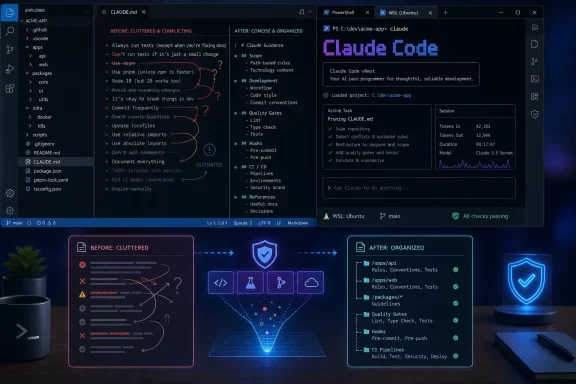 The Configuration File That Became a Second Codebase
Claude Code uses CLAUDE.md files as persistent project context. They can contain build commands, test instructions, architectural conventions, repository layout notes, coding standards, and rules such as which package manager to use. The agent discovers files along the working directory tree, concatenating applicable instructions rather than treating one file as a clean override for another.That loading model is convenient at first. A developer corrects Claude once, adds a note to
CLAUDE.md, and avoids having to repeat the same instruction in a future session. A team can also standardize common tasks: run this test command before changing authentication code, avoid editing generated files, or use a particular formatting tool.The problem begins when the file turns into a running transcript of every past failure. A rule added to compensate for an old model weakness may remain after the tool changes. A temporary migration constraint may outlive the migration. A developer-specific preference can be mistakenly elevated into a repository-wide mandate. In a monorepo, broader instructions can collide with more-local ones that Claude reads later.
That is why pruning matters. An AI coding assistant does not distinguish between “important policy” and “something somebody wrote down after a frustrating Tuesday” unless the instructions themselves make that distinction clear. The more accumulated text it sees, the more chances there are for ambiguity, overlap and conflicting priorities.
For Windows developers, this can become particularly visible when a single repository spans PowerShell scripts, Batch files, .NET projects, Node.js tooling, WSL workflows and GitHub Actions. A broad instruction such as “always use Bash” may be harmless in a Linux-only project but destructive in a Windows-native automation repository. A concise, path-scoped rule is more useful than a global directive that forces every task through the wrong shell or toolchain.
Delete the Debt, Not the Institutional Knowledge
The striking language attributed to Cherny risks being taken too literally. Deleting a neglectedCLAUDE.md can be a useful ablation exercise: remove accumulated context, run representative tasks, observe what the agent now gets wrong, then add back only the rules that demonstrably improve results.That is materially different from discarding the repository’s operating knowledge. Teams should not erase security boundaries, build requirements, deployment constraints or compliance rules simply because an AI model may handle a smaller prompt more gracefully. Those requirements belong in enforceable systems wherever possible: source control protections, CI checks, linting, test suites, package-lock policies, branch controls, hooks and access permissions.
A useful dividing line is whether an instruction describes a preference, a discoverable fact, or a control that must be enforced.
- A build command, an unusual local dependency and a project-specific test prerequisite are good candidates for concise persistent context.
- A formatting rule should normally be enforced by the formatter and checked in CI, rather than explained repeatedly to an agent.
- A requirement that must happen before release should be encoded in a pipeline or approval gate, not trusted to prose in a Markdown file.
- A temporary workaround should carry an owner or expiry condition so it does not quietly become permanent agent policy.
CLAUDE.md is context rather than enforced configuration. It is supplied after the system prompt, and Claude Code may not follow vague or contradictory guidance consistently. For actions that must occur at a particular lifecycle point, Anthropic recommends hooks. For controls requiring stronger certainty, organizations need technical enforcement outside the agent’s prompt.That distinction is central to responsible use. A short instruction file is not inherently safer; it is safer only when the deleted text was duplicative, stale or non-enforceable guidance that distracted from the controls that actually matter.
Precision Depends on Scope, Not Just Brevity
A compact root-levelCLAUDE.md is only one option. Claude Code also supports path-scoped rules, allowing instructions to load when work involves relevant files or directories. That is a better fit for large repositories with separate frontend, backend, infrastructure and documentation stacks.A Windows enterprise repository might use a small top-level file for universal rules—such as required test commands, secrets handling and build entry points—while storing separate instructions for PowerShell modules, C# services, Terraform definitions and installer projects. This reduces the amount of irrelevant context loaded for a narrow task and makes ownership clearer.
Anthropic also now distinguishes between human-maintained
CLAUDE.md instructions and auto memory, where Claude records learnings from corrections and preferences. Both consume session context, but they serve different roles. The former should contain stable facts and deliberate rules; the latter is better suited to operational details the agent has learned, such as a troublesome local test dependency or a debugging pattern.That creates another reason to revisit agent context regularly. A team that never audits either file type may eventually find that Claude is responding to assumptions no one would defend in a code review. The agent can appear inconsistent when the real inconsistency is distributed across project files, user-level configuration and machine-local memory.
Cherny’s emphasis on rewriting rather than endlessly appending therefore reflects a broader configuration-management lesson. AI agent instructions need versioning, ownership and review just like scripts and build definitions. If no one can explain why a rule is present, it is probably time to remove it and see whether tests, code structure and normal task framing already provide enough guidance.
Prompt Injection Does Not Disappear With a Smaller File
Geeky Gadgets also frames Cherny’s remarks around Claude Code’s defenses against prompt injection, but developers should resist any interpretation that an agent is immune to hostile instructions. Anthropic’s security documentation describes multiple protections, including permissions for sensitive operations, context-aware analysis, input sanitization, risky-command blocking, network-request approvals and isolated context for web fetching.Those are meaningful mitigations, not guarantees. Anthropic itself advises users to review proposed code and commands, use project-specific permissions for sensitive repositories, consider isolated development environments, and audit settings. That is consistent with recent academic research on agentic coding systems, which continues to identify prompt-injection and tool-poisoning risks across coding assistants and MCP-connected workflows.
The risk is especially relevant when Claude Code can inspect untrusted issues, pull requests, dependencies, documentation, logs or web content. An attacker does not need to compromise
CLAUDE.md directly if they can persuade an agent to treat text in an external file as an instruction. A leaner memory file can reduce accidental confusion, but it does not replace permission boundaries or human review.For sensitive Windows environments, the practical controls remain familiar: use least privilege, restrict credentials available to development shells, separate production access from local agent sessions, approve network-capable commands deliberately, and keep CI as the final authority on builds and tests. Running an agent in a dev container, sandbox or tightly constrained worktree is more valuable than simply trusting a cleaner prompt.
The Best Reset Is Measurable
The most useful version of the “deleteCLAUDE.md” experiment is not ideological. Make a copy, remove low-confidence instructions, and compare performance on a small set of representative tasks: a bug fix, a refactor, a test failure, a documentation update and a build-system change.If Claude Code loses essential project knowledge, restore that information in the smallest, clearest form possible. If a rule exists only because the agent repeatedly violates a real requirement, determine whether the requirement can be moved into a test, linter, hook or CI policy. If it cannot, preserve it—but place it close to the code it governs and write it as an unambiguous instruction.
The result should be a
CLAUDE.md that functions less like a scrapbook of AI mistakes and more like a reliable onboarding brief. For teams adopting Claude Code on Windows, that is the concrete consequence of Cherny’s advice: treat agent context as living configuration, not as an ever-growing prompt archive.
References
- Primary source: Geeky Gadgets
Published: 2026-08-01T08:00:00+00:00
Claude Code Tips: Why You Should Delete CLAUDE.md - Geeky Gadgets
Claude Code creator Boris Cherny advises developers to delete and rewrite system prompts. Testing with claude_code_simple=1 improves AI coding performance.www.geeky-gadgets.com - Related coverage: code.claude.com
Security - Claude Code Docs
Learn about Claude Code's security safeguards and best practices for safe usage.code.claude.com - Related coverage: code.claude.com
How Claude remembers your project - Claude Code Docs
Give Claude persistent instructions with CLAUDE.md files, and let Claude accumulate learnings automatically with auto memory.code.claude.com - Related coverage: support.claude.com
Give Claude context: CLAUDE.md and better prompts | Claude Help Center
support.claude.com
- Related coverage: support.claude.com
Claude Code power user tips | Claude Help Center
- Related coverage: docs.anthropic.com
Advanced setup - Claude Code Docs
System requirements, platform-specific installation, version management, and uninstallation for Claude Code.docs.anthropic.com - Related coverage: blog.dannyyounes.com
- Related coverage: zeronoise.ai
- Related coverage: pub-161ae4b5ed0644c4a43b5c6412287e03.r2.dev