
Claude is a stronger choice in 2026 for long-document work, serious writing, and repository-level coding than the typical “AI chatbot” label suggests—but the current buying decision turns on a detail that TechieXpert’s July review understates: the most capable model can silently hand a task down to Claude Opus 4.8, and access to it is no longer simply bundled into a subscription.
Anthropic’s current lineup is real: Claude Haiku 4.5, Sonnet 5, Opus 4.8, and Fable 5. But a prospective Pro, Max, Team, or Enterprise customer should not read those names as a straightforward ladder where every task reaches the model selected in the interface. Fable 5, released in June as a generally available version of Anthropic’s more restricted Mythos 5, has safety classifiers that can route certain cybersecurity, biology, chemistry, and model-distillation requests to Opus 4.8 instead.
That is the operational fact missing from a conventional pros-and-cons review. For a writer summarizing a contract or an administrator asking for PowerShell automation, it is unlikely to change the experience. For security teams, developers working on vulnerability research, or life-sciences organizations, it means Fable 5’s headline capability is conditional. The model name on the request is not always the model producing the answer.
TechieXpert is right to identify Claude’s writing, context handling, Projects, Artifacts, and Claude Code as the product’s practical strengths. Its pricing and availability picture, however, mixes several details that have changed since the model launches and omits the restrictions that matter most to professional users.
Anthropic launched Fable 5 on June 9 as its highest-capability broadly released model and positioned Mythos 5 as the closely related version for vetted Project Glasswing partners. Mythos 5 does not use Fable’s safety classifiers and is restricted to approved organizations working in areas such as cybersecurity and biology research.
Fable 5 has a one-million-token context window and up to 128,000 output tokens per API request. That does make it unusual for reviewing huge collections of code, policy documents, discovery material, or internal technical material. But “one million tokens” is capacity, not a guarantee of perfect retrieval or reasoning across an entire corpus. Users still need to specify the task, insist on quoted or file-grounded evidence where appropriate, and validate results against the source material.
The deeper catch is fallback behavior. Anthropic says Fable requests that trigger its classifiers can return a refusal or be retried against another model; in the Claude experience, high-risk subject areas can be handled by Opus 4.8 instead. The company says these safeguards trigger in less than 5% of sessions on average, but average usage tells an IT team very little if its work falls inside the affected domains.
For Windows administrators, that boundary is worth testing before committing a team workflow. A request to explain a Windows Event Log, write a basic Intune remediation script, or refactor an internal line-of-business app may proceed normally. A request involving exploit development, detailed vulnerability reproduction, weaponized remote-code-execution logic, or certain offensive research may not. The output can also differ materially from the Fable response the user expected, because it may come from Opus 4.8.
The June interruption showed why this cannot be treated as a minor product footnote. Anthropic suspended Fable 5 and Mythos 5 access on June 12 after a U.S. export-control directive required restrictions based on nationality. Anthropic restored access on July 1 after the controls were lifted on June 30. The Associated Press independently reported the episode and the policy dispute around the models’ cybersecurity capabilities. For organizations designing a workflow around Fable, the takeaway is plain: access to frontier models can be changed by safety policy and government action faster than an annual software procurement cycle.
Anthropic says Sonnet 5 is available across every Claude plan and in Claude Code. Its introductory API rate is $2 per million input tokens and $10 per million output tokens through August 31, 2026; after that date, Anthropic says the price moves to $3 input and $15 output tokens per million. Opus 4.8, by contrast, starts at $5 input and $25 output tokens per million. Fable 5 costs $10 input and $50 output tokens per million.
Those numbers make the review’s broad recommendation to start with Sonnet rather than Opus sound. They also make the Fable 5 pitch more selective than it first appears. A developer who uses Fable 5 indiscriminately is paying five times Sonnet 5’s temporary input rate and five times its temporary output rate. Even after Sonnet’s promotional pricing ends, Fable remains substantially more expensive.
Sonnet 5 is designed to use browsers, terminals, and other tools in agentic workflows, but that should not be confused with reliable unattended administration. A model that can plan, call tools, and iterate through a multi-step task is useful; it is also capable of making a plausible but wrong assumption repeatedly and quickly. In Windows environments, code review, least-privilege credentials, disposable test tenants, audit logs, and rollback plans remain non-negotiable.
Claude Code is especially relevant here. It works in the terminal and has extensions for Visual Studio Code and JetBrains IDEs, enabling it to read repository files, propose or make changes, execute commands, and inspect results. Anthropic’s own research on hundreds of thousands of Claude Code sessions found that human users still made most planning decisions while Claude made much of the execution work. That is a sensible division of labor: let the agent perform bounded implementation work, but keep humans accountable for architecture, scope, security decisions, and production release approval.
That distinction matters because the free plan is a legitimate evaluation environment for document analysis and current-information queries. It is not a reliable substitute for a paid daily-work plan. Long prompts, attached files, web fetching, artifact creation, and model choice all consume capacity. A user asking Claude to pull a full 10,000-word article into context can burn through a meaningful portion of the available allowance much faster than someone asking a short text question.
Projects are also more useful—and less like permanent memory—than the review suggests. They provide a dedicated workspace with instructions, uploaded material, and a knowledge base. As project content grows, Claude can switch to retrieval-augmented generation, searching relevant stored material rather than injecting every file into every prompt. That helps projects scale, but it also means a Project is a curated retrieval system, not a guarantee that the model has every sentence of every file actively in context.
Artifacts remain a practical differentiator. Claude can place substantial standalone output—documents, code, a single-page website, SVG graphics, diagrams, flowcharts, or interactive React components—in a separate working pane. Users can revise versions and share artifacts. For IT teams, that is useful for small internal tools, report templates, proof-of-concept dashboards, and documentation generators. It is not native image generation, and it does not remove the need to inspect generated code before publishing it.
Max begins at $100 per month, offering either five times or 20 times Pro usage, subject to usage limits. It is for people who regularly reach the Pro ceiling, not for someone who merely wants access to the best model once in a while. Fable 5 was temporarily included in a portion of usage limits immediately after its July restoration, but Anthropic says it subsequently became available through usage credits. That makes it misleading to regard Fable as an uncomplicated included feature of a Max subscription.
The Team plan costs $25 per person monthly on annual billing or $30 per person monthly, with a five-member minimum. It has central billing, administration, collaboration capabilities, Projects, knowledge bases, and more usage than Pro. Yet the current Team support page says Team does not include Claude Code, even though TechieXpert’s review broadly places Claude Code alongside Team access. That is a material distinction for a small software team: five Team seats can cost at least $125 per month on annual billing, but they do not automatically solve the developer-agent requirement.
Enterprise pricing remains custom, with features such as single sign-on, domain capture, enhanced context capacity, and organization controls. For regulated businesses, the subscription tier is only part of the assessment. The more consequential question is whether the model, connector configuration, data retention terms, and access controls meet the organization’s policies. Fable 5 and Mythos 5 have a 30-day retention requirement and are not offered under zero-data-retention arrangements, according to Anthropic’s developer documentation.
The review’s claim that Claude has fewer third-party integrations than ChatGPT is no longer enough to guide a 2026 buyer. Anthropic has put remote Model Context Protocol connections, Google Workspace connections, desktop extensions, and connectors at the center of its paid offering. Claude is still not a replacement for the broadest possible all-in-one consumer assistant, especially where native image generation or deeply embedded vendor-specific services matter. But integration is no longer a blank spot on the product map.
Claude Pro is worth $20 for people whose work benefits from better drafting, document analysis, and controlled coding assistance. The stronger conclusion is more conditional for Fable 5: buy or meter it for a specific high-value workload, test the safety and fallback behavior with representative tasks, and retain an audit trail of the output. In 2026, the question is no longer whether Claude can handle sophisticated work. It is whether the model that answers your most sensitive request is the one your workflow assumes it is.
That is the operational fact missing from a conventional pros-and-cons review. For a writer summarizing a contract or an administrator asking for PowerShell automation, it is unlikely to change the experience. For security teams, developers working on vulnerability research, or life-sciences organizations, it means Fable 5’s headline capability is conditional. The model name on the request is not always the model producing the answer.
TechieXpert is right to identify Claude’s writing, context handling, Projects, Artifacts, and Claude Code as the product’s practical strengths. Its pricing and availability picture, however, mixes several details that have changed since the model launches and omits the restrictions that matter most to professional users.
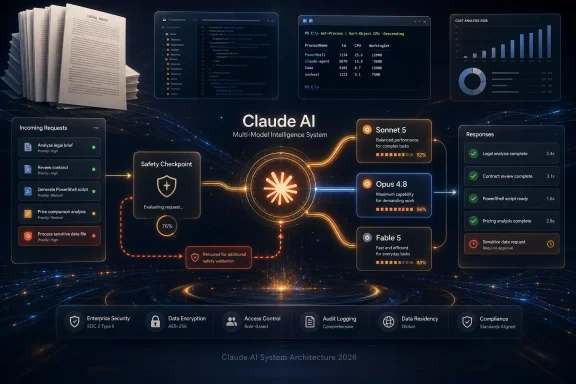 Fable 5 is powerful, but its safeguards are part of the product
Anthropic launched Fable 5 on June 9 as its highest-capability broadly released model and positioned Mythos 5 as the closely related version for vetted Project Glasswing partners. Mythos 5 does not use Fable’s safety classifiers and is restricted to approved organizations working in areas such as cybersecurity and biology research.Fable 5 has a one-million-token context window and up to 128,000 output tokens per API request. That does make it unusual for reviewing huge collections of code, policy documents, discovery material, or internal technical material. But “one million tokens” is capacity, not a guarantee of perfect retrieval or reasoning across an entire corpus. Users still need to specify the task, insist on quoted or file-grounded evidence where appropriate, and validate results against the source material.
The deeper catch is fallback behavior. Anthropic says Fable requests that trigger its classifiers can return a refusal or be retried against another model; in the Claude experience, high-risk subject areas can be handled by Opus 4.8 instead. The company says these safeguards trigger in less than 5% of sessions on average, but average usage tells an IT team very little if its work falls inside the affected domains.
For Windows administrators, that boundary is worth testing before committing a team workflow. A request to explain a Windows Event Log, write a basic Intune remediation script, or refactor an internal line-of-business app may proceed normally. A request involving exploit development, detailed vulnerability reproduction, weaponized remote-code-execution logic, or certain offensive research may not. The output can also differ materially from the Fable response the user expected, because it may come from Opus 4.8.
The June interruption showed why this cannot be treated as a minor product footnote. Anthropic suspended Fable 5 and Mythos 5 access on June 12 after a U.S. export-control directive required restrictions based on nationality. Anthropic restored access on July 1 after the controls were lifted on June 30. The Associated Press independently reported the episode and the policy dispute around the models’ cybersecurity capabilities. For organizations designing a workflow around Fable, the takeaway is plain: access to frontier models can be changed by safety policy and government action faster than an annual software procurement cycle.
Sonnet 5 is the model most users will actually encounter
TechieXpert correctly identifies Claude Sonnet 5 as the default for Free and Pro users. That is the important model for the majority of people evaluating Claude as an everyday assistant, and it is also the better price-performance starting point for developers.Anthropic says Sonnet 5 is available across every Claude plan and in Claude Code. Its introductory API rate is $2 per million input tokens and $10 per million output tokens through August 31, 2026; after that date, Anthropic says the price moves to $3 input and $15 output tokens per million. Opus 4.8, by contrast, starts at $5 input and $25 output tokens per million. Fable 5 costs $10 input and $50 output tokens per million.
Those numbers make the review’s broad recommendation to start with Sonnet rather than Opus sound. They also make the Fable 5 pitch more selective than it first appears. A developer who uses Fable 5 indiscriminately is paying five times Sonnet 5’s temporary input rate and five times its temporary output rate. Even after Sonnet’s promotional pricing ends, Fable remains substantially more expensive.
Sonnet 5 is designed to use browsers, terminals, and other tools in agentic workflows, but that should not be confused with reliable unattended administration. A model that can plan, call tools, and iterate through a multi-step task is useful; it is also capable of making a plausible but wrong assumption repeatedly and quickly. In Windows environments, code review, least-privilege credentials, disposable test tenants, audit logs, and rollback plans remain non-negotiable.
Claude Code is especially relevant here. It works in the terminal and has extensions for Visual Studio Code and JetBrains IDEs, enabling it to read repository files, propose or make changes, execute commands, and inspect results. Anthropic’s own research on hundreds of thousands of Claude Code sessions found that human users still made most planning decisions while Claude made much of the execution work. That is a sensible division of labor: let the agent perform bounded implementation work, but keep humans accountable for architecture, scope, security decisions, and production release approval.
The free plan is more capable than the review says
The TechieXpert review says Claude’s free tier lacks web search and frames Projects primarily as a paid feature. Anthropic’s current pricing page says otherwise: Free users can search the web and have access to unlimited Projects for organizing chats and documents. Anthropic’s support documentation further states that web search and web fetch count toward free-tier usage limits.That distinction matters because the free plan is a legitimate evaluation environment for document analysis and current-information queries. It is not a reliable substitute for a paid daily-work plan. Long prompts, attached files, web fetching, artifact creation, and model choice all consume capacity. A user asking Claude to pull a full 10,000-word article into context can burn through a meaningful portion of the available allowance much faster than someone asking a short text question.
Projects are also more useful—and less like permanent memory—than the review suggests. They provide a dedicated workspace with instructions, uploaded material, and a knowledge base. As project content grows, Claude can switch to retrieval-augmented generation, searching relevant stored material rather than injecting every file into every prompt. That helps projects scale, but it also means a Project is a curated retrieval system, not a guarantee that the model has every sentence of every file actively in context.
Artifacts remain a practical differentiator. Claude can place substantial standalone output—documents, code, a single-page website, SVG graphics, diagrams, flowcharts, or interactive React components—in a separate working pane. Users can revise versions and share artifacts. For IT teams, that is useful for small internal tools, report templates, proof-of-concept dashboards, and documentation generators. It is not native image generation, and it does not remove the need to inspect generated code before publishing it.
Pro is the sensible individual plan, while Team has a notable restriction
For an individual in the United States, Claude Pro is $20 month-to-month or $17 per month when paid annually, with $200 billed upfront. Anthropic describes Pro as including higher usage, its model selector, Projects and knowledge bases, Research, integrations through remote MCP servers, extended thinking, and Claude Code in the terminal.Max begins at $100 per month, offering either five times or 20 times Pro usage, subject to usage limits. It is for people who regularly reach the Pro ceiling, not for someone who merely wants access to the best model once in a while. Fable 5 was temporarily included in a portion of usage limits immediately after its July restoration, but Anthropic says it subsequently became available through usage credits. That makes it misleading to regard Fable as an uncomplicated included feature of a Max subscription.
The Team plan costs $25 per person monthly on annual billing or $30 per person monthly, with a five-member minimum. It has central billing, administration, collaboration capabilities, Projects, knowledge bases, and more usage than Pro. Yet the current Team support page says Team does not include Claude Code, even though TechieXpert’s review broadly places Claude Code alongside Team access. That is a material distinction for a small software team: five Team seats can cost at least $125 per month on annual billing, but they do not automatically solve the developer-agent requirement.
Enterprise pricing remains custom, with features such as single sign-on, domain capture, enhanced context capacity, and organization controls. For regulated businesses, the subscription tier is only part of the assessment. The more consequential question is whether the model, connector configuration, data retention terms, and access controls meet the organization’s policies. Fable 5 and Mythos 5 have a 30-day retention requirement and are not offered under zero-data-retention arrangements, according to Anthropic’s developer documentation.
Claude’s best use is bounded professional work
Claude’s strengths are concrete. Sonnet 5 is a capable general-purpose model; Opus 4.8 is available to paying users who need heavier reasoning and coding capability; Fable 5 pushes further for difficult long-horizon work. The products work across web, iOS, Android, desktop, terminal, APIs, and major cloud marketplaces. For an individual who writes, analyzes documents, builds software, or turns scattered information into usable drafts, Pro remains an easy recommendation.The review’s claim that Claude has fewer third-party integrations than ChatGPT is no longer enough to guide a 2026 buyer. Anthropic has put remote Model Context Protocol connections, Google Workspace connections, desktop extensions, and connectors at the center of its paid offering. Claude is still not a replacement for the broadest possible all-in-one consumer assistant, especially where native image generation or deeply embedded vendor-specific services matter. But integration is no longer a blank spot on the product map.
Claude Pro is worth $20 for people whose work benefits from better drafting, document analysis, and controlled coding assistance. The stronger conclusion is more conditional for Fable 5: buy or meter it for a specific high-value workload, test the safety and fallback behavior with representative tasks, and retain an audit trail of the output. In 2026, the question is no longer whether Claude can handle sophisticated work. It is whether the model that answers your most sensitive request is the one your workflow assumes it is.
References
- Primary source: techiexpert.com
Published: 2026-07-06T05:00:14+00:00
Loading…
techiexpert.com - Related coverage: platform.claude.com
Introducing Claude Fable 5 and Claude Mythos 5 - Claude Platform Docs
Claude Fable 5 and Claude Mythos 5 capabilities, API changes, and availability.platform.claude.com - Related coverage: anthropic.com
Loading…
www.anthropic.com - Related coverage: anthropic.com
Claude Mythos \ Anthropic
Our most capable model for cybersecurity and biology research.www.anthropic.com - Related coverage: platform.claude.com
Presentamos Claude Fable 5 y Claude Mythos 5 - Claude Platform Docs
Capacidades, cambios en la API y disponibilidad de Claude Fable 5 y Claude Mythos 5.platform.claude.com - Related coverage: llmreference.com
Loading…
www.llmreference.com - Related coverage: support.anthropic.com
Loading…
support.anthropic.com - Related coverage: thehackernews.com
Loading…
thehackernews.com - Related coverage: www-cdn.anthropic.com
- Related coverage: static.poder360.com.br
- Related coverage: tomshardware.com
Claude Fable 5 brings Mythos to the masses — Anthropic's new frontier model is 'state-of-the-art on nearly all tested benchmarks' | Tom's Hardware
Queries regarding cybersecurity, biology and chemistry, and distillation will be redirected to the prior-gen Opus 4.8, howeverwww.tomshardware.com - Related coverage: itpro.com
Anthropic just launched Claude Fable 5, its first Mythos-class AI model – but it has new safeguards to prevent misuse and will ‘fall back’ to Opus 4.8 for queries in ‘high risk’ topics | IT Pro
The launch of Claude Fable 5 marks the first public release of a Mythos-class AI modelwww.itpro.com - Related coverage: support.anthropic.com
Loading…
support.anthropic.com - Related coverage: www-cdn.anthropic.com