The change settles a short and confusing run for Fable 5, Anthropic’s public-facing version of its more restricted Mythos 5 model. Fable 5 returned on July 1 after a June suspension tied to U.S. export-control restrictions, initially included in several paid plans through July 7 before shifting to credit-based access. Anthropic subsequently extended that temporary window more than once as it secured capacity.
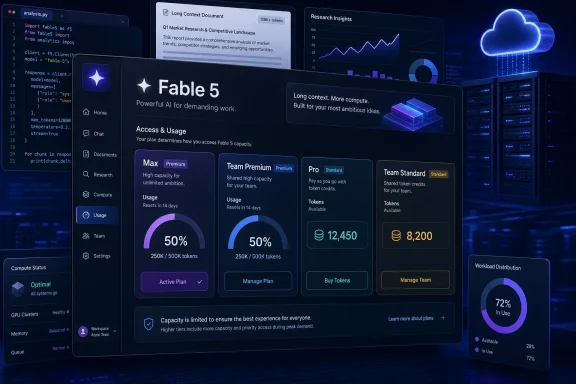 A split between premium and standard plans
Max and Team Premium subscribers will again have Fable 5 included in their recurring allowance, though only up to half of their weekly limits. Anthropic said it is standardizing that level rather than promising full-limit use of the model.
Pro and Team Standard subscribers keep access, but it becomes a usage-credit feature rather than an included-plan benefit. Anthropic is reportedly providing those users with a one-time $100 credit to ease the transition.
That matters for Claude Code users in particular. Fable 5 is positioned for difficult coding, long-context analysis, research, vision tasks, and agent-style work—precisely the workloads likely to chew through a weekly allotment or paid credits quickly. Users who treat the model as their default assistant will need to make its use more selective.
Capacity, not a new model rollout
Anthropic has described demand for Fable 5 as difficult to predict and said the staged rollout was intended to give the company room to add capacity. Startup Fortune characterized the move as a compute constraint rather than a routine subscription adjustment, although Anthropic has not published detailed infrastructure figures alongside the July 20 plan change.
The company’s own support documentation says usage credits let paid subscribers continue after included limits are reached, with consumption billed at standard rates. Team administrators can set organization-level credit spend limits, which is useful but also means a developer’s access can depend on a centrally managed budget.
For Windows users running Claude in the desktop app, browser, or Claude Code, the model itself is not disappearing. The practical difference is entitlement: higher-tier subscribers receive a bounded included allowance, while lower-tier paid users need credits available.
What admins and heavy users should do
Before July 20, organizations using Claude for development or research should:
- Confirm whether seats are Team Standard or Team Premium.
- Review whether usage credits are enabled and whether spend caps are appropriate.
- Reserve Fable 5 for complex coding, deep analysis, or large-context work, and route routine prompts to less expensive Claude models.
- Check automation and developer workflows for assumptions that Fable 5 is always available under a subscription limit.
Anthropic’s revised access rules take effect July 20, with no indication yet that the 50 percent included-use cap will increase soon.
Update: Report details Fable 5 credit costs and Claude Code limit change (July 19, 2026)
Technobezz reports that the July 20 transition also coincides with the expiration of a promotional 50 percent increase to Claude Code’s weekly rate limits. For Max and Team Premium users, that means the new included Fable 5 entitlement may represent a more noticeable effective reduction in capacity than the headline 50 percent cap alone suggests.
The report puts post-credit Fable 5 API pricing at $10 per million input tokens and $50 per million output tokens. It also says Anthropic has not specified when the one-time $100 credit for Pro and Team Standard users will be issued or how long it will remain valid.
For IT teams budgeting autonomous coding, migration, or document-analysis work, the output-token rate is the material figure: long agentic sessions can consume the credit rapidly. Administrators should therefore verify credit availability before July 20 and avoid treating the grant as a substitute for a recurring included allowance.
Update: Additional details (July 20, 2026)
SQ Magazine reports that Fable 5 supports a one-million-token context window and responses of up to 128,000 output tokens, reinforcing why long repository migrations and document-heavy agent work can become costly under metered access.
The report also says Anthropic requires 30-day data retention for Fable 5 safety monitoring. Its safety system may route flagged cybersecurity or biology prompts to Claude Opus 4.8 instead; Anthropic says those rerouted requests are not billed at Fable 5 rates.