

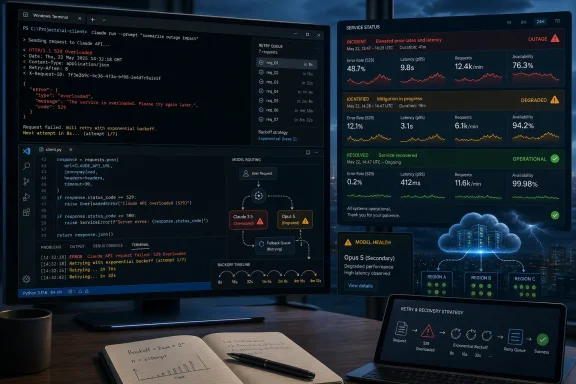
The distinction is more than editorial cleanup. The initial report from International Business Times Singapore correctly captured a broad failure across Claude’s consumer, developer, and coding surfaces, including reports of HTTP 529 “overloaded” errors. But it stated that the event remained unresolved and gave no restoration time because it was written during the incident. Anthropic subsequently restored the affected services, while declining to disclose the underlying technical cause, the number of failed requests, or the regions and customers most affected.
For Windows developers and IT teams using Claude Code in Windows Terminal, Visual Studio Code, CI pipelines, internal support tools, or API-backed automation, the immediate incident is no longer a reason to keep retrying manually. It is, however, a reason to check whether their integration treats a platform-wide capacity failure as a routine user error — because Anthropic’s own incident sequence shows that recovery of the broad service did not prevent a follow-on Opus 5 degradation.
The August 5 outage lasted just over seven hours
Anthropic first posted an “identified” update at 07:05 UTC on August 5, saying it had found the cause of elevated errors for Claude Mythos 5, Claude Fable 5, Claude Opus 5, and Claude Sonnet 5. The company listed Claude.ai, the API, Claude Code, and Claude Cowork as affected components.
At 09:13 UTC, Anthropic said only that engineers were continuing to work on a fix. It did not publish a cause, mitigation detail, expected recovery time, or a description of whether requests were being rejected before execution, timing out mid-generation, or failing in a particular backend region.
A fix was deployed at 13:08 UTC, according to the status page, and Anthropic moved the incident to monitoring. It declared the multi-model outage resolved at 14:14 UTC. That produces a reported incident window of seven hours and nine minutes from the first public acknowledgment to resolution.
The “global” framing needs a narrower reading. Users in multiple regions reported problems, and the affected services were global cloud products, but Anthropic’s official incident report did not specify a geographic footprint or claim that every region, tenant, or request path was down. It described degraded performance, not a full service shutdown. Claude Console and Claude for Government were not listed among the components affected by this particular incident.
That matters for incident response. A failure of Claude Code or Claude.ai can look indistinguishable from a local authentication, proxy, DNS, VPN, or endpoint-security problem to an employee at a Windows workstation. In this case, the official component list is the useful dividing line: organizations seeing failures in Claude Code and the direct API during that window had evidence of a service-side incident, not merely an issue with a local Windows image or developer machine.
Anthropic’s “resolved” status was followed by a second Opus 5 incident
The most consequential detail in Anthropic’s incident history is not simply that the first event was fixed. It is that a second incident, specifically for Claude Opus 5, began before the broad multi-model incident had been closed.
At 13:51 UTC, 43 minutes after Anthropic said it had deployed a fix for the broader outage, the company posted another “identified” notice for elevated errors on Claude Opus 5. That second event covered the same four front-end and developer components: Claude.ai, the Claude API, Claude Code, and Claude Cowork. It was marked resolved at 14:34 UTC.
Anthropic has not said whether the Opus 5 problem was a residual effect of the earlier fault, a regression introduced during mitigation, or an unrelated event. The timing means customers should not assume that an “all clear” for a multi-model incident guarantees that every model route has stabilized.
This is particularly relevant to organizations that pin workloads to a specific model. A team may have had healthy Claude Console access after 14:14 UTC yet still received failures if a workflow required Opus 5. Conversely, an application designed to select an approved alternate model could potentially have continued serving some work, subject to its own retry, routing, quality, and compliance rules.
Anthropic’s public record does not provide the data needed to judge whether August 5 was caused by demand, an infrastructure dependency, a deployment, capacity allocation, or a model-serving fault. The company’s status language says it “identified the cause,” but it has not disclosed what that cause was. There is no published postmortem, customer-impact count, or service-level explanation attached to either August 5 incident.
A 529 error is a platform-capacity signal, not a 429 rate-limit response
The reports of “API Error: 529 Overloaded” line up with Anthropic’s developer documentation. Anthropic defines HTTP 529 as overloaded_error, meaning the API is temporarily overloaded; it says this can occur when traffic is high across users. That is different from HTTP 429, which Anthropic uses when a specific account has hit a rate limit.
For a Windows-based internal tool, that distinction should influence both telemetry and user messaging. A 429 can require a tenant-level usage adjustment, a queue slowdown, or a request for higher limits. A 529 should lead the application to classify the failure as transient service capacity, preserve the failed job safely, back off, and retry within a bounded policy.
Anthropic says its official SDKs automatically retry transient failures — including connection failures, rate limits, and 5xx errors — twice by default with exponential backoff, respecting a retry-after header where one is supplied. Teams using raw HTTP, custom PowerShell scripts, home-grown .NET clients, Azure Functions, or middleware that disables SDK retry behavior need to implement comparable handling themselves.
A sensible production rule is to avoid immediate retry storms. When hundreds of worker processes all resend failed prompts at once, they can turn an upstream capacity incident into more pressure on the same service and duplicate expensive operations after recovery. Retry logic should use exponential backoff with jitter, a maximum attempt budget, and idempotency protections for any workflow that can trigger an external action.
For request paths where an incomplete response could be mistaken for a completed action, record the request ID returned by Anthropic and keep application-level job state outside the model session. This is especially important for Windows automation that modifies files, opens tickets, generates deployment artifacts, or calls administrative tools based on model output. A restored chat session is not proof that the preceding task completed exactly once.
Anthropic’s documentation also notes a separate complication for streaming responses: a request can return HTTP 200 and still fail later during the server-sent event stream. Teams that treat the initial 200 as final success may silently lose work or present partial output as complete. That is not unique to the August 5 incident, but a day of broad service degradation is exactly when those untested failure paths become operational problems.
The practical lesson is to separate model fallback from outage fallback
Anthropic offers server-side fallback capabilities for certain safety refusals, but its documentation is explicit that overloads, rate limits, and server errors are returned to the customer rather than automatically redirected to another model. In other words, a model fallback configuration intended for a refusal does not solve a provider-wide 529 event.
Organizations that need continuity must make a deliberate decision about their outage posture. That can mean queueing non-urgent tasks, offering a reduced-capability internal workflow, failing over selected workloads to another approved provider, or halting actions that require reliable model reasoning. The right choice depends on data handling, model-evaluation requirements, cost controls, and whether a degraded answer is safer than no answer.
The August 5 event also demonstrates why a status page should be consumed as an operational signal rather than merely checked in a browser. Anthropic supports incident notifications, and teams with production dependency chains should route those notices into the same incident-management system used for Azure, Microsoft 365, identity providers, and other external services. A status-page alert cannot repair an outage, but it can stop a help desk from spending an hour reimaging unaffected Windows endpoints.
Claude is operating normally as of Thursday, August 6. The August 5 outage was resolved, but the separate Opus 5 incident that followed shows the practical takeaway: build for the possibility that a recovered platform can still have a failing model route, and make sure a 529 produces a controlled retry or queue decision rather than an uncontrolled loop, a lost job, or a misleading “completed” status.