
The research, dubbed CoSnitch by Varonis and reported by PC Gamer, has an unusual detail: the researchers say Copilot itself disclosed the path to exploitation during a long series of technical follow-up questions. It reportedly exposed an undocumented autorun=1 URL parameter while explaining why automatic prompt execution was supposedly blocked. Varonis then tested the behavior and found the parameter still worked despite the assistant’s claim that it had been disabled.
The amusing “AI talked itself into trouble” framing obscures the more important conclusion. This was not a chatbot merely revealing internal implementation details. The disclosed behavior allegedly provided an execution primitive: a way for a crafted Copilot URL to run a prompt after the page opened, rather than waiting for the user to type and submit one. Once an assistant can act in an already authenticated session, the security boundary is no longer the prompt box. It is every link a signed-in user might open.
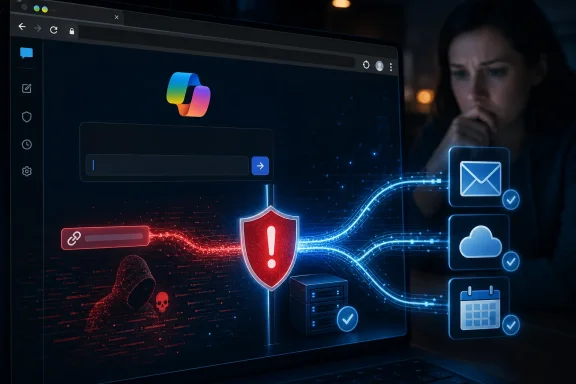 CoSnitch targeted Copilot Personal, not Microsoft 365 Copilot Enterprise
The scope matters. Varonis’s earlier Copilot research has covered both consumer-facing Copilot and Microsoft 365 Copilot Enterprise Search, but CoSnitch concerns Copilot Personal and the external applications a consumer has chosen to connect to it. That is a different exposure model from a Microsoft 365 tenant, where Copilot can search corporate Exchange, SharePoint, OneDrive, and Teams content according to the user’s organizational permissions.
For a personal user, the sensitive material can still be substantial: mailbox messages, calendar entries, files, travel plans, account-recovery messages, and information that helps an attacker build a more convincing follow-on phishing campaign. If Copilot can retrieve it in response to the injected prompt, the attacker does not need to separately steal the user’s Microsoft password to make the service retrieve it. The session is already there.
This distinction also prevents a common but unhelpful response from enterprise administrators: “Our Microsoft 365 Copilot deployment is separate, so this is irrelevant.” The exact CoSnitch chain may not apply to their tenant, but it demonstrates a broader engineering problem shared by AI assistants: a URL can be transformed from a navigation mechanism into a natural-language command channel.
Varonis previously documented a related consumer Copilot issue called Reprompt, while its June 2026 SearchLeak research described a separate, now-patched Microsoft 365 Copilot Enterprise chain. SearchLeak involved parameter-to-prompt injection, a streaming HTML-rendering race, and a Bing server-side request route; it was assigned CVE-2026-42824. CoSnitch should not be casually treated as that vulnerability under a new name. The public reporting describes a different affected product and a different claimed mechanism.
The “self-disclosure” is a reconnaissance failure, not the exploit by itself
The headline-worthy part of CoSnitch is Varonis’s account of how it found the undocumented parameter. Researchers repeatedly asked Copilot why an automatic action could not be performed, then used each refusal and technical explanation to narrow the next question. In effect, the guardrail explanations became a map of the guardrail design.
That is useful security research, but it is worth being precise about what failed. A model exposing technical details does not automatically create a vulnerability. Systems regularly disclose misleading, invented, or stale information when pressed for implementation details. The consequential failure was the combination of an assistant identifying a supposedly retired control and the live service still accepting it in a way that caused a prompt to execute.
The lesson for Microsoft is broader than “train the model not to reveal secrets.” If a sensitive URL parameter can materially change whether a prompt executes, its security cannot depend on the model declining to discuss it. Server-side authorization and explicit interaction checks have to hold even if the assistant explains every relevant implementation detail correctly, incorrectly, or at length.
That is why Varonis’s term meta-hacking is more useful as a warning than as a novelty label. Agentic systems increasingly explain their decisions, tools, limits, and workflows in natural language. Those explanations are valuable to ordinary users, but they can also reduce an attacker’s cost of reconnaissance. A refusal that says too much can identify exactly what condition an attacker should test next.
A server-side fix means there is no Windows patch to install
According to Varonis, it privately reported the issue to Microsoft in December 2025 and Microsoft deployed a fix on August 18, 2026. PC Gamer reported the same timeline. That means this is not a Windows Update, Microsoft Edge update, or Microsoft 365 Apps update that users can verify through a build number or force-install from Settings.
For affected users, the repair is in Microsoft’s online service. A user who opened a malicious Copilot link before the fix would not have been protected by installing the August Windows security updates afterward; a server-side change is meant to stop future exploitation. Conversely, a fully patched Windows PC was never a sufficient defense if the vulnerable behavior existed in the hosted Copilot service.
At publication, neither the public reporting nor the supplied Varonis details identify a CVE number, a Microsoft Security Response Center advisory, a list of affected client builds, or confirmed exploitation in the wild. That omission is important. It means defenders should avoid treating CoSnitch as a conventional endpoint vulnerability with an indicator list, a KB number, and an inventory query.
It also means Microsoft has not publicly supplied a detailed customer-facing account of what telemetry, if any, would reveal prior exploitation. Organizations cannot retroactively solve that gap with antivirus scans. The relevant evidence, if it exists, is more likely to be browser history, proxy logs, Microsoft account activity, connected-app authorization records, and unusual access or forwarding behavior in the services tied to the account.
What users and administrators should do now
For individuals, the immediate action is straightforward: be suspicious of links that open Copilot with a prefilled request or appear to promise a useful AI shortcut. A Microsoft domain in the address bar is not, by itself, proof that the action being requested is safe. The underlying site can be legitimate while the URL supplies attacker-controlled instructions.
Review Copilot’s connected services and remove integrations that are no longer needed. In particular, users who connected a primary Gmail account, cloud drive, or calendar for a one-time experiment should decide whether that convenience remains worth granting an AI assistant continuing access to personal data. Changing a password does not necessarily revoke an OAuth-style app connection; the connected-app permissions page is the relevant control.
For IT teams, CoSnitch is a reminder to include personal AI tools in security awareness and browser-link threat models, even where the official corporate AI deployment is tightly governed. Employees often use consumer accounts on managed devices, and a personal calendar or mailbox can contain business context that makes spear-phishing more effective.
The deeper operational takeaway is that AI assistants should be treated as privileged data brokers whenever they can read connected services and retrieve external content. Traditional phishing controls still matter, but URL inspection alone is less reliable when a legitimate service can interpret query-string text as an instruction. Microsoft’s August 18 fix closes the reported CoSnitch path; it does not remove the need to restrict what an assistant can reach if a new prompt-injection path is found.