
For Windows users, the immediate effect is modest: Copilot Voice continues, but the optional color-changing blob that reacted during a conversation is being taken away from the main experience. The larger significance is that Microsoft has made a visible product decision about what Copilot is supposed to be in 2026. The company is prioritizing a consolidated work-oriented assistant over a distinct consumer “AI companion” personality.
Microsoft has not published a detailed public deprecation notice for Mico, including a firm removal date, rollout regions, supported platforms, or an explanation of what happens to users who enabled it. GeekWire reports that Mico may remain in education-oriented Copilot features, but no other outlet has reported the timing or scope of that exception.
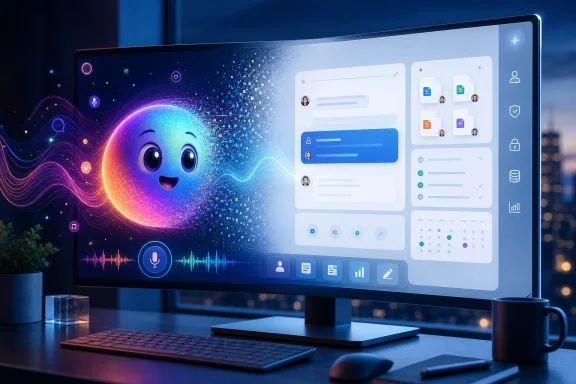 Mico arrived as Copilot’s friendly face
Mico debuted in Microsoft’s Copilot Fall Release in October 2025. Microsoft presented it as an optional visual presence for voice conversations: expressive, customizable, and responsive to the tone and content of an interaction. The name was a contraction of “Microsoft Copilot,” and the feature was deliberately designed to make the chatbot feel less like a text box and more like a conversational companion.
It was also a conspicuous break from the company’s recent Copilot branding. The familiar multicolor Copilot logo and the various Copilot app interfaces are product identity; Mico was a character. It blinked, reacted, changed colors, and could sit on screen while a user spoke to Copilot. Microsoft positioned that emotional feedback as useful rather than decorative, particularly for learning and voice-based conversations.
The education use case remains important. Microsoft’s public Copilot material for students still identifies Mico as one of the tools available alongside Study Mode and Copilot Learn Live, a voice-led tutoring mode. That gives the reported partial reprieve some logic: an animated visual tutor may be more defensible in a guided learning session than in a work assistant used to summarize documents, retrieve files, or launch agents.
But it also underscores the narrowness of the feature’s role. Mico was never a foundational Copilot capability such as chat, memory, file grounding, web search, or Microsoft 365 access. It was a layer placed on top of Copilot Voice. Removing it does not change what Copilot can do, but it changes the personality Microsoft chose to put between the user and the model.
The product strategy changed before Mico’s first anniversary
Mico’s short run tracks a larger reorganization at Microsoft. In March 2026, Microsoft CEO Satya Nadella announced that the company was combining its consumer and commercial Copilot efforts into a single organization. Jacob Andreou, formerly a Snap executive, was placed in charge of the Copilot experience across consumer and commercial products, covering design, product, growth, and engineering.
Microsoft described the reorganization as an effort to replace a “collection of great products” with a more integrated system. The company divided that system into four connected areas: Copilot experience, Copilot platform, Microsoft 365 apps, and AI models. Mustafa Suleyman, who had led Microsoft AI and pushed the human-centered consumer approach around Copilot, remained central to the company’s AI work but shifted toward the model layer.
Reporting by The Information supplied a sharper description of the operating philosophy that followed. Andreou reportedly told staff that Copilot needed to focus on “real work” and be “optimized for outcomes,” rather than chase intelligence for its own sake. The same report said Microsoft planned to merge consumer and enterprise Copilot chatbots into a unified application.
That is the context in which Mico’s departure reads less like an isolated design cleanup than a product-priority decision. A visual companion makes sense if Microsoft is competing for habitual consumer chat use through warmth, personality, and a sense of relationship. It makes less sense if the core objective is to turn Copilot into a single interface for work data, files, agents, task execution, and paid business services.
Microsoft’s own March announcement emphasized multi-step work with user control points, connected agents and apps, enterprise governance, and reduced manual coordination. Those are specific operational promises. Mico, however appealing to some users, did not directly advance any of them.
The unified Copilot push affects Windows administrators more than Mico does
For IT administrators, Mico’s removal is not the operational story. The important development is Microsoft’s continued simplification and expansion of the Copilot app experience.
Microsoft’s recent Microsoft 365 Message Center notice says the Microsoft 365 Copilot app received a simplified, chat-centered interface, streamlined navigation, a Tasks tab, and a consolidated Work IQ control. The worldwide rollout began in June 2026, with standard-release tenants moving through July and deferred-release tenants scheduled for August.
Separately, Microsoft resumed automatic installation of the Microsoft 365 Copilot app on eligible Windows devices running Microsoft 365 desktop apps in June. The company said the rollout was expected to complete by mid-July, unless an organization opted out; the European Economic Area was excluded from that automatic installation change.
Those are tangible deployment changes that matter more to enterprise customers than whether a voice interface displays an animated orb. Admins should distinguish between the standalone Microsoft Copilot app, which Microsoft still describes as a personal-account conversational assistant, and the Microsoft 365 Copilot app, which provides work and school users access to enterprise chat, Microsoft 365 files, agents, and productivity apps.
The names remain confusing because Microsoft has repeatedly moved functions and branding between them. The stated objective is unification, yet the products still vary by account type, license, data boundary, application surface, and tenant configuration. A consolidation that removes an optional character does nothing on its own to resolve those practical distinctions.
Organizations should therefore treat the current rollout as a user-experience change, not merely a branding update. Review whether the Microsoft 365 Copilot app is already installed across managed Windows devices, confirm who can access Copilot Chat and custom agents, and update internal user guidance. The interface is becoming more chat-centered at the same time Microsoft is adding more ways for Copilot to reach organizational data and perform work across apps.
The Clippy comparison is easy, but incomplete
GeekWire casts Mico as the latest entry in Microsoft’s long history of retiring software characters: Rover in Microsoft Bob, Clippy in Office, and Cortana in Windows and mobile. The comparison is fair at the visual level. Each tried to make a complex computer interface feel more approachable through a recognizable personality.
Yet Mico’s retirement is materially different from Clippy’s or Cortana’s. Clippy was embedded in Office’s help system and became notorious for interrupting work at the wrong moment. Cortana was a broad digital assistant whose decline involved strategic reversals, phone-platform failure, privacy concerns, integration limits, and the arrival of generative AI. Mico did not replace a workflow, operate a platform, or carry a standalone service. It was an optional visual mode in a voice experience.
That distinction should restrain the eulogies. Microsoft has not abandoned Copilot Voice, nor has it walked away from conversational AI, consumer accounts, or education. It is shedding a presentation layer while building a broader Copilot product around agents, Microsoft 365 data, and task completion.
Still, Mico’s brevity is revealing. Microsoft launched it in October 2025 as a symbol of a personable consumer Copilot. By August 2026, the company is removing it from the primary voice experience while reorganizing Copilot around a unified consumer-commercial product and an explicitly outcome-focused strategy.
For users who liked Mico, the loss is simple: Copilot Voice will feel more utilitarian. For Microsoft, the decision is a visible signal that the company’s next Copilot phase will be judged less on whether the assistant seems charming and more on whether it can complete work inside the company’s increasingly crowded Windows, Microsoft 365, and agent stack.