
Tom’s Hardware first highlighted the contract and Intrator’s accompanying claim that pricing for earlier-generation GPU SKUs is at or above levels seen years ago. CoreWeave’s earlier investor materials had already argued that A100 usage was outlasting the company’s six-year GAAP useful-life estimate; the newly disclosed 2029 commitment is the clearest public indication yet that at least one customer sees remaining economic value in that hardware.
The important correction is in the framing. An A100 contract through 2029 does not prove CoreWeave itself is profitable. The company reported $2.58 billion in second-quarter revenue, up 112% year over year, while its quarterly GAAP net loss was still about $626 million, weighed down heavily by interest expense and the cost of its rapid buildout. What the contract does demonstrate is something narrower and still consequential: old AI GPUs can retain billable value long after the market has shifted its attention to newer Nvidia platforms.
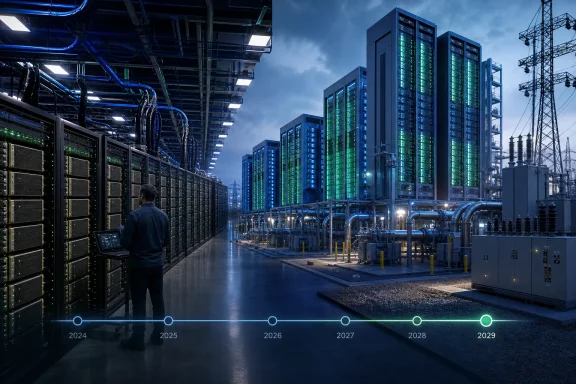 A100s have become part of the capacity problem’s solution
Nvidia introduced the A100 as the first data-center GPU based on its Ampere architecture in May 2020. It was designed for training and inference workloads in an era before the current rush toward giant, liquid-cooled AI racks. Since then, Nvidia’s data-center roadmap has moved through Hopper, Blackwell, and newer systems built around much denser compute, memory, networking, and power delivery.
In a normal accelerator refresh cycle, that succession would pressure an older GPU’s rental rates. A100s lack several advances that make newer parts more compelling for frontier-scale model training, including newer low-precision formats, larger memory configurations, and faster interconnect options. A customer training the largest models has sound technical reasons to prefer current-generation systems.
But cloud demand is not composed solely of frontier training. A100s remain capable inference and training hardware for many established models, smaller fine-tuning jobs, batch processing, scientific workloads, image generation pipelines, and internal enterprise AI projects. Software compatibility also matters: CUDA applications, container images, monitoring tooling, and deployment practices built around Ampere do not become unusable when Nvidia introduces a successor.
CoreWeave’s disclosure suggests a customer has decided that this combination of adequate performance, established software, and available capacity is worth locking in for years. That is a stronger signal than a spot-market listing or a vendor’s projected service-life chart because it involves a contracted customer commitment.
It remains an incomplete signal. CoreWeave did not disclose the customer, the number of A100s involved, the contract’s revenue value, the utilization guarantee, or whether the arrangement includes an upgrade path. Without those terms, outsiders cannot calculate the gross margin on the fleet or conclude that every A100 in the market will command similar pricing.
Legacy data halls may be protecting Ampere’s value
The more revealing part of the story is physical infrastructure. Tom’s Hardware points to the gulf between an air-cooled NVIDIA DGX A100 deployment and Blackwell-era NVL72 racks that demand direct-to-chip liquid cooling and far more power per rack. The exact figures vary by system configuration and facility design, but the direction is clear: a hall built for conventional air-cooled GPU servers cannot simply accept a modern high-density AI rack.
That constraint changes the economics of “obsolete” GPUs. A facility with energized power, working air cooling, network connectivity, and racks designed around older density limits can often host A100 systems without a wholesale rebuild. Replacing those systems with the newest Nvidia generation may require utility upgrades, new switchgear, liquid-cooling equipment, plumbing, structural work, and prolonged construction schedules.
For a cloud operator, the relevant question is therefore not simply whether a Blackwell or later rack produces more tokens or floating-point operations per watt. It is whether the company can place that rack in a given hall, and when. If the answer is no, the comparison is between renting A100 capacity and leaving the already-powered space underused.
Power availability has become a product constraint. CoreWeave said it had 3.7 GW of contracted power at the end of the second quarter and 4.2 GW as of Monday, but only 1.5 GW online. That gap does not mean the remaining capacity is immediately usable. Contracted power must still be connected to operating sites, equipped with substations and cooling, populated with servers, and accepted by customers. In the meantime, an operational legacy facility has value precisely because it is operational.
This helps explain why technological generations can coexist longer in data centers than in consumer PCs. A laptop GPU can be replaced by buying a new machine. A large AI deployment is embedded in a building and electrical system whose useful life is measured in decades.
The useful-life debate needs a more precise test
The A100 contract arrives amid a wider argument over how long AI hardware should remain on companies’ books. Investor Michael Burry has argued that large cloud operators may be understating depreciation by assigning GPUs useful lives of five or six years while Nvidia’s product cadence accelerates. Nvidia and AI cloud providers have countered that older hardware continues to operate at high utilization and retains commercial value after the first customer contract ends.
CoreWeave has a direct financial interest in the latter view. Depreciating GPUs over a longer period lowers the annual depreciation charge, improving reported earnings metrics during the period that the hardware remains in service. Its March investor presentation explicitly used observed utilization of earlier Nvidia generations to support a roughly six-year useful-life assumption for its GPU assets, while warning that actual useful life could vary significantly.
The newly disclosed contract does not settle the accounting argument. A single deal through 2029 does not establish that every A100 will still produce revenue at attractive rates, or that the fleet will have sufficient residual value after a nine-year service life. Hardware ages unevenly. A100 systems can be limited by networking, host CPUs, storage, memory capacity, power efficiency, failures, support costs, and customer software needs, not merely GPU compute performance.
Nor does a long contract automatically mean the underlying machines will be the same physical units for its entire term. CoreWeave has not provided enough information to establish whether the contract guarantees A100 availability from a specified fleet, permits substitutions, or is paired with broader capacity terms.
Still, the deal undercuts the simplistic version of the obsolescence argument: that a new Nvidia architecture necessarily turns the preceding generation into stranded capital within a few years. In data-center infrastructure, the installed base can earn money long after it stops being the preferred option for the most demanding buyer.
CoreWeave’s financial result is the caveat investors cannot ignore
CoreWeave’s second-quarter numbers show why GPU utilization and corporate profitability should not be conflated. The company’s revenue backlog reached $104 billion, and management said that figure excluded more than $25 billion in new commitments booked after the quarter ended. Those figures support management’s case that demand for leased AI capacity remains substantial.
They do not erase the financing burden of building that capacity. CoreWeave’s business requires vast upfront spending on GPUs, servers, networking, data-center leases, power arrangements, and construction. Its second-quarter capital expenditures were $9.4 billion, more than three times quarterly revenue. Interest expense was also a major drag on the reported result.
That distinction matters for IT buyers evaluating long-term GPU reservations. A provider can have valuable installed hardware and strong demand while remaining exposed to construction delays, component pricing, power-delivery bottlenecks, customer concentration, and the cost of refinancing debt. A long A100 reservation improves the case that old capacity can continue producing revenue; it says much less about the provider’s full balance-sheet risk.
For enterprise customers, the practical implication is less dramatic but useful. Older accelerators are likely to remain a viable tier for workloads that do not require the newest precision modes, largest memory pools, or maximum interconnect bandwidth. Organizations should evaluate GPU reservations by workload profile, memory requirement, software support, data locality, and service-level terms rather than treating the newest architecture as the only deployable option.
CoreWeave’s 2029 A100 agreement therefore makes Ampere a live planning consideration rather than a relic. The GPU’s age is real, and newer Nvidia hardware is technically superior for many jobs. But the limiting resource in AI infrastructure is increasingly the powered, cooled, deployable capacity around the silicon—and the A100 can still fit where newer systems cannot.