
CoreWeave has brought NVIDIA’s Vera Rubin NVL72 rack into operation and published its first performance figures, but the practical news for enterprise buyers is narrower than the headline suggests: the system has been validated, benchmarked on one reasoning model, and is being prepared for cloud integration. General customer availability, pricing, regions, and instance configuration remain undisclosed.
StartupHub.ai describes CoreWeave as the first AI cloud provider to validate the system, with 72 Rubin GPUs, 36 Vera CPUs, and a 260 TB/s NVLink fabric in each rack. CoreWeave announced its own bring-up on June 1, 2026, while NVIDIA said on July 21 that Vera Rubin production was ramping across several partners, including CoreWeave, Google Cloud, Microsoft Azure, Oracle Cloud Infrastructure, and Nebius.
The more useful update arrived from CoreWeave on July 21: its comparison of Vera Rubin NVL72 with NVIDIA GB200 NVL72 on DeepSeek-R1 reported up to 10 times more tokens per megawatt at comparable per-user token throughput. That is a power-efficiency result for a particular workload and software stack, not a blanket promise that every AI model will become ten times cheaper or ten times faster.
For organizations planning agentic AI services, that distinction is the whole story. Long-running reasoning models can generate far more tokens per request than conventional chat systems, turning electricity, GPU occupancy, GPU-to-GPU bandwidth, and response latency into direct limits on how many users a service can support. Vera Rubin’s value proposition is to make that specific class of inference denser within a fixed data-center power envelope.
CoreWeave says it completed the industry’s first bring-up and validation of NVIDIA Vera Rubin NVL72. Data Center Dynamics independently reported the CoreWeave/Dell deployment in June, but also flagged a complication: Microsoft had said in March that it was the first cloud provider to bring up a Vera Rubin NVL72 system for validation.
The claims can coexist only if “first” is read very precisely. CoreWeave’s announcement describes a fully validated and operational rack-scale deployment, including power, cooling, networking, and compute; Microsoft’s earlier statement concerned validation. Neither company’s public wording establishes an independently auditable, universal first-place ranking for every definition of “bring-up,” “validation,” or production operation.
That is more than public-relations hair-splitting. The step from receiving an engineering rack, to validating it, to running customer workloads, to offering a metered cloud service is substantial. CoreWeave has demonstrated the first two and published a controlled benchmark. It has not yet publicly specified when a customer can provision an NVL72 instance, what the service-level commitments will be, how capacity will be allocated, or how much access will cost.
NVIDIA’s own January 2026 materials had placed broad partner availability in the second half of 2026, naming CoreWeave alongside AWS, Google Cloud, Microsoft, Oracle Cloud Infrastructure, Lambda, Nebius, and Nscale. NVIDIA’s July update confirms that the platform is now ramping at several providers. CoreWeave’s lead, therefore, is best understood as early operational experience with an unusually complex rack rather than exclusive access to Rubin.
That combination matters because the 10x claim is a systems result. It reflects a specific model, quantization format, inference framework, distributed execution strategy, and power-normalized target. It is not equivalent to saying that a single Rubin GPU is ten times faster than a Blackwell GPU, or that a Windows application calling an AI API will automatically see a tenfold speedup.
CoreWeave’s own published comparison uses GB200 NVL72—not every system in the Blackwell family—as its baseline. NVIDIA has separately promoted claims around lower cost per million tokens and fewer GPUs versus Blackwell, but token cost depends on the model, the prompt and output profile, batch size, uptime, reserved capacity terms, networking, storage, and the cloud provider’s margin. There is no public CoreWeave rate card yet from which buyers can calculate a real before-and-after cost per million tokens.
The performance measurement does contain a credible operational message: power efficiency is becoming a first-order procurement metric for AI inference. A company with a fixed amount of available electrical capacity may be able to serve more reasoning traffic without constructing another facility or waiting for a utility interconnect. Conversely, customers who need a fixed volume of inference could, in principle, use less energy and fewer racks.
But “in principle” remains appropriate until independent benchmarks cover multiple models and production traffic profiles. DeepSeek-R1 is a meaningful test case for reasoning and mixture-of-experts workloads, where all-to-all communication can dominate performance. It does not represent every enterprise deployment, particularly smaller models, retrieval-heavy applications, vision pipelines, traditional machine-learning inference, or on-premises workloads with different networking constraints.
The design addresses an increasingly visible AI bottleneck: moving model state, experts, and context between accelerators fast enough that expensive GPUs do not sit idle. CoreWeave says DeepSeek-R1’s mixture-of-experts routing is precisely the sort of workload that benefits from that tightly coupled fabric. In a rack this dense, the hardware, cooling plant, networking topology, firmware, scheduler, observability layer, and failure handling are inseparable.
That helps explain why CoreWeave emphasizes its cooling and management work as much as the silicon. Its “Valvey” system manages per-rack liquid cooling controls and isolation; “Racky” aggregates power, cooling, and environmental telemetry; its network design supports both InfiniBand and Spectrum-X Ethernet approaches. Those are vendor claims, but the underlying operational problem is real: a cloud provider cannot monetize a high-density rack if a thermal event, an upgrade, or a networking fault causes adjacent capacity to go offline.
For enterprise IT teams, the immediate implication is that Rubin will reach most organizations as a cloud service or through a tightly integrated appliance, not as a casual server refresh. Windows-based line-of-business applications may consume the resulting models through APIs, Azure services, containers, or hybrid data pipelines, but the training and high-scale inference infrastructure described here is centered on Linux, specialized networking, and data-center engineering. There is no announcement of a Windows Server-specific Vera Rubin deployment model.
The advertised rack fabric and per-watt gains are aimed at preventing the cost of those repeated model calls from overwhelming the value of the service. That is why CoreWeave’s metric is tokens per megawatt rather than a peak floating-point number. For a provider selling inference, the relevant question is how much useful, responsive model output it can deliver under a constrained power budget.
There is a counterweight: more efficient infrastructure can also encourage developers to run longer reasoning traces, larger context windows, and more concurrent agents. Lower unit cost does not guarantee lower AI spending; it can unlock workloads that were previously too expensive to deploy. CoreWeave’s commercial advantage depends on converting that newly affordable demand into sustained bookings before competing clouds make comparable Rubin capacity broadly available.
The unresolved commercial details are now more important than the rack’s headline specifications. Buyers should look for CoreWeave to publish availability dates, geographic regions, instance or cluster sizes, reservation terms, network options, storage pairings, and pricing. They should also expect independent tests that compare Rubin with GB200 and GB300 systems across more than DeepSeek-R1, using documented quality, latency, throughput, and power methods.
Until those details arrive, CoreWeave has proved an early infrastructure capability and issued a promising but vendor-run benchmark. It has not yet proved the “one-tenth cost per million tokens” outcome for a customer’s actual workload—or shown who can buy the capacity and at what price.
The more useful update arrived from CoreWeave on July 21: its comparison of Vera Rubin NVL72 with NVIDIA GB200 NVL72 on DeepSeek-R1 reported up to 10 times more tokens per megawatt at comparable per-user token throughput. That is a power-efficiency result for a particular workload and software stack, not a blanket promise that every AI model will become ten times cheaper or ten times faster.
For organizations planning agentic AI services, that distinction is the whole story. Long-running reasoning models can generate far more tokens per request than conventional chat systems, turning electricity, GPU occupancy, GPU-to-GPU bandwidth, and response latency into direct limits on how many users a service can support. Vera Rubin’s value proposition is to make that specific class of inference denser within a fixed data-center power envelope.
 The “first” claim needs more careful wording
CoreWeave says it completed the industry’s first bring-up and validation of NVIDIA Vera Rubin NVL72. Data Center Dynamics independently reported the CoreWeave/Dell deployment in June, but also flagged a complication: Microsoft had said in March that it was the first cloud provider to bring up a Vera Rubin NVL72 system for validation.The claims can coexist only if “first” is read very precisely. CoreWeave’s announcement describes a fully validated and operational rack-scale deployment, including power, cooling, networking, and compute; Microsoft’s earlier statement concerned validation. Neither company’s public wording establishes an independently auditable, universal first-place ranking for every definition of “bring-up,” “validation,” or production operation.
That is more than public-relations hair-splitting. The step from receiving an engineering rack, to validating it, to running customer workloads, to offering a metered cloud service is substantial. CoreWeave has demonstrated the first two and published a controlled benchmark. It has not yet publicly specified when a customer can provision an NVL72 instance, what the service-level commitments will be, how capacity will be allocated, or how much access will cost.
NVIDIA’s own January 2026 materials had placed broad partner availability in the second half of 2026, naming CoreWeave alongside AWS, Google Cloud, Microsoft, Oracle Cloud Infrastructure, Lambda, Nebius, and Nscale. NVIDIA’s July update confirms that the platform is now ramping at several providers. CoreWeave’s lead, therefore, is best understood as early operational experience with an unusually complex rack rather than exclusive access to Rubin.
What the 10x result actually measures
CoreWeave’s figure compares tokens per second per megawatt on DeepSeek-R1, a reasoning model, against GB200 NVL72 at matched interactivity—the token rate available to each active user. The company says it enabled large-scale expert parallelism, NVFP4 precision, multi-token prediction, and disaggregated prefill and decode using NVIDIA TensorRT-LLM and NVIDIA Dynamo.That combination matters because the 10x claim is a systems result. It reflects a specific model, quantization format, inference framework, distributed execution strategy, and power-normalized target. It is not equivalent to saying that a single Rubin GPU is ten times faster than a Blackwell GPU, or that a Windows application calling an AI API will automatically see a tenfold speedup.
CoreWeave’s own published comparison uses GB200 NVL72—not every system in the Blackwell family—as its baseline. NVIDIA has separately promoted claims around lower cost per million tokens and fewer GPUs versus Blackwell, but token cost depends on the model, the prompt and output profile, batch size, uptime, reserved capacity terms, networking, storage, and the cloud provider’s margin. There is no public CoreWeave rate card yet from which buyers can calculate a real before-and-after cost per million tokens.
The performance measurement does contain a credible operational message: power efficiency is becoming a first-order procurement metric for AI inference. A company with a fixed amount of available electrical capacity may be able to serve more reasoning traffic without constructing another facility or waiting for a utility interconnect. Conversely, customers who need a fixed volume of inference could, in principle, use less energy and fewer racks.
But “in principle” remains appropriate until independent benchmarks cover multiple models and production traffic profiles. DeepSeek-R1 is a meaningful test case for reasoning and mixture-of-experts workloads, where all-to-all communication can dominate performance. It does not represent every enterprise deployment, particularly smaller models, retrieval-heavy applications, vision pipelines, traditional machine-learning inference, or on-premises workloads with different networking constraints.
The rack is the product, not simply the GPU
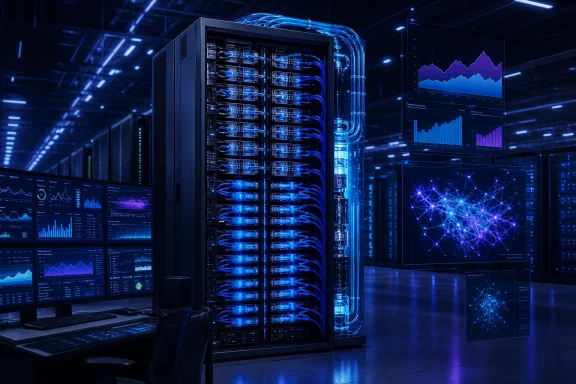
Vera Rubin NVL72 is a rack-scale system rather than a conventional GPU server upgrade. NVIDIA and CoreWeave describe a unit with 72 Rubin GPUs and 36 Vera CPUs attached through sixth-generation NVLink at 260 TB/s. It also incorporates ConnectX-9 SuperNICs and BlueField-4 data processing units, with the surrounding fabric intended to scale across large clusters.The design addresses an increasingly visible AI bottleneck: moving model state, experts, and context between accelerators fast enough that expensive GPUs do not sit idle. CoreWeave says DeepSeek-R1’s mixture-of-experts routing is precisely the sort of workload that benefits from that tightly coupled fabric. In a rack this dense, the hardware, cooling plant, networking topology, firmware, scheduler, observability layer, and failure handling are inseparable.
That helps explain why CoreWeave emphasizes its cooling and management work as much as the silicon. Its “Valvey” system manages per-rack liquid cooling controls and isolation; “Racky” aggregates power, cooling, and environmental telemetry; its network design supports both InfiniBand and Spectrum-X Ethernet approaches. Those are vendor claims, but the underlying operational problem is real: a cloud provider cannot monetize a high-density rack if a thermal event, an upgrade, or a networking fault causes adjacent capacity to go offline.
For enterprise IT teams, the immediate implication is that Rubin will reach most organizations as a cloud service or through a tightly integrated appliance, not as a casual server refresh. Windows-based line-of-business applications may consume the resulting models through APIs, Azure services, containers, or hybrid data pipelines, but the training and high-scale inference infrastructure described here is centered on Linux, specialized networking, and data-center engineering. There is no announcement of a Windows Server-specific Vera Rubin deployment model.
Agentic AI is driving the economics CoreWeave wants to sell
CoreWeave and NVIDIA frame Vera Rubin around agentic workloads: systems that reason over many steps, invoke tools, inspect results, and continue generating. Whether every enterprise needs that pattern is debatable, but the infrastructure demand is straightforward. A multi-step agent can consume orders of magnitude more inference tokens than a short question-and-answer exchange, and it can make latency failures more visible because users are waiting for a process rather than a single completion.The advertised rack fabric and per-watt gains are aimed at preventing the cost of those repeated model calls from overwhelming the value of the service. That is why CoreWeave’s metric is tokens per megawatt rather than a peak floating-point number. For a provider selling inference, the relevant question is how much useful, responsive model output it can deliver under a constrained power budget.
There is a counterweight: more efficient infrastructure can also encourage developers to run longer reasoning traces, larger context windows, and more concurrent agents. Lower unit cost does not guarantee lower AI spending; it can unlock workloads that were previously too expensive to deploy. CoreWeave’s commercial advantage depends on converting that newly affordable demand into sustained bookings before competing clouds make comparable Rubin capacity broadly available.
What buyers should watch next
The deployment itself is real, and NVIDIA’s July confirmation that racks are running at multiple partners removes any suggestion that Vera Rubin remains a paper launch. The operational milestone is significant for CoreWeave because it shows the company can stand up NVIDIA’s latest rack-scale platform with Dell hardware and its own cooling, control, and network layers.The unresolved commercial details are now more important than the rack’s headline specifications. Buyers should look for CoreWeave to publish availability dates, geographic regions, instance or cluster sizes, reservation terms, network options, storage pairings, and pricing. They should also expect independent tests that compare Rubin with GB200 and GB300 systems across more than DeepSeek-R1, using documented quality, latency, throughput, and power methods.
Until those details arrive, CoreWeave has proved an early infrastructure capability and issued a promising but vendor-run benchmark. It has not yet proved the “one-tenth cost per million tokens” outcome for a customer’s actual workload—or shown who can buy the capacity and at what price.
References
- Primary source: startuphub.ai
Published: 2026-08-03T13:17:24.565000+00:00
Loading…
www.startuphub.ai - Related coverage: coreweave.com
First-Ever Measured Vera Rubin NVL72 Silicon Performance Stats | CoreWeave Blog
NVIDIA Vera Rubin NVL72 on CoreWeave delivers 10x tokens-per-second per megawatt compared to NVIDIA Blackwell NVL72 on the same DeepSeek R1 workload.www.coreweave.com - Related coverage: coreweave.com
Loading…
www.coreweave.com - Related coverage: investors.coreweave.com
Loading…
investors.coreweave.com - Related coverage: blogs.nvidia.com
NVIDIA Vera Rubin Driving Performance Per Watt, Lower Token Costs for Partners Worldwide | NVIDIA Blog
Backed by 300 global partners, Vera Rubin is ramping up worldwide. NVIDIA partners CoreWeave, Google Cloud, Microsoft Azure and Mistral are among many deploying Vera Rubin, which delivers benchmark leadership on performance per watt and lowest token costs.blogs.nvidia.com - Related coverage: datacenterdynamics.com
Loading…
www.datacenterdynamics.com - Related coverage: spheron.network
Loading…
www.spheron.network - Related coverage: wf.coreweave.com
Loading…
wf.coreweave.com - Related coverage: gigabyte.com
Loading…
www.gigabyte.com - Related coverage: nvidianews.nvidia.com
Loading…
nvidianews.nvidia.com - Related coverage: tomshardware.com
Loading…
www.tomshardware.com - Related coverage: tomshardware.com
Loading…
www.tomshardware.com