
The XF1 began shipping in the United States on August 6 in black and white. Creative rates the pair at 72W RMS, with a bi-amplified arrangement: each speaker contains a 3-inch woofer and a 0.75-inch tweeter, each driven by its own amplification channel. PC Gamer praised the clarity, volume and compact footprint in its August 21 review, while CNET and Music Photo Life separately reached the same broad conclusion: these are convincing near-field speakers for their size, not inexpensive replacements for larger monitors or a subwoofer-equipped system.
For PC desks where a monitor, microphone arm, charging dock and dual displays have already consumed the available surface, that distinction is useful. The XF1 is a serious alternative to the cheap satellite speakers that Creative has long sold under the Pebble name—but buyers should be clear about which features will benefit a Windows setup immediately, and which depend on their source device.
 USB-C is the sensible connection for a Windows PC
The XF1’s strongest PC feature is its USB-C audio input, not Bluetooth 6.0. Plugged in over USB, the speakers can accept up to 24-bit/96kHz PCM audio, avoiding an onboard analog output that may pick up electrical noise from a desktop PC or docking station. The supplied cable is USB-A-to-USB-C, so most existing Windows desktops and laptops can connect without an adapter.
It is also the lower-friction option for gaming. A wired USB audio device removes the latency and codec negotiation variables that come with Bluetooth, and it means the system’s advertised high-resolution capability does not hinge on a particular wireless chipset. PC Gamer’s reviewer describes quickly switching the XF1 from a gaming PC to a phone or laptop using the front control; that convenience is real, but the best default arrangement is to leave the PC connected over USB and reserve Bluetooth for secondary devices.
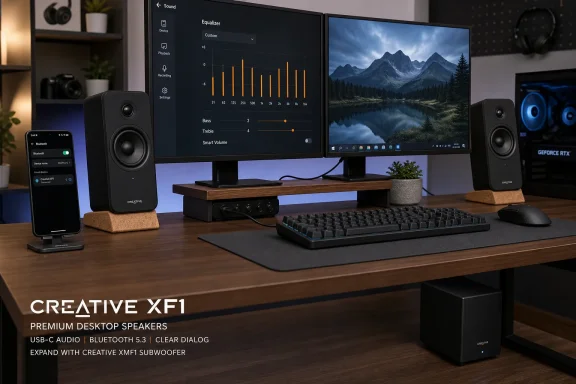
Creative’s software support is concrete here. The company lists Creative Nexus for Windows 10 64-bit and Windows 11, with a July 2026 release that fixes firmware-download and installation failures under certain conditions. Nexus is not necessary for basic playback, but it is necessary to access the XF1’s distinguishing control: a 10-band parametric equalizer rather than a familiar bass-and-treble slider.
That is much more useful than the lengthy catalog of game-specific presets Creative advertises. A parametric EQ lets an owner select the frequency, gain and bandwidth of individual adjustments. On a desk, where speaker output reflects from the surface, a nearby wall and the rear of a monitor, that can fix a persistent boom or harshness in a way a generic “Gaming” mode cannot. Music Photo Life found the speakers’ upper midrange could become forward with poorly mixed material and said the EQ was essential to getting the preferred balance. That is a limitation, but it also validates the reason Creative included the more advanced adjustment tool.
The LDAC claim needs a Windows reality check
Creative markets Bluetooth 6.0 and LDAC as high-quality wireless features, and the XF1 does support SBC, AAC and LDAC. PC Gamer treats LDAC as a way to retain audio quality regardless of connection. That overstates what the specification guarantees.
LDAC requires support at both ends of the connection. Creative’s own compatibility language says a source must support LDAC to receive the higher-quality mode; Bluetooth 6.0 by itself says nothing about the codec a PC will use. Microsoft’s Windows Bluetooth documentation details core Bluetooth and profile support, but it does not promise built-in LDAC transmission for every Windows 11 PC. The practical result is simple: a Windows owner should not buy the XF1 assuming the laptop’s or motherboard’s ordinary Bluetooth radio will deliver LDAC.
For a PC, USB remains the dependable high-quality path. An Android phone that supports LDAC may be a stronger match for the XF1’s wireless selling point, while Apple hardware will use AAC rather than LDAC. Bluetooth can still be convenient for a work laptop or phone, but codec logos should not drive the purchasing decision when the speakers will spend most of their time connected to one Windows machine.
The “Bluetooth 6.0” badge also deserves perspective. It indicates a newer Bluetooth core specification, but it does not automatically improve sound quality, reduce game latency, or add LE Audio support to the XF1. Creative specifies classic A2DP stereo operation, not a low-latency gaming mode. Anyone playing competitive shooters or rhythm games should use USB-C or the 3.5mm analog input rather than regard Bluetooth as an equivalent gaming connection.
A subwoofer output is the feature that changes the long-term value
Creative’s 55Hz-to-40kHz published frequency response looks impressive on paper, but 55Hz is not the same as deep, room-filling bass. The XF1 uses compact 3-inch woofers in compact cabinets. Both PC Gamer and Music Photo Life report respectable bass for the dimensions, while also drawing the line before true high-end or larger-speaker performance. CNET similarly found the sound rich and balanced for a near-field desktop placement, but short of the deeper impact supplied by a larger system.
Creative has acknowledged that constraint in hardware by including a dedicated output for a powered subwoofer. This is the part of the XF1 design that separates it from an all-in-one desk speaker purchase. A buyer can begin with a clean 2.0 arrangement, then add a powered subwoofer later for games, movies and bass-heavy music without discarding the initial speakers.
That route makes more sense than overdriving the low-end EQ. Raising bass aggressively on a small woofer can muddy the midrange, cause desk resonance, and ask the drivers to reproduce material they cannot deliver cleanly at higher volumes. The subwoofer output allows the XF1 to remain what it is best suited to be: a compact near-field pair that handles mids, treble and upper bass clearly.
There is one important absence. The XF1 does not provide HDMI ARC, optical audio, balanced XLR or TRS inputs, RCA inputs, or a headphone output. It is a PC-focused desktop speaker, not a compact television hub and not a replacement for studio monitors connected to an audio interface. Users who need balanced inputs for recording equipment should look elsewhere; users who want HDMI ARC for a console or TV should do the same.
The included stands are more than box filler
Creative includes cork stands that tilt each speaker upward by 15 degrees. That sounds like a minor accessory, but it addresses one of the common failures of desktop speaker setups: tweeters firing into the listener’s chest instead of toward the ears. PHILE WEB’s review specifically noted that aiming the tweeters toward ear level matters in a desktop placement, particularly because high frequencies are directional.
The stands may also help reduce the desk itself becoming part of the speaker enclosure. PC Gamer reports that the XF1 can shake the desk at volume; that is an entertaining description of output, but it can also blur bass and transmit vibration into monitors, microphone arms and furniture. The cork material and upward angle will not eliminate resonance, yet they are a better starting point than placing a pair of small speakers flat against a bare desktop.
Placement remains central. The XF1 measures 6.10 by 3.93 by 7.52 inches per speaker, so it is easy to fit beside a display, but it still needs space to form a stereo image. Keep the pair roughly symmetrical around the primary listening position, use the stands if the speakers sit below ear height, and start with restrained bass EQ. The system is designed for a listener a few feet away, not for filling a large living room.
A feature-heavy alternative, with clear boundaries
At $179.99, the XF1 lands close to Edifier’s M60, another compact desktop option with USB-C and LDAC, while undercutting premium small-format models such as Kanto’s ORA. eCoustics notes that Creative’s combination of USB audio, parametric EQ and a dedicated subwoofer output is unusually complete at the price. The comparison is persuasive because it is based on functionality rather than a simple wattage contest.
Creative’s 72W RMS rating helps explain why reviewers found the XF1 louder than its size suggests, but wattage does not settle sound quality. Cabinet volume, driver design, crossover tuning, room acoustics and listening distance all matter more once a pair of speakers can reach adequate levels. The better reason to choose the XF1 is that it gives a Windows user usable ways to address those variables: a digital USB connection, detailed EQ, upward-facing placement stands and a credible move to 2.1 later.
For a small Windows desk, the XF1 looks like one of the more practical speaker launches of 2026. Buy it for wired PC audio and the ability to tune or expand the setup—not for the assumption that Bluetooth 6.0 or an LDAC logo will automatically produce better wireless sound from every Windows machine.