

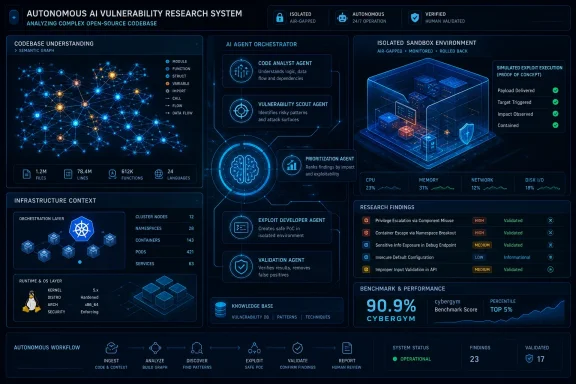
The announcement, published by Wiz Research on July 27, positions Atlas as an AI-driven extension to static application security testing, or SAST. Wiz says it tested the system against projects including Kubernetes, the Linux kernel, gVisor, containerd, grpc, and dnsmasq, and is responsibly disclosing the reported vulnerabilities before releasing technical details.
That caveat matters. The 200-plus figure is Wiz’s own testing result, not a public vulnerability count independently verified across those projects. But the company’s broader design choice—treating exploit reproduction and adversarial validation as gates before reporting—is directly aimed at the false-positive problem that has long limited automated code scanning.
Atlas separates the hunt from the proof
Rather than asking one large language model to inspect a repository end to end, Wiz says Atlas splits the work among specialized agents. It first maps entry points, untrusted data paths, and dangerous operations using a code property graph; agents then pursue vulnerability hypotheses in parallel.
Candidate flaws go through an adversarial phase in which one agent attempts to establish exploitability, another tries to disprove it, and a third weighs the evidence. The final stage creates an execution environment and runs a trigger designed to demonstrate the security impact.
This is a meaningful distinction for enterprise AppSec teams. A conventional scanner can produce thousands of findings requiring triage; an agent that reliably provides a reproducible proof of concept could sharply reduce that workload. It also creates its own operational concern: organizations will need strict controls around isolated build environments, dependencies, secrets, and the handling of automatically generated exploit code.
CyberGym is a useful score, not a discovery metric
Wiz reports that Atlas ranks first on CyberGym at 90.9%. The public benchmark measures whether an AI system can reproduce known, patched vulnerabilities in real software projects with a working proof of concept.
That makes it a credible measure of exploit-reproduction capability, but it is not the same as independently measuring unknown-vulnerability discovery. As Wiz acknowledges, CyberGym supplies a vulnerability description and relevant code; real code review begins without either. A strong benchmark result therefore supports the company’s claims about validation and proof generation more clearly than it proves the 200-plus discovery figure.
The architecture may be the more durable development. Wiz says it evaluates models separately for threat modeling, hunting, validation, and proof generation, replacing components as better models become available rather than betting its product on one model vendor or one agent framework.
GitHub Enterprise Server administrators already have one concrete lesson
Atlas’s early tooling was used in the discovery of CVE-2026-3854, a critical remote-code-execution issue in GitHub’s Git infrastructure, according to Wiz. The National Vulnerability Database says the flaw allowed an attacker with push access to a repository to inject metadata through crafted Git push options, leading to remote code execution on a GitHub Enterprise Server instance.
GitHub fixed CVE-2026-3854 in GitHub Enterprise Server 3.14.24, 3.15.19, 3.16.15, 3.17.12, 3.18.6, and 3.19.3. Administrators who have not yet updated should treat that upgrade as the actionable takeaway from the research story, independent of the Atlas product claims.
Atlas is not yet presented as a generally available standalone scanner. Wiz says it plans to incorporate the system into Wiz Code, where continuous repository analysis would identify high-risk areas and invoke deeper agentic investigation selectively. The test for customers will be simpler than any benchmark rank: whether those validated findings arrive fast enough, with low enough noise, to change patching decisions before the next commit ships.
References
- Atlas: Wiz's autonomous AI Agent for vulnerability research, ranked #1 on CyberGym wiz.io · 2026-07-27T14:00:02+00:00