

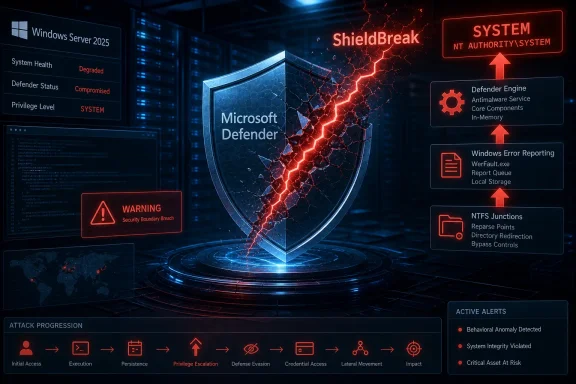
Cyber Kendra first reported the ShieldBreak release early on August 12, saying the code was published on GitHub and tested against Windows 11 version 25H2, Windows Insider Canary builds, and Windows Server 2025. The central claim is serious: ShieldBreak reportedly turns a previously temperamental race condition into a local SYSTEM-level escalation with a 100 percent success rate.
But there is an important reporting boundary: no independent researcher, Microsoft advisory, or incident-response vendor has publicly reproduced ShieldBreak at publication time. Microsoft has not commented on the new PoC, and the Microsoft Security Response Center’s record for CVE-2026-50656 still identifies the July Defender engine update as the available remediation. ShieldBreak should therefore be treated as a credible public claim requiring urgent defensive review, rather than as a newly confirmed Microsoft vulnerability with a separate CVE or a verified in-the-wild campaign.
The July Defender Fix Is the Point of Failure
RoguePlanet was never an ordinary malware-detection bypass. The original June PoC exploited improper link resolution in the Microsoft Malware Protection Engine, the component behind Microsoft Defender’s scanning and remediation functions. An authenticated, low-privileged local user could manipulate Defender’s file handling and cause work to execute as NT AUTHORITY\SYSTEM.
Microsoft acknowledged the issue as CVE-2026-50656, rated it Important with a CVSS score of 7.8, and described exploitation as more likely. SecurityWeek, Help Net Security, and BleepingComputer independently reported the original flaw’s basic mechanism and its ability to elevate a local user to SYSTEM on fully updated Windows 10 and Windows 11 systems.
Microsoft’s answer arrived as Malware Protection Engine version 1.1.26060.3008 rather than a conventional Windows cumulative update. That distinction mattered operationally: Defender engine updates normally arrive through security intelligence update channels, and enterprise systems can lag if proxies, update rings, WSUS configuration, or disconnected management infrastructure delay them. Administrators were advised to query AMEngineVersion through Get-MpComputerStatus, because a device shown as current in Windows Update was not necessarily current at the Defender engine layer.
ShieldBreak changes the meaning of that verification. The July engine version remains necessary; it closes the original published RoguePlanet implementation. But if ShieldBreak genuinely reaches SYSTEM on a machine running 1.1.26060.3008, the version number now proves only that the first exploit was addressed, not that the underlying file-handling condition was eliminated.
That is the material discrepancy in Microsoft’s current posture. The vendor’s existing CVE record can accurately say an update was released for RoguePlanet while defenders still face a PoC that claims to bypass the mitigation. Those are not contradictory statements, but they are very different risk messages for administrators.
A Reliable Local SYSTEM Escalation Would Change Server Risk
Nightmare Eclipse described the June RoguePlanet exploit as unreliable because it depended on winning a timing race. BleepingComputer quoted the researcher at the time as saying success varied sharply between machines; some achieved full reliability while others struggled. That behavior was consistent with a time-of-check to time-of-use flaw, where execution timing, system load, disk behavior, and Defender activity can decide whether an exploit succeeds.
Cyber Kendra says ShieldBreak claims 100 percent reliability. That result has not been independently validated, but the difference is meaningful if confirmed. A brittle lab exploit may be useful for research and opportunistic attacks; a repeatable local escalation is far easier to incorporate into commodity malware, post-compromise toolkits, and hands-on-keyboard intrusion playbooks.
The reported Windows Server 2025 support needs equally careful interpretation. RoguePlanet’s earlier public PoC did not run on Windows Server because a standard user could not mount ISO images using the same initial path, although the researcher argued that the underlying Defender exposure extended to server builds. ShieldBreak reportedly removes that practical limitation.
That puts Windows Server 2025 session hosts, application servers, jump boxes, and other multi-user systems in the highest-priority review group. A low-privileged account on those systems may be obtained through phishing, a remote desktop compromise, an exposed application account, or a separate flaw; a reliable local escalation then converts that foothold into full machine control.
The claim that ShieldBreak brings domain controllers “into scope” needs one qualification. A domain controller running an affected Defender engine would be technically consequential because SYSTEM on a domain controller is effectively domain compromise. Yet domain controllers are not generally exposed to ordinary interactive users, and a local elevation-of-privilege bug still requires code execution under an authenticated account first. The practical risk is highest where low-privileged logon or application execution on the server is already possible—not simply because a server has the domain controller role installed.
Windows 10 is also a difficult edge case. Cyber Kendra reports that it remains vulnerable but is unsupported by the current ShieldBreak code. That does not make Windows 10 safe. It means the newly released PoC reportedly does not package a dependable exploitation route for it. For organizations still operating Windows 10 estates, especially systems with delayed Defender engine updates or local-user exposure, that distinction offers little comfort.
The Files in the PoC Are Clues, Not Independent Proof
Cyber Kendra reports that the ShieldBreak repository includes a Warden.dll, a Report.wer Windows Error Reporting artifact, an eicar_com.zip test file, and project support files. Those names fit the reported theory that ShieldBreak reuses some of RoguePlanet’s plumbing: NTFS junctions, opportunistic locks, and the Windows Error Reporting QueueReporting scheduled task.
The Windows Error Reporting element deserves attention, but it should not be overstated. A Report.wer file can indicate that the PoC is attempting to manufacture or redirect an error-reporting workflow. It does not by itself prove that Windows Error Reporting is the escalation trigger, that the QueueReporting task is abused successfully, or that the exploit defeats Defender engine version 1.1.26060.3008 on a clean test system.
The eicar_com.zip file is similarly easy to misread. EICAR is a harmless, standardized antivirus test string used to test detection pipelines. Its presence suggests that the author may be using Defender’s scanning behavior as part of the demonstration or testing setup. It is not malware, and it does not establish the claimed privilege escalation on its own.
That evidence gap matters because public PoCs can contain working components, unfinished experiments, decoy artifacts, or environment-specific assumptions. The code may be real and still fail to reproduce across standard enterprise configurations. Conversely, it may be more robust than the initial report suggests. Until a separate laboratory validates it, the important fact is that the alleged bypass is public—not that its advertised reliability is settled.
Application Control Is the Strongest Available Brake
There is no Microsoft patch specifically addressing ShieldBreak as of August 12. The right response is not to remove the July RoguePlanet engine update; organizations should keep deploying version 1.1.26060.3008 or later, because reverting would restore exposure to the original public exploit.
ThreatLocker previously reported that its default application allowlisting controls blocked RoguePlanet. That is relevant, but it is not a ShieldBreak validation. No public test has yet shown that the same policy blocks the new PoC, and administrators should not advertise that outcome internally unless they test it in their own environment.
The practical immediate steps are straightforward:
- Verify Defender engine versions centrally, but classify version 1.1.26060.3008 as a baseline rather than a confirmed ShieldBreak mitigation.
- Review Windows Server 2025 systems where unprivileged users, remote desktop users, or application identities can execute local code, with particular attention to session hosts, VDI infrastructure, shared application servers, and administrative jump hosts.
- Enforce application control with Windows Defender Application Control, AppLocker where appropriate, or a third-party allowlisting product, and test whether the policy prevents the ShieldBreak executable and its supporting components from running.
- Investigate unusual Windows Error Reporting activity, unexpected child processes launched in proximity to Defender scanning activity, suspicious NTFS reparse-point creation, and attempts to create or manipulate queued WER reports.
- Limit local administrative rights and remove unnecessary interactive sign-in permissions from servers. ShieldBreak is reported as a local escalation, so constraining the first foothold still reduces the number of systems where the flaw can be used.
Microsoft’s August 11 Patch Tuesday addressed 421 CVEs, including at least one Defender-related issue, but there is no indication that the release remediates ShieldBreak. The practical consequence is immediate: Defender engine compliance is no longer the finish line for CVE-2026-50656. Until Microsoft validates or rejects the bypass claim, enterprises need to treat local execution controls and server logon exposure as the controls standing between a standard user session and SYSTEM.
Update: Microsoft says it is investigating the reported ShieldBreak bypass (August 13, 2026)
Microsoft has now acknowledged the ShieldBreak claims publicly. In a statement reported by Computerworld, the company said it is “aware of the reported vulnerability” and is actively investigating both the validity of the claim and whether it applies broadly to affected systems.
That does not confirm ShieldBreak as a working bypass or announce a replacement Defender engine update. It does, however, move the issue beyond the prior absence of Microsoft comment and indicates that the vendor is assessing whether the PoC defeats the July remediation for CVE-2026-50656.
For administrators, the immediate guidance remains unchanged: retain the July Defender engine update, but do not rely on engine-version compliance alone as proof that the reported local SYSTEM escalation path is closed. Prioritize application-control testing and reduce unprivileged code-execution and interactive-logon exposure on Windows Server systems while Microsoft’s investigation continues.
Update: Independent testing reportedly confirms ShieldBreak on updated Windows 11 (August 13, 2026)
Korben reports that security researcher Kevin Beaumont has independently tested ShieldBreak and confirmed that it works against a fully updated Windows 11 system. That is the first reported third-party validation of the public proof of concept, though Microsoft has not yet issued its own technical assessment or a replacement Defender engine update.
Beaumont reportedly disputes one important characterization: ShieldBreak may not be a direct bypass of the July RoguePlanet patch, because its exploitation path appears materially different from the original flaw. Practically, however, that distinction does not reduce the immediate concern for defenders: a low-privileged local user may still be able to reach SYSTEM with Microsoft Defender enabled on a current system.
The report also says Beaumont has published Microsoft Defender for Endpoint hunting queries intended to identify suspicious processes loading Defender libraries or Cloud Filter API components. Those detections may help security teams investigate exposure, but they are monitoring measures rather than a mitigation. Organizations should treat them as an additional hunting option while maintaining application-control restrictions and limiting unprivileged local code execution.
Update: Will Dormann reportedly verifies ShieldBreak behavior (August 13, 2026)
VarIndia reports that security researcher Will Dormann independently verified ShieldBreak’s reported privilege-escalation behavior and noted that Microsoft Defender must be enabled for the exploit to function.
If confirmed, this provides a second reported external validation alongside Kevin Beaumont’s testing, strengthening the case that the public PoC can reach SYSTEM on affected configurations. It does not establish that every supported Windows version or Defender configuration is vulnerable, nor does it replace Microsoft’s pending technical assessment.
For defenders, Defender-enabled Windows 11 and Windows Server 2025 systems should remain the priority for application-control testing, threat hunting, and restrictions on unprivileged local code execution.
Update: Third-party ACL workaround released for ShieldBreak (August 13, 2026)
ITBrief reports that Ubitquity and Nettwerked have published an open-source interim mitigation for ShieldBreak while Microsoft’s investigation continues. The release is not a Microsoft patch and has not been independently validated, but it reportedly includes a PowerShell script intended to restrict permissions in commonly used temporary directories.
According to ITBrief, the workaround aims to prevent the directory-junction creation required by the reported ShieldBreak exploitation chain. That could offer administrators an additional short-term control where low-privileged local execution cannot be eliminated immediately.
The groups caution that tighter ACLs may disrupt legacy application installers or other software that depends on creating junctions in affected temporary paths. Organizations should therefore test the script in representative systems and maintain a rollback plan before deploying it broadly.
Update: Additional details (August 14, 2026)
PC Perspective reports that the National Vulnerability Database changed CVE-2026-50656’s public PoC reference on August 12 from RoguePlanet to the ShieldBreak repository. That linkage does not establish that ShieldBreak is the same underlying defect or a confirmed bypass of the original fix.
The report also identifies Microsoft’s August 5 Defender release as platform 4.18.26070.9 and engine 1.1.26070.7; its published notes reportedly list performance and reliability changes, not a ShieldBreak remediation.
Update: Microsoft reportedly assigns CVE-2026-69414 and prepares a ShieldBreak fix (August 17, 2026)
WindowsReport, citing BleepingComputer, reports that Microsoft has assigned ShieldBreak the identifier CVE-2026-69414 and is developing a security update for the Defender Malware Protection Engine flaw.
If accurate, this is a material change from Microsoft’s earlier statement that it was investigating the reports: ShieldBreak would now be tracked as a separate vulnerability rather than solely as an unverified bypass claim tied to RoguePlanet. Microsoft reportedly has not provided a release date, workaround, or affected-build list.
The practical position for Windows administrators remains unchanged until Microsoft publishes the update. Keep Defender enabled and current, but treat engine compliance as insufficient protection against this reported local SYSTEM escalation. Prioritize application control, restrictions on unprivileged local execution, and investigation of suspicious Defender- or WER-related activity on exposed Windows 11, Windows 10, and Windows Server systems.
References
- ShieldBreak PoC Bypasses Microsoft's RoguePlanet Defender Fix cyberkendra.com · 2026-08-12T02:40:00+00:00