
The newly released development video is useful precisely because it shows the mod under stress instead of presenting a scripted two-player showcase. Multiplayer conversions for large single-player open worlds live or die on synchronization—players, vehicles, combat state, traffic, world objects, and network ownership all have to agree across every connected PC. A server that can admit 66 people briefly but degrades above 40 has demonstrated that the connection model works; it has not yet demonstrated the headroom needed for public servers to survive normal player churn, collisions, combat, or heavily modified clients.
CyberMP’s own website now describes the project as being in “semi-open beta,” while its download page says the launcher is inaccessible unless a player is accepted as a tester through its Discord-based public test process. That distinction is the missing context in claims that the mod lets players create their own servers: the project has server infrastructure and a server browser, but it is not a consumer-ready public release that any Cyberpunk 2077 owner can install today.
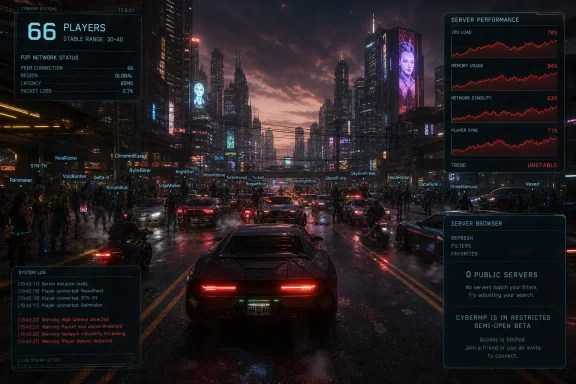 The 66-player figure does not match the public server listing
There is a small but revealing discrepancy between the test report and CyberMP’s public-facing server page. The new test reportedly reached 66 players on one server, while the project’s live server listing currently shows zero online players, zero available servers, and a recorded peak of 60.
That does not prove the 66-player report is wrong. A semi-open test can be temporary, private, or excluded from the persistent public browser, and the site’s counter may update differently from the test server’s telemetry. But CyberMP has not publicly explained the difference, published a test report, or provided performance metrics such as tick-rate stability, disconnect rates, desynchronization frequency, hardware configuration, or the number of active entities the server was handling.
For prospective testers and server operators, this is more important than the record itself. “66 players” suggests scale, but the meaningful number is the level at which a session remains playable during the activities users will actually attempt: driving at speed through dense streets, fighting, spawning vehicles, using custom scripts, and arriving or leaving a server. The team’s stated stable range of 30 to 40 is therefore the more actionable capacity figure.
A 30-player Night City can still be compelling, especially for role-play, races, PvP events, or social free-roam. It also sets expectations closer to a private GTA-style community server than a conventional MMO shard. Administrators planning large communities should treat the current ceiling as a test result, not a supported deployment target.
This is free-roam multiplayer, not campaign co-op
Earlier CyberMP coverage from DSOGaming and MMORPG.com made a point that remains easy to miss amid the promotional footage: the project is built around multiplayer free-roam and custom server experiences, not synchronized co-op play through the original campaign. Players should not expect to invite friends into a clean replica of the single-player questline, with every dialogue, scripted sequence, progression flag, and mission state operating in lockstep.
That limitation is not cosmetic. Cyberpunk 2077 was designed as a single-player RPG, where quests can branch on individual decisions, scripted scenes take control of the player, and saves maintain a large amount of personalized world state. Building a shared social world and building reliable narrative co-op are technically and structurally different undertakings. The former can avoid much of the campaign’s state-management burden by defining its own modes, rules, spawns, jobs, and progression.
The December 2025 CyberMP test, as reported by DSOGaming, focused on vehicle and player synchronization, a new overlay, Racing and PvP test modes, platform resilience, and a JavaScript module. The July 2025 beta update also highlighted synchronization for player appearance, vehicles, armed combat vehicles, and AVs. Those are substantial features for a mod team, but they reinforce the same point: CyberMP’s direction resembles a platform for community servers, not a patch that converts the existing RPG into drop-in campaign co-op.
That is the right framework for judging the new test. Seeing a convoy or a motorcycle ride through Night City proves the project is solving visible parts of the multiplayer problem. It says much less about the hard cases that make or break a public release: clients with differing mods, mission boundaries, crowd and traffic replication, server-side abuse prevention, crashes, save handling, and the consequences of a game update changing the underlying code.
The official multiplayer gap is real, but CD Projekt Red has not endorsed CyberMP
CyberMP is filling a gap left by CD Projekt Red’s abandoned plans for a standalone Cyberpunk multiplayer project. CD Projekt said in 2021 that it was reconsidering that project during a wider restructuring, and subsequent reporting from Ars Technica and VGC described the planned standalone multiplayer title as shelved. The publisher moved future major development toward Unreal Engine 5, while Cyberpunk 2077 remains on REDengine.
That history does not make CyberMP official, supported, or protected from future policy changes. CD Projekt Red’s REDmod license permits non-commercial modifications for use with Cyberpunk 2077, but it explicitly says the company does not monitor, endorse, or accept responsibility for mods. The publisher’s fan-content guidelines also require unofficial fan works to be clearly presented as unapproved and prohibit putting content behind a paywall, though reasonable donations are permitted.
The distinction became more than theoretical in 2026 when CD Projekt Red acted against a paid Cyberpunk 2077 VR mod that conflicted with its fan-content rules, as reported by Windows Central. CyberMP’s public messaging presents it as an independent, community-supported project, and a third-party server operator, NightCity.MP, likewise says it has no affiliation with the CyberMP development team. But anyone investing time into an early multiplayer mod should understand the dependency chain: the project relies on an unchanged game, access to testers, a working launcher, server operators, and a continuing tolerance for the model from the rights holder.
No official CyberMP release date has been announced. The project’s public site advertises a semi-open beta, but its own download gate confirms that availability remains tester-based rather than open to the whole player base.
Windows 11 is now part of the baseline
For Windows users, the underlying game’s supported operating-system position has shifted since CyberMP’s earlier development videos. CD Projekt Red says Cyberpunk 2077 and The Witcher 3 now have Windows 11 as their minimum required operating system after Windows 10 reached end of support on October 14, 2025. The studio says it will no longer test those games on Windows 10.
CyberMP has not published a separate Windows support matrix, minimum specifications, network-port guidance, anti-cheat compatibility statement, or an official compatibility list for popular Cyberpunk mod frameworks. That absence matters. A multiplayer layer is much more sensitive than a cosmetic or quality-of-life mod to version mismatches: one client with a different game build, dependency set, script package, or modded asset can turn into a connection failure or a server-side desynchronization problem.
The NightCity.MP testnet, one of the few public projects advertising that it runs on CyberMP, lists Cyberpunk 2077 version 2.21 or later as a requirement and requires a licensed copy of the game. It also describes its own access as a weekly random-selection process, not an open public shard. Its existence is evidence that third-party server operators are beginning to build around CyberMP; it is not proof that the core mod has reached general availability.
Players should therefore avoid treating the development video as an installation guide or a promise that their existing heavily modded single-player setup will be multiplayer-safe. Back up saves, keep a clean game installation available, and wait for the CyberMP team to publish explicit launcher, build, dependency, and server-hosting requirements before assuming a public test will work like a normal mod download.
A capacity test is progress, but it is also a warning
The strongest result from the second semi-open test is that CyberMP has moved beyond proof-of-concept footage. A single server with dozens of people is a meaningful engineering test for a fan-built multiplayer layer on a game never shipped with public online play. The team has also identified the instability that emerged at higher population counts, which is preferable to dismissing it or masking it with carefully edited footage.
But the test also sets the project’s present boundary in unusually clear terms. The stable target is 30 to 40 players, access remains restricted to testers, the public server listing is currently empty, and there is no announced release schedule. The important development is not that Cyberpunk 2077 multiplayer has arrived—it is that CyberMP now has a measurable capacity target to beat before it can credibly claim to have arrived.