
OpenAI will remove the official DALL·E GPT from ChatGPT on August 30, 2026, and anyone who wants to preserve images made through that dedicated GPT should download the files before then. The deadline is confirmed in OpenAI’s July 31 ChatGPT release notes and its current Images in ChatGPT help page; Notebookcheck also highlighted the change after it appeared in the release notes.
The practical point is narrower than some of the early coverage suggests. OpenAI is retiring a ChatGPT surface—the official preconfigured DALL·E GPT—not turning off image creation in ChatGPT. ChatGPT Images remains the replacement for generating and editing images, and OpenAI says custom GPTs with Image Generation enabled are unaffected.
But the company has supplied a cutoff date and a download recommendation without saying what, if anything, happens to the old DALL·E GPT’s generated images after August 30. For users who treat ChatGPT as a working asset library rather than a disposable prompt window, that omission is enough reason to save the originals now.
OpenAI’s wording is specific: it is “retiring the official DALL·E GPT in ChatGPT” on Sunday, August 30. The release notes direct users to ChatGPT Images for new image creation and editing, while explicitly exempting user-created GPTs that have image generation enabled.
That leaves three distinct things that are easy to conflate:
OpenAI describes ChatGPT Images 2.0 as available across all ChatGPT tiers, including Free. Its more deliberate “Images with thinking” mode is currently limited to Plus, Pro, and Business, with Enterprise and Edu listed as forthcoming. For most users, then, the August 30 change does not remove their ability to create pictures. It removes a legacy model choice and the predictable behavior attached to it.
The same OpenAI help article that says the official DALL·E GPT will retire on August 30 also still contains an FAQ answer stating that users who prefer DALL·E can access it through the DALL·E GPT. Those statements cannot both remain true after August 30. The retirement notice is the newer, date-specific instruction, and it is repeated in the July 31 release notes, so it should be treated as controlling.
This is more than a cosmetic contradiction. A user who lands on the older FAQ language after the GPT is removed could reasonably conclude that the disappearance is a temporary UI problem or an account-level rollout issue. It is neither, based on OpenAI’s current announcement: the official GPT is being retired.
OpenAI has not said whether the stale FAQ line will be removed before the deadline. It also has not published a migration guide for users who depended on DALL·E-specific prompting, nor has it promised a compatibility mode in ChatGPT Images. The company’s stated path is simply to use ChatGPT Images going forward.
For administrators and support teams, that means the right internal message is not “DALL·E is unavailable now.” It is: the DALL·E GPT is being removed on August 30, while ChatGPT’s image capability continues through a different feature and model family.
On Windows, the safest routine is to open ChatGPT in a desktop browser, visit Images, open each asset worth retaining, and use Save. Put the downloaded files in an ordinary local folder, a OneDrive folder, or an approved work repository—not only in a browser download history.
The company’s support documentation describes a per-image Save control. It does not document a bulk image-download tool specifically for this DALL·E GPT retirement. That makes this a manual archival job for anyone with a substantial image history.
A sensible preservation pass should include more than the PNG or JPG itself:
The upgraded ChatGPT search interface, released July 14 for web, iOS, and Android, can search across chats, projects, files, and images. That should help locate older DALL·E work, particularly where the user remembers a prompt fragment, project name, or subject but not the original conversation title.
What OpenAI has not said is equally important: it has not explicitly said that images created through the retiring DALL·E GPT will be deleted on August 30. “Download any images you want to keep” is a warning to preserve local copies, not a published deletion policy. Until OpenAI states the post-retirement retention behavior, users should not gamble valuable source material on continued access to an online gallery.
However, “not affected” means the custom GPT remains available; it does not mean its image outputs will remain visually or operationally identical. OpenAI says GPTs with Image Generation enabled can create images with the new generation model. That means any workflow dependent on a particular DALL·E visual tendency, prompting response, text rendering quirk, or image-editing behavior should be retested before August 30.
For a Windows-based content team, the low-risk approach is straightforward: run a small benchmark now. Take five to 10 representative production prompts—hero art, technical diagrams, social graphics, product mockups, transparent-background assets, and image revisions—and generate them through ChatGPT Images or the relevant custom GPT. Compare the results against the older DALL·E output for required dimensions, text accuracy, brand constraints, and editability.
This is especially relevant where image output feeds an automated Windows workflow: PowerPoint templates, SharePoint libraries, Teams posts, OneDrive-synced design folders, or documentation pipelines. The file may still arrive in the same place, but output variation can create review work downstream.
OpenAI’s developer documentation currently labels both
That record is messy enough that API owners should not infer a live production status from the ChatGPT retirement—or from a documentation page alone. Check application logs, test the deployed model identifier, and review account-level deprecation notices. The August 30 action is a consumer-product retirement; it is not a substitute for validating an API migration.
For ChatGPT users, the deadline is simpler: locate the old DALL·E images you need, save the files locally, and preserve the prompts that made them useful. On August 30, the official DALL·E GPT goes away; the images worth keeping should already be somewhere you control.
But the company has supplied a cutoff date and a download recommendation without saying what, if anything, happens to the old DALL·E GPT’s generated images after August 30. For users who treat ChatGPT as a working asset library rather than a disposable prompt window, that omission is enough reason to save the originals now.
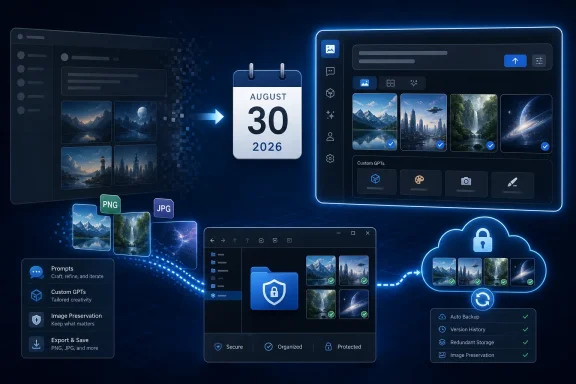 August 30 removes the official GPT, not image generation
OpenAI’s wording is specific: it is “retiring the official DALL·E GPT in ChatGPT” on Sunday, August 30. The release notes direct users to ChatGPT Images for new image creation and editing, while explicitly exempting user-created GPTs that have image generation enabled.That leaves three distinct things that are easy to conflate:
- The official DALL·E GPT is scheduled to disappear from ChatGPT on August 30.
- ChatGPT Images remains available for ordinary image creation and editing on the web, iOS, and Android.
- Custom GPTs using the Image Generation capability will continue to work, but they will use ChatGPT’s newer image-generation path rather than preserve a separate DALL·E experience.
OpenAI describes ChatGPT Images 2.0 as available across all ChatGPT tiers, including Free. Its more deliberate “Images with thinking” mode is currently limited to Plus, Pro, and Business, with Enterprise and Edu listed as forthcoming. For most users, then, the August 30 change does not remove their ability to create pictures. It removes a legacy model choice and the predictable behavior attached to it.
OpenAI’s own help page contains a stale DALL·E instruction
There is a documentation problem worth flagging before users assume there is a way to keep DALL·E alive inside ChatGPT after the deadline.The same OpenAI help article that says the official DALL·E GPT will retire on August 30 also still contains an FAQ answer stating that users who prefer DALL·E can access it through the DALL·E GPT. Those statements cannot both remain true after August 30. The retirement notice is the newer, date-specific instruction, and it is repeated in the July 31 release notes, so it should be treated as controlling.
This is more than a cosmetic contradiction. A user who lands on the older FAQ language after the GPT is removed could reasonably conclude that the disappearance is a temporary UI problem or an account-level rollout issue. It is neither, based on OpenAI’s current announcement: the official GPT is being retired.
OpenAI has not said whether the stale FAQ line will be removed before the deadline. It also has not published a migration guide for users who depended on DALL·E-specific prompting, nor has it promised a compatibility mode in ChatGPT Images. The company’s stated path is simply to use ChatGPT Images going forward.
For administrators and support teams, that means the right internal message is not “DALL·E is unavailable now.” It is: the DALL·E GPT is being removed on August 30, while ChatGPT’s image capability continues through a different feature and model family.
Download the actual image files, not only the chats
OpenAI says images created in ChatGPT are automatically stored under the Images area on the web and mobile apps. Opening an image exposes options to Copy, Save, or Share. The option that matters for preservation is Save, which downloads the image file to the local device.On Windows, the safest routine is to open ChatGPT in a desktop browser, visit Images, open each asset worth retaining, and use Save. Put the downloaded files in an ordinary local folder, a OneDrive folder, or an approved work repository—not only in a browser download history.
The company’s support documentation describes a per-image Save control. It does not document a bulk image-download tool specifically for this DALL·E GPT retirement. That makes this a manual archival job for anyone with a substantial image history.
A sensible preservation pass should include more than the PNG or JPG itself:
- Save the highest-resolution file ChatGPT offers for each image that has production, commercial, or personal value.
- Preserve the prompt text and any important revision instructions in a text file, document, or exported chat record.
- Record where the asset was used, such as a presentation, website, support article, or internal training deck.
- Keep a local copy before deleting a conversation, because OpenAI says deleting the originating conversation removes the image from My Images.
The upgraded ChatGPT search interface, released July 14 for web, iOS, and Android, can search across chats, projects, files, and images. That should help locate older DALL·E work, particularly where the user remembers a prompt fragment, project name, or subject but not the original conversation title.
What OpenAI has not said is equally important: it has not explicitly said that images created through the retiring DALL·E GPT will be deleted on August 30. “Download any images you want to keep” is a warning to preserve local copies, not a published deletion policy. Until OpenAI states the post-retirement retention behavior, users should not gamble valuable source material on continued access to an online gallery.
Custom GPT builders avoid shutdown, but should test output changes
OpenAI’s exemption for user-created GPTs is useful, especially for teams that use custom GPTs to enforce brand prompts, image sizes, naming conventions, or editorial checks. Those GPTs are not being removed merely because their Image Generation capability is turned on.However, “not affected” means the custom GPT remains available; it does not mean its image outputs will remain visually or operationally identical. OpenAI says GPTs with Image Generation enabled can create images with the new generation model. That means any workflow dependent on a particular DALL·E visual tendency, prompting response, text rendering quirk, or image-editing behavior should be retested before August 30.
For a Windows-based content team, the low-risk approach is straightforward: run a small benchmark now. Take five to 10 representative production prompts—hero art, technical diagrams, social graphics, product mockups, transparent-background assets, and image revisions—and generate them through ChatGPT Images or the relevant custom GPT. Compare the results against the older DALL·E output for required dimensions, text accuracy, brand constraints, and editability.
This is especially relevant where image output feeds an automated Windows workflow: PowerPoint templates, SharePoint libraries, Teams posts, OneDrive-synced design folders, or documentation pipelines. The file may still arrive in the same place, but output variation can create review work downstream.
The ChatGPT deadline should not be mistaken for an API notice
Developers should keep the August 30 ChatGPT retirement separate from the DALL·E API story. OpenAI’s July 31 notice names the official DALL·E GPT in ChatGPT and points end users to ChatGPT Images. It does not announce an API change.OpenAI’s developer documentation currently labels both
dall-e-2 and dall-e-3 as deprecated, while still displaying model pages with image-generation endpoint and pricing material. Separately, an OpenAI Developer Community deprecation notice said the two API models would shut down on May 12, 2026 and recommended migration to GPT Image models.That record is messy enough that API owners should not infer a live production status from the ChatGPT retirement—or from a documentation page alone. Check application logs, test the deployed model identifier, and review account-level deprecation notices. The August 30 action is a consumer-product retirement; it is not a substitute for validating an API migration.
For ChatGPT users, the deadline is simpler: locate the old DALL·E images you need, save the files locally, and preserve the prompts that made them useful. On August 30, the official DALL·E GPT goes away; the images worth keeping should already be somewhere you control.
References
- Primary source: Notebookcheck
Published: 2026-08-05T07:48:00+00:00
Loading…
www.notebookcheck.net - Related coverage: help.openai.com
Loading…
help.openai.com - Related coverage: help.openai.com
Loading…
help.openai.com - Related coverage: community.openai.com
Loading…
community.openai.com - Related coverage: community.openai.com
Loading…
community.openai.com - Related coverage: lumenfall.ai
Loading…
lumenfall.ai - Related coverage: nerova.ai
Loading…
nerova.ai - Related coverage: linkedin.com
Loading…
www.linkedin.com - Related coverage: learn.microsoft.com
Loading…
learn.microsoft.com - Related coverage: nextomoro.com
Loading…
nextomoro.com - Related coverage: developers.openai.com
Loading…
developers.openai.com - Related coverage: developers.openai.com
Loading…
developers.openai.com - Related coverage: help-lb.openai.com
Loading…
help-lb.openai.com - Related coverage: openai.com
Loading…
openai.com - Related coverage: techradar.com
Loading…
www.techradar.com - Related coverage: androidauthority.com
Loading…
www.androidauthority.com