
The U.S. open-weight AI push now has three very different kinds of contenders: models that can be downloaded today, a heavily funded lab that has not yet shipped one, and a national-security argument that is far less settled than its advocates suggest. For Windows developers and enterprise IT teams, the immediate takeaway is practical: American alternatives to Chinese open-weight models are becoming real, but availability, licensing, hardware requirements, and independent evidence still vary sharply.
The Wall Street Journal recently highlighted Arcee, Poolside, Reflection AI, and Mira Murati’s Thinking Machines Lab as U.S. companies positioning themselves against Chinese open-weight developers such as DeepSeek, Moonshot AI, Z.ai, and Alibaba. Digital Today’s follow-up framed the trend as a potential U.S. response to Chinese leadership in downloadable models.
That framing gets one big point right: model weights matter. A company can run an open-weight model inside its own environment rather than sending prompts, documents, source code, and retrieval data to a vendor-hosted API. But the emerging U.S. field does not yet offer a clean “buy American, solve the problem” answer. Two of the most visible U.S. releases are large enough to require serious infrastructure, their headline benchmark results remain substantially vendor-produced, and the startup with the biggest valuation has yet to publicly release a model.
The most concrete error in the supplied account concerns Arcee’s flagship. Digital Today described “Trinity Large” as a 4.5-billion-parameter model. Arcee’s own technical report and deployment documentation identify Trinity Large as a 400-billion-parameter sparse mixture-of-experts model, with 13 billion parameters active for each token.
The distinction is not cosmetic. A 4.5B model is within reach of many workstations and higher-end PCs, particularly when quantized. Arcee lists a minimum of 224GB of RAM for a 4-bit Trinity Large deployment, with 336GB recommended; an 8-bit version requires 448GB. That makes Trinity Large a self-hosted enterprise or lab deployment, not a model most Windows enthusiasts will download to a gaming PC and begin using locally.
Arcee did train the model on 2,048 Nvidia B300 GPUs and says it completed the wider effort, including compute, staffing, data, storage, and operations, for $20 million. That is a noteworthy claim because it challenges the assumption that every frontier-scale U.S. model requires the capital base of OpenAI, Anthropic, Google, or Meta. It is still a company-reported cost figure, not an independently audited bill.
Arcee’s earlier Trinity Large release used the permissive Apache 2.0 license, but its newer Trinity-Large-Thinking release is distributed under OpenMDW-1.1. Administrators should check the license attached to the exact checkpoint they intend to deploy rather than treating “open weight” as a universal permission to redistribute, fine-tune, or commercialize. Open weight means the trained parameters are available; it does not automatically mean the training corpus, training code, data rights, or downstream commercial permissions are equally open.
That distinction has operational consequences. An organization can inspect, host, and adapt the released artifact, but it cannot recreate the training run or fully audit the provenance of its data from weights alone. The same is true of most Chinese open-weight models.
That still is not the same as “run it on a PC.” A DGX Spark is specialized AI hardware, not a typical Windows workstation. The useful shift is that organizations with an on-premises AI appliance, an Nvidia-backed private cloud, or a sufficiently capable Linux inference stack can consider a self-hosted coding model without constructing a cluster around a 400B checkpoint.
Poolside has published trajectory data for Terminal-Bench 2.1 and says Laguna S 2.1 compares favorably with substantially larger models on Terminal-Bench, SWE-Bench Pro, DeepSWE, and related coding evaluations. Its public model page, however, also says its comparisons use the highest available result among its own reports, benchmark-author leaderboards, and third-party leaderboards.
That is transparent, but it limits how much readers should infer from a single scorecard. The model may be a strong choice for its targeted work—coding agents and long-running terminal tasks—without being a general replacement for the best closed models. Poolside itself identifies Laguna S 2.1 as a coding and reasoning model, not as a universal assistant.
The release is also under OpenMDW-1.1 rather than a conventional permissive software license. Enterprises should involve legal and procurement teams before treating it as a drop-in equivalent to an Apache- or MIT-licensed package. Downloadable weights reduce dependency on a hosted inference service; they do not eliminate contractual obligations.
The important context came from The Information: Thinking Machines said Inkling’s architecture “largely follows” DeepSeek V3, and the company used synthetic data from open models including Moonshot AI’s Kimi K2.5 for part of post-training. Thinking Machines itself has described Inkling as a broad, balanced model rather than the strongest available model, open or closed.
That makes the geopolitical pitch more complicated than “U.S. model versus Chinese model.” Inkling is an American-developed, downloadable model with U.S. governance and a U.S. company behind it. It is also an example of the normal cross-pollination that open research and released weights make possible. If Washington’s concern is that Chinese research or model behavior must be excluded from domestic AI stacks, the leading U.S. entrants may not meet that test without demanding disclosures about architecture, synthetic training data, post-training sources, and evaluation methods that the entire industry rarely provides.
For organizations, this is a procurement issue rather than an ideological one. If your rule is that no production model may contain outputs generated by a particular supplier’s model, ask the vendor directly and obtain the answer in writing. Country of incorporation and a downloadable checkpoint do not answer that question by themselves.
That status matters. A company that has not shipped a checkpoint, a model card, deployment guidance, evaluation artifacts, or a license cannot be weighed against DeepSeek, Arcee, Poolside, or Thinking Machines as an actual open-weight option. It can be viewed as a well-financed bet on a future U.S. model supplier.
The Information reported that Reflection planned a first model this year, followed by larger and smaller releases in early 2027, and that its first release was expected to match leading Western models while trailing top Chinese open-weight models. That is a report about an unreleased roadmap, not an independently testable capability claim.
The investment picture therefore does not support the idea that American open-weight developers broadly lack money. It shows something narrower: capital will flow to a perceived strategic challenger with elite founders, Nvidia backing, and government relationships, even before a public model exists. Smaller companies that have already released models must still demonstrate a path from downloads and benchmark charts to durable enterprise revenue.
Researchers have also documented political-information suppression in DeepSeek behavior. That is a legitimate concern for organizations that need reliable answers on politically sensitive topics, and it can affect downstream applications where a model’s selective refusals or framing are difficult to detect.
But hosted-service risk and self-hosted-weight risk are different. A user sending confidential data to a hosted chatbot must evaluate where prompts are processed, retained, logged, and accessible. A company running downloaded weights on its own infrastructure removes that direct prompt-transfer path, while retaining other risks: unreviewed model behavior, vulnerable inference servers, poisoned model files, dependencies, license restrictions, and the inability to verify all training inputs.
Sweden’s Defence Research Agency reached a more restrained conclusion after examining DeepSeek artifacts and associated code: it found them purposefully published in line with contemporary AI research practices and did not identify evidence of hidden agendas in the released material. That does not negate the U.S. government’s censorship and security findings. It does show why blanket claims about a model’s national origin are a poor substitute for artifact verification, red-teaming, network controls, and task-specific testing.
The emerging American model roster gives U.S. buyers more options, but it does not yet establish a performance, cost, or security lead over China’s best open-weight releases. Arcee, Poolside, and Thinking Machines have supplied real artifacts that can be tested; Reflection AI has supplied a powerful financial narrative but no downloadable model. For Windows and enterprise administrators, the near-term decision remains concrete: evaluate the exact checkpoint, license, hardware footprint, data path, and benchmark relevance before treating “U.S.-made open weight” as either a security control or a practical local-AI deployment plan.
That framing gets one big point right: model weights matter. A company can run an open-weight model inside its own environment rather than sending prompts, documents, source code, and retrieval data to a vendor-hosted API. But the emerging U.S. field does not yet offer a clean “buy American, solve the problem” answer. Two of the most visible U.S. releases are large enough to require serious infrastructure, their headline benchmark results remain substantially vendor-produced, and the startup with the biggest valuation has yet to publicly release a model.
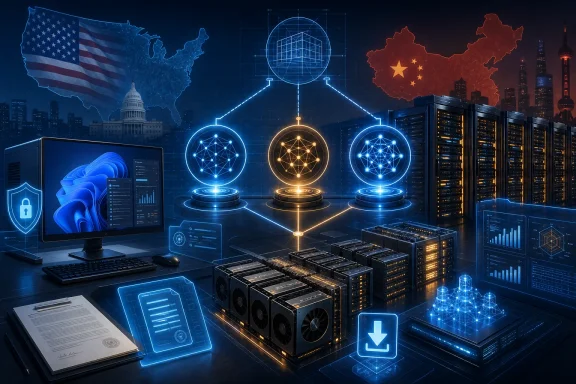 Arcee’s Trinity Large Is 400B, Not 4.5B
The most concrete error in the supplied account concerns Arcee’s flagship. Digital Today described “Trinity Large” as a 4.5-billion-parameter model. Arcee’s own technical report and deployment documentation identify Trinity Large as a 400-billion-parameter sparse mixture-of-experts model, with 13 billion parameters active for each token.The distinction is not cosmetic. A 4.5B model is within reach of many workstations and higher-end PCs, particularly when quantized. Arcee lists a minimum of 224GB of RAM for a 4-bit Trinity Large deployment, with 336GB recommended; an 8-bit version requires 448GB. That makes Trinity Large a self-hosted enterprise or lab deployment, not a model most Windows enthusiasts will download to a gaming PC and begin using locally.
Arcee did train the model on 2,048 Nvidia B300 GPUs and says it completed the wider effort, including compute, staffing, data, storage, and operations, for $20 million. That is a noteworthy claim because it challenges the assumption that every frontier-scale U.S. model requires the capital base of OpenAI, Anthropic, Google, or Meta. It is still a company-reported cost figure, not an independently audited bill.
Arcee’s earlier Trinity Large release used the permissive Apache 2.0 license, but its newer Trinity-Large-Thinking release is distributed under OpenMDW-1.1. Administrators should check the license attached to the exact checkpoint they intend to deploy rather than treating “open weight” as a universal permission to redistribute, fine-tune, or commercialize. Open weight means the trained parameters are available; it does not automatically mean the training corpus, training code, data rights, or downstream commercial permissions are equally open.
That distinction has operational consequences. An organization can inspect, host, and adapt the released artifact, but it cannot recreate the training run or fully audit the provenance of its data from weights alone. The same is true of most Chinese open-weight models.
Poolside Has Shipped a Smaller Operational Target
Poolside’s Laguna S 2.1 is the more immediately interesting release for technical teams focused on agentic coding. The company released the 118B-total-parameter mixture-of-experts model in July, with 8B parameters active per token, and says it was trained on 30 trillion tokens. Poolside specifically markets it as small enough to run on one Nvidia DGX Spark, putting it closer to a single-appliance deployment than Arcee’s Trinity Large.That still is not the same as “run it on a PC.” A DGX Spark is specialized AI hardware, not a typical Windows workstation. The useful shift is that organizations with an on-premises AI appliance, an Nvidia-backed private cloud, or a sufficiently capable Linux inference stack can consider a self-hosted coding model without constructing a cluster around a 400B checkpoint.
Poolside has published trajectory data for Terminal-Bench 2.1 and says Laguna S 2.1 compares favorably with substantially larger models on Terminal-Bench, SWE-Bench Pro, DeepSWE, and related coding evaluations. Its public model page, however, also says its comparisons use the highest available result among its own reports, benchmark-author leaderboards, and third-party leaderboards.
That is transparent, but it limits how much readers should infer from a single scorecard. The model may be a strong choice for its targeted work—coding agents and long-running terminal tasks—without being a general replacement for the best closed models. Poolside itself identifies Laguna S 2.1 as a coding and reasoning model, not as a universal assistant.
The release is also under OpenMDW-1.1 rather than a conventional permissive software license. Enterprises should involve legal and procurement teams before treating it as a drop-in equivalent to an Apache- or MIT-licensed package. Downloadable weights reduce dependency on a hosted inference service; they do not eliminate contractual obligations.
Thinking Machines Shows How Blurred the U.S.-China Divide Already Is
Thinking Machines Lab’s Inkling is arguably the clearest evidence that the American open-weight field is moving from slogans to products. The Murati-led company released Inkling in July as a 975B-total-parameter, 41B-active multimodal model supporting text, image, and audio inputs. Artificial Analysis currently assigns Inkling an Intelligence Index score of roughly 41, which is respectable but trails the leading Chinese and closed frontier systems in that ranking.The important context came from The Information: Thinking Machines said Inkling’s architecture “largely follows” DeepSeek V3, and the company used synthetic data from open models including Moonshot AI’s Kimi K2.5 for part of post-training. Thinking Machines itself has described Inkling as a broad, balanced model rather than the strongest available model, open or closed.
That makes the geopolitical pitch more complicated than “U.S. model versus Chinese model.” Inkling is an American-developed, downloadable model with U.S. governance and a U.S. company behind it. It is also an example of the normal cross-pollination that open research and released weights make possible. If Washington’s concern is that Chinese research or model behavior must be excluded from domestic AI stacks, the leading U.S. entrants may not meet that test without demanding disclosures about architecture, synthetic training data, post-training sources, and evaluation methods that the entire industry rarely provides.
For organizations, this is a procurement issue rather than an ideological one. If your rule is that no production model may contain outputs generated by a particular supplier’s model, ask the vendor directly and obtain the answer in writing. Country of incorporation and a downloadable checkpoint do not answer that question by themselves.
Reflection AI Is a Valuation, Not Yet a Deployable Alternative
Reflection AI is the sharpest example of the gap between investment excitement and a usable product. The company raised $2 billion in a funding round that included an approximately $800 million Nvidia investment and was previously valued at $8 billion. More recent reporting from Axios has described Reflection at a $25 billion valuation, while also noting that it had not released a model.That status matters. A company that has not shipped a checkpoint, a model card, deployment guidance, evaluation artifacts, or a license cannot be weighed against DeepSeek, Arcee, Poolside, or Thinking Machines as an actual open-weight option. It can be viewed as a well-financed bet on a future U.S. model supplier.
The Information reported that Reflection planned a first model this year, followed by larger and smaller releases in early 2027, and that its first release was expected to match leading Western models while trailing top Chinese open-weight models. That is a report about an unreleased roadmap, not an independently testable capability claim.
The investment picture therefore does not support the idea that American open-weight developers broadly lack money. It shows something narrower: capital will flow to a perceived strategic challenger with elite founders, Nvidia backing, and government relationships, even before a public model exists. Smaller companies that have already released models must still demonstrate a path from downloads and benchmark charts to durable enterprise revenue.
Security Concerns Need to Be Split Into Separate Risks
There is evidence for concern about Chinese AI systems, but it does not support treating every Chinese open-weight checkpoint as an uninspectable backdoor or every U.S.-made alternative as inherently safe. The U.S. National Institute of Standards and Technology’s CAISI evaluation found shortcomings in DeepSeek models involving performance, security, and censorship, and said those issues could affect developers, consumers, and national security.Researchers have also documented political-information suppression in DeepSeek behavior. That is a legitimate concern for organizations that need reliable answers on politically sensitive topics, and it can affect downstream applications where a model’s selective refusals or framing are difficult to detect.
But hosted-service risk and self-hosted-weight risk are different. A user sending confidential data to a hosted chatbot must evaluate where prompts are processed, retained, logged, and accessible. A company running downloaded weights on its own infrastructure removes that direct prompt-transfer path, while retaining other risks: unreviewed model behavior, vulnerable inference servers, poisoned model files, dependencies, license restrictions, and the inability to verify all training inputs.
Sweden’s Defence Research Agency reached a more restrained conclusion after examining DeepSeek artifacts and associated code: it found them purposefully published in line with contemporary AI research practices and did not identify evidence of hidden agendas in the released material. That does not negate the U.S. government’s censorship and security findings. It does show why blanket claims about a model’s national origin are a poor substitute for artifact verification, red-teaming, network controls, and task-specific testing.
The emerging American model roster gives U.S. buyers more options, but it does not yet establish a performance, cost, or security lead over China’s best open-weight releases. Arcee, Poolside, and Thinking Machines have supplied real artifacts that can be tested; Reflection AI has supplied a powerful financial narrative but no downloadable model. For Windows and enterprise administrators, the near-term decision remains concrete: evaluate the exact checkpoint, license, hardware footprint, data path, and benchmark relevance before treating “U.S.-made open weight” as either a security control or a practical local-AI deployment plan.
References
- Primary source: 디지털투데이
Published: 2026-08-04T21:51:37+00:00
Loading…
www.digitaltoday.co.kr - Related coverage: globenewswire.com
Poolside releases Laguna S 2.1, the West’s most capable
Poolside releases Laguna S 2.1, the West’s most capable open-weight model...www.globenewswire.com
- Related coverage: zeronoise.ai
Loading…
zeronoise.ai - Related coverage: axios.com
Loading…
www.axios.com - Related coverage: theinformation.com
Loading…
www.theinformation.com - Related coverage: itpro.com
Big tech faces an adapt or die predicament with open weight AI models | IT Pro
An array of US tech providers are now defending the AI models that undermine the illusion of big tech exceptionalismwww.itpro.com - Related coverage: nist.gov
CAISI Evaluation of DeepSeek AI Models Finds Shortcomings and Risks
The Center for AI Standards and Innovation at NIST evaluated several leading models from DeepSeek, an AI company based in the People’s Republic of China.www.nist.gov - Related coverage: nist.gov
Loading…
www.nist.gov - Related coverage: commerce.gov
Loading…
www.commerce.gov - Related coverage: digichina.stanford.edu
- Related coverage: axios.com
Axios C-Suite: Open-source AI pits cost against security
It's free to download, cheaper to run — and dominated by China.www.axios.com
- Related coverage: tomshardware.com
Trump administration reportedly reviving push to ban Chinese AI models following Kimi K3 launch, citing cybersecurity concerns — downloadable open weights could make an outright U.S. ban nearly impossible to enforce amid growing adoption | Tom'
Critics say the ban will stifle innovation and encourage monopolieswww.tomshardware.com