
The comparison, attributed to Blockchain.news and republished by RSWEB Solutions, uses DeepSWE results to place DeepSeek-V4 Flash at 53.3% pass@1 and GPT-5.6 Luna at 67.2%. Those are recognizable public leaderboard figures for the max reasoning configurations used with the same mini-swe-agent harness. The public DeepSWE record also puts DeepSeek at $0.10 per task and roughly 23 minutes 59 seconds, while Luna’s earlier run cost was $3.03 and took 18 minutes 43 seconds.
The reported $0.61 cost for Luna is not the original benchmark run’s price. It is the old $3.03 task estimate recalculated after OpenAI cut Luna API pricing by 80% in late July 2026, from $1 input and $6 output per million tokens to $0.20 input and $1.20 output. That change is important: it narrows the real economics sharply, and it means any comparison that mixes July benchmark performance with August token prices should say so explicitly.
 The underlying DeepSWE numbers are real, but they are not a 900-task test
DeepSWE is a long-horizon software-engineering benchmark from Datacurve. Its public v1.1 leaderboard covers 113 original tasks across 91 repositories and five programming languages, using isolated environments and programmatic verification. It is not a 900-task, eight-domain comparison.
The submitted comparison appears to have blended the public DeepSWE leaderboard with a broader framing about “900 authentic coding tasks.” The public records support the quoted 67.2% score for GPT-5.6 Luna at maximum reasoning and the 53.3% score for DeepSeek-V4 Flash at maximum reasoning. They do not support describing those two results as a single 900-task DeepSWE test spanning eight domains.
That distinction changes how the scores should be read. DeepSWE is deliberately a demanding agent benchmark: the model is paired with a particular coding-agent harness, a chosen reasoning level, a tool environment, time limits, and a verifier. The 67.2% and 53.3% figures are not standalone measures of what either model will do in Visual Studio Code, GitHub Copilot Chat, OpenAI Codex, Cline, or an internal CI pipeline.
They are, however, useful directional evidence. With the same mini-swe-agent configuration and maximum reasoning, Luna solved more tasks than DeepSeek-V4 Flash in the published run. DeepSeek delivered a far lower estimated inference cost. For teams that run many independent, low-consequence coding jobs, that is a meaningful operational difference.
Luna’s price cut changed the arithmetic
The original leaderboard attached a $3.03 estimated cost to GPT-5.6 Luna’s 67.2% DeepSWE result. OpenAI’s current Luna API pricing is one-fifth of its launch price, so applying the new token rates to the same estimated workload produces about $0.61 per task.
That is how the comparison reaches its headline economics:
| Configuration | Published pass@1 | Estimated task cost used in comparison | Successful tasks per $100, by simple score/cost arithmetic |
|---|---|---|---|
| DeepSeek-V4 Flash, max | 53.3% | $0.10 | 533 |
| GPT-5.6 Luna, max | 67.2% | about $0.61 | 110 |
The math behind the 4.8x claim is sound as a benchmark-cost ratio: 53.3 successful-task percentage points divided by $0.10 produces 5.33 pass points per dollar, while 67.2 divided by $0.61 produces about 1.10. DeepSeek therefore produces roughly 4.8 times as many benchmark-weighted completions per dollar under those assumptions.
But this is not a billing forecast. The per-task figure depends heavily on the agent’s token use, its retry policy, the size of the checked-out repository, tool-call frequency, context-cache hit rate, and whether a task needs vision, browser access, hosted shell tools, or lengthy outputs. A 20-line PowerShell correction and a cross-repository TypeScript refactor will not consume anything close to the same budget.
For Windows administrators and developer-platform teams, the safer interpretation is simpler: DeepSeek-V4 Flash is very inexpensive for bulk jobs, while Luna is no longer the six-times-costlier option claimed by the original cost table. Its price reduction has moved it into a much more credible role for high-volume coding queues.
The proposed cascade is an oracle calculation until it has a gate
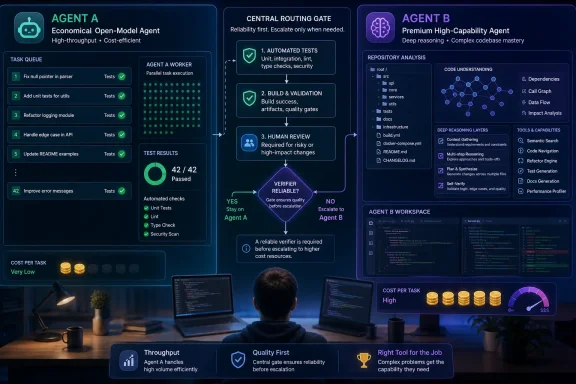
The most attractive claim in the comparison is the proposed DeepSeek-first, Luna-second cascade: 78.9% pass@1 at $0.385 per task. The cost is easy to reproduce. Run DeepSeek on every task for $0.10, then send the 46.7% it did not solve to Luna at about $0.61 each:
$0.10 + (0.467 × $0.61) = about $0.385The issue is that the calculation assumes the system can identify DeepSeek’s failed tasks before escalating them. In benchmark reporting, that information comes from the verifier after the run. In production, an agent does not receive a reliable “this patch failed” label merely because it has produced an answer.
A practical cascade needs a gate, such as unit tests, integration tests, build validation, static analysis, policy checks, a deterministic output validator, or human review. Without one, the choice is either to trust DeepSeek’s output and risk silent defects, or run Luna as well—which largely erases the claimed saving.
The 78.9% combined score also needs more documentation than the circulated analysis provides. A score above Luna’s 67.2% standalone result is possible if the two models fail on different tasks and the routing logic accurately detects DeepSeek failures. It is not guaranteed by simply placing one model ahead of another. The analysis does not disclose the routing policy, whether it used test failures as the handoff signal, whether Luna received DeepSeek’s intermediate work, or how the combined score was calculated.
The cascade is a promising deployment pattern, not a demonstrated 78.9% production result. Teams should treat it as an experiment to validate against their own repositories rather than an accuracy number to put into a procurement spreadsheet.
What each model is actually suited to
DeepSeek’s official V4 documentation describes Flash as the smaller, faster, economical member of the V4 family, with 284 billion total parameters and 13 billion active parameters. It supports a one-million-token context window, OpenAI Chat Completions compatibility, Anthropic API compatibility, and both thinking and non-thinking modes. The model’s open weights also create a deployment option that Luna cannot match: organizations with the infrastructure and compliance requirements can run DeepSeek-V4 Flash under their own controls rather than sending source code to a hosted proprietary model.
That makes Flash a sensible first choice for jobs where an objective verifier already exists:
- It is well suited to generating or repairing repetitive configuration, SQL, infrastructure-as-code, test fixtures, migration scripts, and documentation transformations that can be checked automatically.
- It is a plausible low-cost worker for issue triage, log classification, codebase indexing, patch proposals, and test-generation batches where failure is cheap and retries are acceptable.
- It should not be allowed to merge changes solely because it produced a plausible explanation or a green-looking diff.
GPT-5.6 Luna is OpenAI’s low-cost, high-volume GPT-5.6 tier, not the family’s flagship. OpenAI positions Sol as the stronger coding and reasoning option, while Luna is the affordable and fast tier. Still, Luna’s DeepSWE result at maximum reasoning was materially higher than Flash’s public result, and its API offers supported access to tools including hosted shell, code interpreter, file search, web search, computer use, MCP, image generation, and patch application.
For Windows-centric development work, Luna becomes more attractive where the task involves a mix of code, screenshots, UI state, repositories, and tools—or where a failed first attempt is expensive. A difficult PowerShell remediation runbook, a multi-project .NET regression, a concurrency bug, or a JavaScript build-chain failure can consume more engineer time than the model-price difference ever saves.
Use test outcomes, not model branding, to route work
The strongest conclusion from this comparison is not “cheap-first” by default. It is verify-first, then route by consequence.
If a task has a deterministic test suite, lint gate, compilation check, or infrastructure plan validation, DeepSeek-V4 Flash can be an economical first-pass agent. A failed gate can automatically trigger a second attempt, an escalation to Luna, or human review. That structure turns the theoretical cascade into an auditable engineering workflow.
If the task lacks a dependable verifier, involves a production outage, touches security-sensitive code, or requires a correct answer on the first pass, choosing the cheaper model first may be false economy. The cost of one unnoticed bad patch, wasted incident-response hour, or incorrect configuration change dwarfs a few dozen cents of model inference.
OpenAI’s August pricing now makes Luna substantially cheaper than the comparison’s original framing suggests. DeepSeek-V4 Flash remains the cost leader in the published DeepSWE run, but the evidence supports a narrower claim: use Flash for high-volume work that your pipeline can prove right or wrong, and use Luna when the task’s failure cost makes a 14-point benchmark gap worth paying for.
References
- Primary source: RS Web Solutions
Published: August 8, 2026 at 6:00 PM UTC
Loading…
www.rswebsols.com - Related coverage: axios.com
OpenAI makes major upgrades for ChaptGPT. What to know
The upgrades will help both paid and free users.www.axios.com
- Related coverage: developers.openai.com
GPT-5.6 Luna Model | OpenAI API
 developers.openai.com
- Related coverage: aidenapp.org
Loading…
aidenapp.org - Related coverage: eesel.ai
Loading…
www.eesel.ai - Related coverage: gate.ai
Loading…
gate.ai - Related coverage: techjournal.org
Loading…
techjournal.org - Related coverage: unifically.com
Loading…
unifically.com - Related coverage: the-agent-report.com
GPT-5.6 Sol, Terra, Luna: Full Benchmark Analysis and Which Tier to Actually Use | The Agent Report
TL;DR: OpenAI shipped GPT-5.6 to general availability on July 9, 2026, as a three-tier family: Sol (flagship, $5/$30 per M tokens), Terra (balanced, $2.50/$1... the-agent-report.com
- Related coverage: codingfleet.com
GPT-5.6 Luna vs GLM 5.2: Coding, Cost, Context and Open Weights · CodingFleet Blog
A sourced comparison of GPT-5.6 Luna and GLM 5.2 across coding benchmarks, 1M context, tools, pricing, modalities, licensing and practical production fit. codingfleet.com
- Related coverage: docsbot.ai
GPT-5.6 Luna vs Kimi K3 - Detailed Performance & Feature Comparison
Discover how OpenAI's GPT-5.6 Luna and Moonshot AI's Kimi K3 stack up in performance, features, and applications. Read our detailed comparison to find out which AI model best suits your needs. docsbot.ai
- Related coverage: trilogyai.substack.com
GPT‑5.6 Terra, Luna and Sol Gain a Powerful Edge Over Anthropic Models
GPT‑5.6 Sol, Terra, Luna, and Ultra compared: benchmarks, API costs, and a practical guide to choosing the right model for coding agents.trilogyai.substack.com - Related coverage: aitier.net

GPT-5.6 Luna (Non-reasoning) — OpenAI | AITier
GPT-5.6 Luna (Non-reasoning) model details including pricing, speed, benchmark scores and rankings.
aitier.net
- Related coverage: tokenrate.dev
DeepSeek API Pricing in 2026: The 100x Cheaper Question | TokenRate
DeepSeek V4 Flash costs about $0.10 per million input tokens — roughly 100x below frontier pricing. Here's the full V4 and R1 price breakdown, and the caveats that matter.tokenrate.dev - Related coverage: requesty.ai
DeepInfra Inc. deepseek-ai/DeepSeek-V4-Flash API Pricing & Cost: Context Window & Benchmarks | Requesty
deepseek-ai/DeepSeek-V4-Flash API pricing: $0.10/1M input, $0.20/1M output, 1.0M context. Intelligence Index 51.8. DeepSeek V4 Flash is an efficiency-focused MoE model with 284B total parameters… Specs, benchmarks and instant access via one OpenAI-compatible API.www.requesty.ai - Related coverage: flowtivity.ai
We Ran DeepSWE at 1M Context vs 262K. The Results Surprised Us. | Flowtivity
Real-world A/B benchmark running DeepSWE tasks on DeepSeek V4 Flash at 1M vs 262K context. The 1M run was 3x faster but produced identical results. Here is what we learned about local LLM agent benchmarks.flowtivity.ai - Related coverage: api-docs.deepseek.com
DeepSeek V4 Preview Release | DeepSeek API Docs
🚀 DeepSeek-V4 Preview is officially live & open-sourced! Welcome to the era of cost-effective 1M context length.api-docs.deepseek.com - Related coverage: huggingface.co
deepseek-ai/DeepSeek-V4-Flash · Hugging Face
We’re on a journey to advance and democratize artificial intelligence through open source and open science.huggingface.co - Related coverage: morphllm.com
Loading…
www.morphllm.com - Related coverage: whichllm.io
DeepSeek V4 Flash on OpenRouter · 1048K context · $0.14/1M input | whichllm
DeepSeek V4 Flash on OpenRouter: 1048K context window, $0.14/1M input tokens, supports tool calling, reasoning. Compare pricing and context across providers on whichllm.whichllm.io - Related coverage: allaimodel.com

DeepSeek V4 Flash pricing — $0.112 in / $0.224 out per 1M tokens
DeepSeek V4 Flash by GMI Cloud: $0.112 input, $0.224 output per 1M tokens. Context, capabilities, cache pricing, and how it compares to the market. Updated daily.
allaimodel.com
- Related coverage: tokencost.app
Cheapest LLMs 2026: V4-Flash vs Haiku, Nano, Flash-Lite | TokenCost
DeepSeek V4-Flash at $0.14/$0.28 redrew the budget tier. Pricing, benchmarks, and capability comparison vs Claude Haiku 4.5, GPT-5.4 Nano, Gemini Flash-Lite.tokencost.app
- Related coverage: openrouter.ai
DeepSeek V4 Flash 0423 - API Pricing & Benchmarks | OpenRouter
DeepSeek V4 Flash is an efficiency-optimized Mixture-of-Experts model from DeepSeek with 284B total parameters and 13B activated parameters, supporting a 1M-token context window. $0.06846 per million input tokens, $0.1369 per million output tokens. 1,048,576 token context window, maximum output...openrouter.ai - Related coverage: huggingface.co
DeepSeek V4 GA: Architecture, Inference Efficiency, and What the Grayscale Test Reveals
A Blog post by Viddi AI on Hugging Facehuggingface.co - Related coverage: techradar.com
- Related coverage: geiger.studio
Muse Spark 1.1 Review: Meta Scores 51 on the Intelligence Index - Benchmarks, Cost Per Task & Where It Still Lags | Geiger Studios
Meta's Muse Spark 1.1 scores 51 on the Artificial Analysis Intelligence Index at ~$0.26 per task — but its 4x factuality gain came from abstention, not accuracy.geiger.studio - Related coverage: neuralgist.com
LLM API pricing compared: OpenAI vs Anthropic vs Google · NeuralGist
OpenAI, Anthropic and Google API pricing compared like-for-like, July 2026. Output costs 5-6x input across all three — and only Anthropic charges flat rate for long context.neuralgist.com