
For GCC security teams, the immediate conclusion is straightforward: do not treat the full commercial-cloud Submissions experience as a delivered or committed GCC capability. The scheduled July date has passed, but the roadmap’s status still reads “In development,” creating an unusually clear conflict between the old planning fields and the current removal notice. The removal notice is the newer record, last updated August 26, 2026, and it supersedes the stale target date.
Microsoft’s own Defender documentation confirms why the missing parity matters. The Submissions page in the Defender portal is where administrators submit suspicious or misclassified emails, URLs, and attachments to Microsoft for analysis, review results, and in some cases turn the submission into a tenant block action. Microsoft has not published a replacement delivery date, a revised scope, or an explanation for why GCC’s planned “full” experience was pulled.
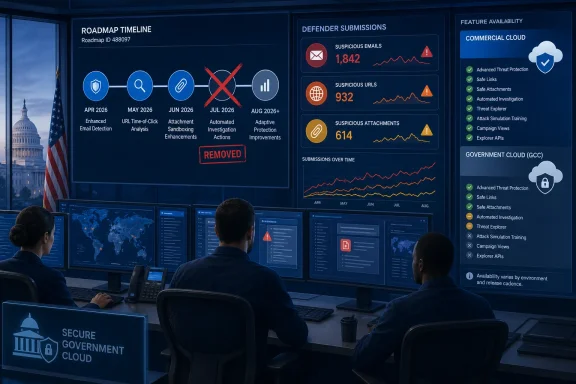 Roadmap ID 488097 is a cancellation notice, not a delayed rollout
The roadmap record was created on April 14, 2025, assigned to Microsoft Defender for Office 365, and scoped specifically to the web experience in GCC. It was designated for general availability rather than preview, with an original target of July 2026.
Those metadata fields can tempt administrators into reading this as an overdue rollout. They should not. Microsoft’s updated description is explicit: the roadmap item is inaccurate and is being removed. There is no revised month, no “rolling out” designation, and no replacement roadmap identifier.
This is a distinction that matters operationally. A missed roadmap date can justify keeping implementation work on a near-term backlog. A removed item should trigger a review of any deployment plan, procurement commitment, control assessment, or user communication that assumed feature parity would arrive. A feature can eventually reappear under a new entry, but Microsoft has not announced one.
No other outlet appears to have reported the timing or reason for the removal. The only authoritative statement on the cancellation is Microsoft’s revised roadmap entry, so the scope of the change should be kept narrow: Microsoft has withdrawn this specific planned GCC rollout, not announced the retirement of the Submissions service across Defender for Office 365.
The existing Submissions workflow is more than a reporting form
Microsoft describes the Defender portal’s Submissions page as the place for organizations with Exchange Online mailboxes to send messages, URLs, and attachments for analysis. In commercial environments, the interface separates items by type and includes administrator-originated submissions as well as user-reported messages.
For a security operations team, that workflow is tied to real response work:
- Administrators can submit a suspicious email, an attachment, or a URL to obtain Microsoft’s analysis and verdict.
- A confirmed threat submission can also create a related tenant allow/block-list entry for a file, URL, domain, or sender, depending on the item and action selected.
- Submitted items retain details such as the submission type, status, result, submitter, and recommendations, giving analysts a record they can use while deciding whether to escalate containment.
- User-reported messages can be visible in the same broader workflow, allowing security teams to distinguish employee reports from administrator-directed analysis.
Microsoft’s documentation also makes clear that a submission result is not interchangeable with an incident response. A verdict may support a blocking decision, but the organization still needs to investigate message delivery, other recipients, related URLs, and whether a campaign has already reached mailboxes. In other words, the portal can accelerate triage and feedback to Microsoft, but it does not replace hunting, quarantine review, Exchange message tracing, or tenant-specific containment.
The word full in the withdrawn roadmap title is therefore important, even though Microsoft never defined it in the public entry. It suggests the planned GCC work was intended to close an experience or capability gap, but the roadmap does not identify which tabs, actions, result details, submission types, or administrative controls were in scope. Treating the title as a guarantee of every commercial-cloud feature would have gone beyond the evidence even before Microsoft removed the item.
GCC customers should not assume commercial documentation equals availability
GCC is a U.S. government-focused Microsoft 365 environment used by federal, state, local, tribal, and eligible contractor organizations. Microsoft positions it as a government offering with U.S. data residency, screened personnel access, and government-aligned compliance commitments. That operating model is precisely why feature availability and release timing can differ from the worldwide commercial cloud.
Microsoft’s current Defender documentation does include government-specific behavior in its Submissions result definitions. It notes that GCC, GCC High, and DoD organizations can receive a government-specific outcome when nothing is found within the service’s allowed email-authentication and policy checks. That confirms that submissions-related functionality exists in government environments in some form.
But it does not establish that GCC has, or will receive, the exact “Full Submissions experience” described by Roadmap ID 488097. Documentation for a core workflow, a result definition, or a tenant portal location does not prove parity in every page, action, control, or backend analysis path. The withdrawn roadmap item cannot now be used to bridge that gap.
This is where government-cloud administrators need to resist a common planning mistake: using a commercial portal screenshot or generic Microsoft Learn procedure as proof that a feature is supported in GCC. Documentation often describes a general product path first, while government-specific service descriptions and availability tables carry the exceptions. Where a GCC tenant does not expose a tab, button, result field, or block action described in the commercial instructions, the tenant’s actual service availability is the practical answer.
What Defender for Office 365 administrators should do now
Organizations that had this roadmap entry in a security roadmap should remove the July 2026 assumption from internal plans. This is particularly relevant where a team had planned to retire a manual evidence-collection process, simplify an analyst runbook, or demonstrate a new feedback loop to an auditor or agency customer.
Administrators should review the current state of the Defender portal in their own GCC tenant and document what actually exists under Actions & submissions > Submissions. The review should distinguish between capabilities that are present today and ones inferred from commercial documentation or an old roadmap record.
A focused validation should include:
- Confirm whether analysts can submit emails, URLs, and attachments, and record which submission types are available.
- Confirm whether the portal exposes user-reported messages and whether analysts can convert or escalate those reports through the interface.
- Test whether submission outcomes provide the details the team needs for triage, including verdicts, recommended actions, and submission history.
- Verify whether a submission can create or support a tenant allow/block-list action, and separately verify the retention and expiry behavior of any resulting block entry.
- Update playbooks so analysts have a documented fallback when a desired portal action is absent, including tenant block procedures, message tracing, quarantine operations, and a Microsoft support case where needed.
Testing should use approved benign samples or controlled internal exercises, not live malicious material. It should also be treated as a capability check, not a claim that every workflow is permanently supported. Microsoft’s roadmap reversal shows why a release-plan date is not a substitute for validation in the tenant where the control must operate.
Microsoft has left the important questions unanswered
The removal notice does not say whether the planned capability was canceled for technical, compliance, architecture, or prioritization reasons. It does not say whether GCC users will retain a partial submissions workflow, whether the target is being redesigned, or whether the work will return under another roadmap entry.
It also does not state whether GCC High and DoD were ever included. The item’s cloud-instance field names GCC only, so extending the cancellation to the other government environments would be unsupported. Administrators in GCC High and DoD should check their own service descriptions and portals rather than infer a shared outcome.
For now, the dependable fact is narrower but useful: the July 2026 general-availability promise for Microsoft Defender for Office 365’s Full Submissions experience in GCC no longer stands. Any GCC security program that was waiting on Roadmap ID 488097 should plan around the features visible and supported today, not around the roadmap item Microsoft has removed.