
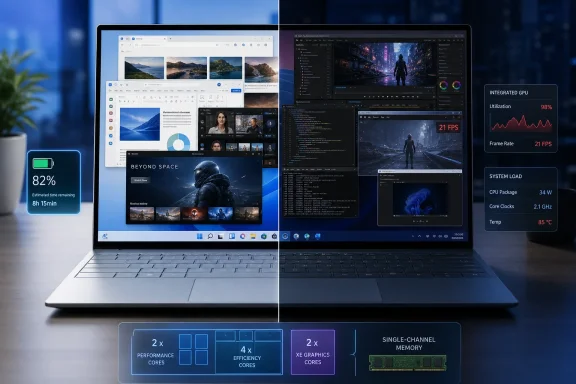
The important finding is less the familiar “budget chip is slower” conclusion than the pattern behind it. Notebookcheck found Core 5 320 single-thread performance comparable to Intel’s much more capable Lunar Lake Core Ultra 7 256V, but multi-thread performance closer to the older Core i7-1185G7. Intel’s official specification explains why: this is a six-core, six-thread part with only two Performance cores and four Low Power Efficient cores. There are no conventional Efficient cores and no Hyper-Threading reserve to help it absorb sustained parallel work.
Intel announced the Core Series 3 family, formerly codenamed Wildcat Lake, on April 16, 2026, positioning it for value notebooks, schools, small businesses, and edge hardware. The Core 5 320 is a 15 W processor with a 35 W maximum turbo rating, 6 MB of cache, a 4.6 GHz maximum P-core turbo, and four LP E-cores topping out at 3.4 GHz. It is modern silicon built on Intel 18A, but it is deliberately right-sized silicon rather than a stripped-down Core Ultra replacement.
 Fast enough until the workload turns parallel
For the buyer whose day is Teams or Zoom calls, browser tabs, Microsoft 365, a few web apps, and 4K streaming, the Core 5 320’s strong single-threaded behavior is the useful part of the story. Applications often remain bound by the speed of one main thread or a small number of active threads, particularly while interacting with a document, loading a website, starting an application, or navigating Windows 11. A system can therefore feel far more responsive than its multi-core benchmark ranking suggests.
Tom’s Guide reached a similar practical conclusion in its XPS 13 review. Its $699 test system handled a workload of roughly 15 Chrome tabs with video playing without heat or responsiveness issues, while its lab result reached 2,684 points in Geekbench 6 single-core and 7,952 in multi-core. The review also recorded a 10-minute, 38-second HandBrake conversion from 4K to 1080p—work the machine completed, but more slowly than Apple’s MacBook Neo in the same test.
Those figures are a useful corrective to broad comparisons with older Intel chips. Core 5 320 can deliver a pleasant interactive experience because its two big cores are current-generation designs. But a multi-threaded job sees the architecture for what it is: two performance-oriented cores plus four efficiency-first cores, with six threads total. Compiling a large project, running a virtual machine alongside a browser, indexing a photo library, batch-processing RAW images, or exporting video will reach that ceiling quickly.
For IT buyers, this makes the part plausible for shared-use systems, frontline work, web-centric employees, reception desks, classroom carts, and lightweight managed endpoints. It should not be treated as a generic replacement for older Core i5 business laptops merely because the badge says “Core 5.” A five-year-old system with more full-performance cores may still be the better device for users whose work is consistently parallel.
The graphics limitation is built into the platform
Notebookcheck’s weaker graphics result is the other half of the Core 5 320 story. Intel lists the processor with just two Xe cores under the deliberately broad “Intel Graphics” name, rather than an Intel Arc designation. Notebookcheck reported that its Graphics 2 Xe3 implementation fell behind the Iris Xe configuration with 96 execution units found in some older ultrabooks, making modern 3D games and GPU-assisted creative work unrealistic expectations.
Tom’s Guide arrived at the same functional answer with a different test suite. Its XPS 13 delivered 14 frames per second in 3DMark Wild Life Extreme and 8.7 fps in Borderlands 3 at 1080p—numbers that describe an integrated GPU for display output, video playback, desktop composition, and modest acceleration, not gaming. Older 2D titles and lightweight games can still work, but buyers should not mistake support for DirectX 12 for usable current-game performance.
There is a platform constraint beneath those results that deserves more attention than the Xe-core count. Intel’s own Core 5 320 specification lists one maximum memory channel. Dell’s initial Wildcat Lake XPS 13 configurations consequently use single-channel LPDDR5X memory and top out at 16 GB, while the planned Core Ultra 7 355 XPS models move to dual-channel memory and offer 16 GB or 32 GB configurations.
That distinction affects more than capacity. Integrated graphics shares system memory with the CPU, so a single-channel design limits available memory bandwidth for the GPU. The two-Xe-core graphics block was never going to turn the Core 5 320 into a gaming processor, but the one-channel memory ceiling reinforces the divide. More system RAM will help a browser-heavy workflow avoid paging, yet it will not transform the platform into the Core Ultra configuration Dell plans to sell later.
Battery life is the point, but tests are measuring different things
Notebookcheck measured more than 18 hours in its video playback testing and reported under 2 W total system draw while the XPS 13 sat idle on the desktop. Dell’s own claim is based on Netflix 4K streaming with the screen at 150 nits, Wi-Fi enabled, 16 GB of memory, and a 512 GB SSD; Dell explicitly warns that real-world results will vary by configuration and workload.
Independent testing supports the broad battery-life claim without proving any one advertised runtime. Tom’s Guide measured 14 hours and 26 minutes in continuous Wi-Fi web surfing at 150 nits. That is materially shorter than Notebookcheck’s video result, but the gap is not a contradiction: video playback and active browsing exercise the display, wireless connection, CPU wakeups, scripts, advertisements, and background activity in different ways.
The practical takeaway is that Wildcat Lake appears optimized for low-load endurance rather than record performance per watt under heavy computation. Notebookcheck’s comparison with Intel’s Core Ultra X7 358H is revealing: the more powerful chip reportedly delivered roughly three times the multi-threaded performance and five times the graphics performance while using 1.5 to 2.5 times the power. For an all-day Office laptop, the 320’s low idle consumption is valuable. For a user who spends substantial time rendering, compiling, or working on GPU-heavy tasks, finishing the job quickly can be the more efficient outcome even if instantaneous power draw is higher.
The $699 XPS 13 makes the compromises visible
Dell’s new XPS 13 is an unusually premium vessel for such an entry-level processor. The base model pairs Core 5 320 with 8 GB of memory, a 512 GB SSD, a 13.4-inch 2560×1600 touch display, Wi-Fi 7, a 52 Wh battery, and a 2.2-pound aluminum chassis. Dell set the regular starting price at $699, with an eligible-student offer at $599.
The price is central to the processor’s case. A thin XPS chassis, sharp 2.5K display, 512 GB SSD, and long battery life make a more complete everyday machine than many traditional bargain laptops with low-resolution panels and slow storage. Notebookcheck’s assessment that the CPU is sufficient for browsing, streaming, and word processing aligns with that design goal.
But prospective buyers should price the machine based on the configuration they can actually use, not on the headline. The 8 GB base configuration is workable for light web and Office use, but it is already narrow for a Windows 11 machine expected to stay in service for several years, especially with browser-based collaboration tools, endpoint protection, cloud-sync clients, and a crowded taskbar of background utilities. Since Core 5 320 models are capped at 16 GB and single-channel memory, the sensible configuration for longer ownership may not remain at the entry price.
Dell also limits the Core 5 320 XPS to two USB-C 3.2 Gen 2 ports; Thunderbolt 4 arrives only with the later Core Ultra 7 355 version. That matters to docking-heavy users, external-storage workflows, and anyone planning to attach high-speed peripherals. The low-cost model is modern enough for a simple desk setup, but it is not the fully featured XPS configuration implied by the nameplate.
Wildcat Lake is a defined trade, not a Core Ultra bargain
Intel has not hidden the Core Series 3 positioning: it says the family targets value buyers and promises more than 70 partner designs during 2026. The Core 5 320 gives OEMs a current CPU architecture, Wi-Fi 7 support, modern media and AI-related software support, and exceptionally low idle power without paying for the core count, graphics configuration, memory bandwidth, and I/O capabilities of Core Ultra systems.
Notebookcheck’s benchmark results show the consequence clearly. Wildcat Lake’s Core 5 320 is a credible everyday Windows processor whose single-thread speed prevents it from feeling like the low-end Atom-era machines many buyers remember. It is also a six-thread chip with two small Xe graphics cores and single-channel memory, so its limits arrive much sooner than the premium XPS enclosure and Core 5 branding might suggest.
For a student, home user, or managed endpoint that lives in the browser and Office, the Dell XPS 13 configuration makes a persuasive value case. For anyone who edits media, relies on virtual machines, does serious local builds, or expects to play contemporary games, the right move is to skip the Core 5 320 tier and wait for—or buy into—a Core Ultra configuration with more CPU resources, dual-channel memory, Thunderbolt 4, and substantially stronger integrated graphics.