
In an interview published by Technology Record, Velosio chief executive Robbie Morrison describes the Microsoft partner’s internal rollout as a “customer zero” program: the firm uses the platforms and agentic workflows it sells to clients before turning them into a service. Gartner has promoted that model for AI providers because internal use can expose quality, safety and adoption problems earlier than a customer pilot. But it also creates an obvious reporting problem: the provider gets to choose the measurements, baseline and scope used to prove success.
Velosio has disclosed neither the cost base behind the 185 percent figure nor the calculation behind its forecast 400 percent return over three years. It has not said whether the first-year measure includes software licensing, Microsoft Fabric capacity, Azure consumption, implementation labor, data cleanup, training, change-management work, or the cost of maintaining the agent after launch. Those omissions do not invalidate the outcome, but they mean customers should treat it as a vendor case study rather than a benchmark for an equivalent Business Central project.
The more defensible takeaway is narrower: an implementation partner that has standardized its own finance, CRM and project operations data may be able to automate portions of its repeatable delivery process. That is far different from proving that a customer with fragmented records, bespoke integrations, incomplete permissions and inconsistent project methods can expect the same result.
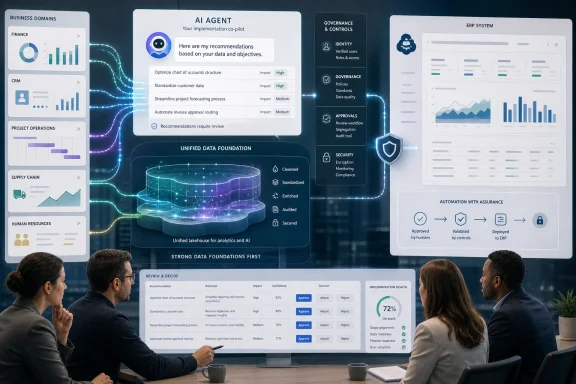 The data foundation came before the agent
Morrison dates Velosio’s consolidation effort to 2019, after the company was assembled from multiple businesses. The stated goal was to establish one working data model through Microsoft Dynamics applications covering finance, customer relationship management and project operations, then place the data in Microsoft Fabric for analytics and AI use.
That sequencing is significant. AI agents applied directly to ERP implementation work need reliable access to project templates, requirements, configuration choices, data-migration rules, issue histories and customer-specific decisions. If the agent is retrieving conflicting or stale source material, it can accelerate the production of incorrect work just as efficiently as it can accelerate the production of useful work.
Microsoft’s Fabric and OneLake architecture is designed to provide a unified data layer, but “single source of truth” remains an organizational discipline rather than a feature a tenant can switch on. Fabric can present data from external systems in a shared namespace without physically moving all of it; its shortcuts and mirroring options can leave data at the source or replicate it depending on the connector and workload. A unified view therefore does not settle which record is authoritative, who owns its definition, or how quickly operational changes propagate into reports and agent context.
Velosio’s story is strongest where it acknowledges this plumbing. A seven-year data consolidation is a material prerequisite that many AI launch announcements leave out. For IT teams reading the case study, it is also the reason not to begin with the agent: the data model, identity structure, governance rules and integration inventory are part of the product.
The company says it used Microsoft Entra ID for a common sign-in and Microsoft Purview for security and governance. Microsoft documents Purview’s integration with Fabric as covering cataloging, governance, risk controls and audit capabilities for Fabric Copilots and agents. Those services can help an organization understand and constrain access to governed data, but they do not automatically make every source, prompt, connector or action safe.
Access control is especially consequential when the system moves beyond summarizing data and starts carrying out implementation tasks. An agent that can read a project plan, create a configuration record, query a customer environment or call an external API needs controls at each step: least-privilege permissions, approval gates for consequential actions, logging that captures the input and output, and a way to revoke a tool or identity quickly. Entra ID and Purview are ingredients in that control plane; neither removes the need to design it.
MCP is an integration mechanism, not proof of a governed agent
Velosio says it used “Microsoft Azure model context protocol servers and APIs” to connect third-party solutions and bring information back into Fabric. The Model Context Protocol, or MCP, is an open client-server mechanism for giving an AI application structured access to tools, data and prompts. It has become a common way to connect agents to external systems without building one-off integrations for every model or assistant.
The wording leaves an important technical detail unresolved. Microsoft’s Azure MCP Server documentation describes a service that lets compatible AI clients interact with Azure resources using authenticated tools and Azure role-based access control. Its stated use cases center on developer and Azure operations workflows: querying resources, managing services, deployment and diagnostics. Microsoft also cautions that its local server is intended for developer use within an organization, rather than as an external-application component.
That does not mean Velosio used the wrong technology. The company may have built custom MCP servers, deployed remote MCP endpoints through Microsoft Foundry or Copilot Studio, used Azure MCP Server tools alongside its own connectors, or simply used MCP as one component of a broader API architecture. Technology Record does not identify the servers, permissions model, client, model provider, action boundaries or human-approval rules involved.
For Windows and Microsoft administrators, the distinction is more than nomenclature. MCP expands what an AI assistant can see and do. Every server becomes another tool boundary to authenticate, authorize, monitor, patch and disable. Treating MCP as an easy connector layer without handling it as privileged integration infrastructure would recreate the very access-control problem Velosio says Purview and Entra helped it address.
A rigorous customer-zero deployment should be able to answer operational questions that the published account does not: Which tools can the implementation agent invoke? Can it write to Business Central or only recommend configuration? Are agents limited to approved project workspaces? Are customer data and production tenants segregated? Is tool use logged at the agent, identity and downstream API layers? What happens when a connector returns incomplete data, fails, or is manipulated through prompt injection?
Those questions are not theoretical. ERP implementation projects typically involve data that is commercially sensitive, operationally consequential and difficult to reverse after a bad configuration reaches production. The appropriate measure of an implementation agent is therefore not only time saved, but the rate of rework, defect escape, permission exceptions and customer remediation after the work is delivered.
“Half the effort” needs a denominator
Velosio’s Business Central implementation agent is described as halving implementation effort compared with the previous year. Morrison also says that the company is seeing fewer credits and less rework, with happier clients because quality has improved.
Those are promising internal indicators, particularly because they link automation to delivery quality rather than only headcount reduction. Yet no independent outlet has reported the underlying timing, project count, complexity mix, labor hours, customer satisfaction method or credit volume. The published interview does not establish whether the comparison was made across similar Business Central implementations, whether the agent handled discovery, configuration, testing, documentation or data migration, or how much of the saving came from standardized project scope rather than AI.
Velosio already markets accelerated Business Central deployment offerings, including its Velosio Express service for a predefined scope of services. That matters because a partner can improve implementation speed through templates, prebuilt extensions, narrower requirements and stronger project discipline even before introducing an agent. AI may be the additional accelerator, but the available record does not isolate its contribution from the established delivery method.
Customers evaluating similar claims should insist on a project-level scorecard rather than a blended ROI percentage. It should compare like-for-like engagements and include the measures that affect both the customer and the partner:
- The baseline and current labor hours should be broken down by discovery, configuration, data migration, testing, training and post-go-live remediation.
- The quality measure should include defects discovered after go-live, change orders, project credits and time to resolve critical issues.
- The agent’s role should be explicit, including the tasks it completes autonomously, the tasks it drafts for consultant approval and the tasks it cannot perform.
- The financial comparison should include licensing, usage-based AI charges, implementation effort, governance tooling and ongoing support rather than counting only billable labor saved.
- The measurement period should extend beyond go-live, because a faster implementation that produces more later remediation is not a productivity gain.
The staffing warning is the part customers should hear
Morrison’s most candid observation concerns junior staff. He says agents can easily take on work commonly performed by employees at an early career stage, but argues that organizations still need to develop those people or they will lack experienced talent a decade later.
That is a real delivery risk for systems integrators. Entry-level consultants often learn ERP work through documentation, requirements gathering, testing, data validation and repetitive configuration tasks. If the automation takes away the work without replacing it with supervised review, exception handling, process design and customer communication, firms may save near-term labor while weakening their pipeline of future solution architects and project leads.
Velosio says it reassured employees that the aim was efficiency rather than workforce reduction. Its published account also concedes that greater efficiency could reduce the need for additional hiring. Both statements can be true at once: a company can retain its current staff while hiring fewer people as its delivery capacity rises. The practical question is whether the saved time becomes better customer work, more implementations per consultant, structured training, or simply a lower demand for new entrants.
For clients, that makes the human operating model part of the procurement discussion. An AI-assisted Business Central partner should be able to identify who reviews its agent-generated work, who owns a failed recommendation, whether the customer can audit the decision path, and how the partner preserves subject-matter expertise when routine work is automated.
Velosio’s account offers a credible blueprint for the prerequisites of enterprise agent deployment—standardized business applications, governed data, identity controls, connectors and change management. It does not yet provide enough evidence to validate its ROI claims or show that its implementation agent will reproduce the same results outside its own highly standardized environment. The concrete consequence for buyers is simple: ask for the project-level evidence before accepting the percentage, and evaluate the controls around the agent before letting it touch ERP work.
References
- Primary source: Technology Record
Published: August 10, 2026 at 6:41 AM UTC
Loading…
www.technologyrecord.com - Related coverage: velosio.com
Loading…
www.velosio.com - Related coverage: velosio.com
Loading…
www.velosio.com - Related coverage: itpro.com
Loading…
www.itpro.com - Related coverage: learn.microsoft.com
What Is the Azure MCP Server? - Azure MCP Server | Microsoft Learn
Learn about the Azure MCP Server, its features, and how it helps developers build and deploy apps to Azure. Discover benefits and get started today.learn.microsoft.com - Related coverage: learn.microsoft.com
Loading…
learn.microsoft.com