
The Hill first reported the August 14 petitions, and Earthjustice, which represents the two groups, confirmed that the cases challenge approvals of two new semiconductor chemicals. EPA declined to comment on the pending litigation. No court has yet ruled that EPA violated the Toxic Substances Control Act, or TSCA, and the petitions themselves do not stop the approvals merely by being filed.
What is clear is that the dispute is not over a generic warning about chip fabs. It concerns two individual regulatory decisions in which EPA’s own redacted consent orders reportedly identified potentially serious hazards while also stating that available information was insufficient to calculate parts of the risk.
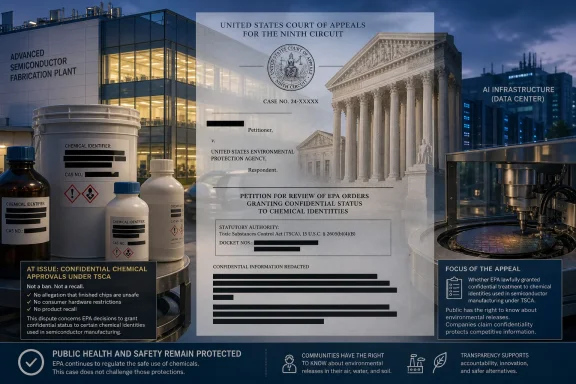 The chemicals are redacted, and that limits accountability
According to The Hill’s review of the consent orders attached to the litigation, one chemical carried possible developmental and reproductive risks to the public through drinking-water or air exposure. The other was associated with general-population toxicity and potential developmental and reproductive risks for workers through skin exposure. The reporting also says the orders used acute lethality—the potential for sudden death in analogous substances—as a principal concern.
Those are serious descriptions, but they should not be read as proof that a worker, neighbor, or end user has been harmed by either chemical. EPA’s assessment apparently relied at least partly on comparisons with related substances, rather than a complete toxicity profile for the precise compounds. That distinction is central to the legal fight: the environmental groups argue that uncertainty should have prevented approval, while EPA’s consent-order process is designed to allow a chemical into commerce under specified restrictions when the agency identifies concerns.
EPA’s public explanation of Section 5(e) consent orders says they can restrict manufacture, processing, distribution, use, disposal, recordkeeping, exposure controls, and testing. In other words, an EPA order is not necessarily a clean bill of health. It can be a conditional authorization intended to constrain use while the agency manages a suspected risk.
But the redactions create a real public-information problem. Neither the chemical identities nor the companies seeking approval were disclosed in the reporting, and neither were the fabs or communities expected to receive them. Without those basics, workers cannot determine whether their sites are involved, local residents cannot evaluate a likely exposure pathway, and downstream technology customers cannot connect the dispute to a specific chipmaker or device supply chain.
The fact that a chemical is confidential business information does not automatically make EPA’s approval unlawful. It does mean the ordinary check on regulatory decisions—outside scientists, affected communities, journalists, and customers reviewing the substance and proposed use—is sharply constrained.
This is a TSCA review fight, not a semiconductor product safety alert
The public-facing headlines risk blurring the distinction between fab-process chemicals and the semiconductors that leave a factory. Semiconductor plants use chemicals for wafer cleaning, etching, deposition, photolithography, packaging, and waste treatment. A lawsuit over approval of an input chemical does not establish that the compound remains in a finished CPU, GPU, memory package, SSD controller, or server accelerator shipped to customers.
That does not make the case peripheral. Chip fabrication is a manufacturing process with large chemical inputs, and its expansion is increasingly tied to new data-center capacity and AI infrastructure. But the likely exposure questions described by The Hill and Earthjustice concern plant workers, transport, disposal, emissions, and communities near production—not someone using a Windows PC or administering a server rack.
For IT buyers and data-center operators, the responsible takeaway is therefore narrower than the rhetoric around AI’s physical footprint. There is no disclosed evidence in this case requiring an inventory change, a hardware procurement freeze, a change to endpoint management, or a new server-room safety procedure. There are also no publicly identified chip products, chip fabs, component suppliers, or cloud providers tied to the two approvals.
The relevant risk-management work sits upstream. Chip manufacturers and chemical suppliers need to meet any consent-order terms; fab operators need controls for handling, ventilation, personal protective equipment, wastewater, waste shipment, and worker communication; and regulators need enough disclosed information to verify that those controls map to the risks EPA identified.
EPA’s expedited-review policy gives the lawsuit wider significance
The timing matters because EPA announced in 2025 that it would prioritize new-chemical submissions tied to data centers and related infrastructure, including semiconductor manufacturing. The agency said it would not bypass the standard review process and would apply the same risk-determination thresholds. Yet prioritization can still matter materially when an agency has a backlog, industry pressure for faster decisions, and a national policy centered on rapid deployment of AI capacity.
WIRED previously reported that semiconductor manufacturing could be a major beneficiary of that policy, because fabs rely on a steady stream of specialized chemical inputs and the industry has sought regulatory changes intended to preserve access to substances it regards as essential. The report also quoted EPA saying eligible applications would move to the front of the line rather than skip scientific review.
That is the factual and policy tension now being tested. Faster processing is not inherently a weaker review, and the existence of a Section 5(e) consent order suggests EPA did identify risks and impose some form of conditions. But the petitions challenge whether the agency can approve a new chemical when it says it lacks enough information to quantify relevant risks.
The lawsuit may clarify whether EPA’s conditions were sufficiently protective, whether it made the legally required TSCA finding, and how much uncertainty the agency can accept before a chemical reaches workplaces and communities. It will not, by itself, determine whether the administration’s broader data-center chemical-prioritization policy is lawful.
What remains unknown before anyone can measure the real impact
The most consequential missing details are the chemical identities, the EPA case numbers, the submitters, the production volumes, the intended fab processes, the locations where the chemicals may be used, and the exact restrictions imposed by the consent orders. The public also does not yet know whether either approval is connected to a new U.S. fab, an expansion at an existing site, or a chemical supplier serving multiple manufacturers.
Earthjustice says the chemicals may involve cancer, neurological harm, and persistent or bioaccumulative properties. Those claims are part of the groups’ case and should be treated as allegations until the court record and unredacted technical material establish their basis. The Hill’s reporting provides more specific descriptions from the orders but likewise does not identify the compounds, leaving independent toxicological verification impossible.
For now, the court petitions are a warning about a blind spot in the semiconductor supply chain rather than a consumer-facing hardware emergency. If the Ninth Circuit forces EPA to revisit the approvals, the result could be tighter conditions, additional testing, new disclosures, withdrawal of the decisions, or affirmation of EPA’s approach. Until the agency or the court releases more of the record, the public cannot tell which fabs, workers, or nearby communities are actually implicated—and that is the most important fact missing from this case.
