
That qualification is the useful part. A Linux executable for the launcher is apparently not the finish line Epic has set for itself; the company is working through the surrounding platform work needed for a supported client. Yet Epic has published no date, supported distribution list, SteamOS commitment, hardware requirements, feature-parity target, or migration plan for existing Linux users. As of August 15, Epic’s own download page still lists Windows 10, Windows 11, and macOS 10.13 or later for its PC and Mac client, with no Linux option.
For people with large Epic libraries, that means the immediate advice has not changed: keep using the Linux setup that works today. A native Epic launcher may eventually simplify installing, updating, browsing, and claiming games, but it will not automatically turn every Windows-only Epic purchase into a Linux-compatible game.
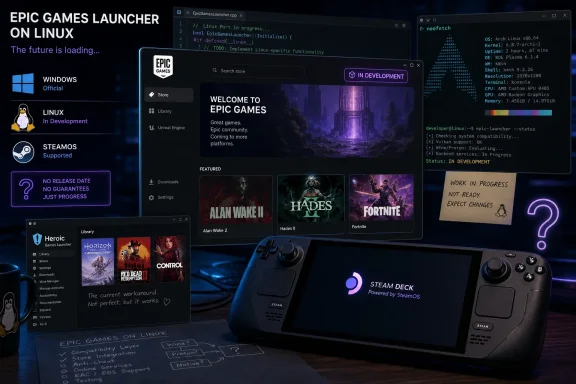 The confirmation comes from a Discord AMA, not an Epic launch notice
The reported commitment emerged from a Discord community AMA rather than an Epic Games Store blog post, release-note page, or updated system-requirements document. A Reddit post preserving answers from the event says OnePercentNachos confirmed that a Linux version is in development and indicated that it would not arrive in the upcoming launcher preview.
PC Gamer reported the same response, including the staffer’s warning that Epic must do more than get a native build of the launcher running. TechRadar independently described the exchange and likewise reported that the Linux client will not be part of the next preview. Both accounts lead back to the same underlying Discord event, so they should not be read as two separate confirmations of a delivery timetable.
That distinction matters because “soon” is not a product schedule. Epic has not said whether Linux support will ship alongside the company’s broader Epic Games Launcher v2 effort, as a separate beta, or only after the new launcher reaches a particular feature threshold. The Reddit AMA summary also says the broader v2 early-access release has slipped beyond August, though the exact timing has not been published by Epic in a formal roadmap.
Epic’s own public installation page is a useful reality check. It currently describes the desktop store as available on PC and Mac, then specifies Windows 10 or 11 and macOS 10.13 or newer as the supported desktop operating systems. Until that documentation changes or Epic publishes a Linux installer, there is no supported native client for ordinary Linux desktops or SteamOS.
A native launcher would remove friction, not solve game compatibility
Linux users can already access much of an Epic library through third-party software, particularly Heroic Games Launcher. Heroic is a native Linux application that connects to Epic through the open-source Legendary command-line client, handling authentication, downloading, library management, and game launching. Its documentation supports common Linux distribution formats and provides Steam Deck-oriented setup guidance through Flatpak.
But Heroic’s existence also illustrates why Epic’s work is larger than putting a storefront window on Linux. The launcher itself can be native while many purchased games still need Wine or Valve’s Proton compatibility layer, per-game launch options, graphics workarounds, different Proton builds, or manual fixes for secondary publishers’ launchers.
Heroic’s own project documentation makes that limitation plain. It supports Epic games on Linux, but anti-cheat functionality depends on the individual game. Its troubleshooting and game-workaround pages remain extensive, covering save locations, launchers embedded in games, overlays, Wine prefixes, and title-specific exceptions. An official Epic client could reduce the need to emulate the launcher, but it cannot eliminate those game-level variables by itself.
The practical result is likely to be incremental rather than transformational on day one:
- A native Epic client could make claiming weekly free games, browsing a library, installing supported titles, and applying launcher updates less dependent on community-built tools.
- Windows-only Epic games will still need Proton or Wine unless their publishers ship Linux builds.
- Games with unsupported anti-cheat, unsupported launchers, or publisher-imposed platform restrictions may remain unavailable even if the Epic storefront runs perfectly on Linux.
- Existing Heroic users should expect to keep it installed until Epic demonstrates equivalent library management, install handling, controller behavior, cloud-save reliability, and Steam Deck usability.
That is not an argument against an official launcher. It is a warning against conflating storefront support with a blanket compatibility promise.
Anti-cheat remains the larger barrier for multiplayer games
Epic already has technical building blocks that can support some Linux multiplayer titles. Epic Online Services announced in 2021 that developers could enable Easy Anti-Cheat support for Linux through Wine or Proton in the EOS Developer Portal. Valve’s Steamworks documentation likewise describes the Linux library developers need to include when supporting Epic Online Services’ version of Easy Anti-Cheat through Proton.
The key word is developers. Epic’s own Online Services material describes its services as modular, meaning game makers choose which services to use and how they configure them. A launcher port cannot unilaterally change the anti-cheat policy, deployment decisions, or support posture of every publisher selling through the Epic Games Store.
For Linux and Steam Deck players, the decisive test will therefore be a game-by-game one. A native client could make installing a compatible multiplayer game easier. It will not make an incompatible anti-cheat stack work, nor does it tell readers whether Epic’s own major online games will receive broader Linux support.
Epic has not tied the launcher announcement to an anti-cheat expansion, a certified-games program, a Steam Deck compatibility badge, or a Linux storefront category. Those omissions are significant because they are the features that would let buyers distinguish a downloadable title from a reliably playable one before spending time on a large install.
The launcher rebuild makes the Linux project more plausible — and more uncertain
The Linux effort appears to be arriving during a wider rewrite of Epic’s desktop software. In June, PC Gamer reported that Epic had presented a ground-up launcher rebuild at Unreal Fest, using a framework called Tauri and claiming substantially faster cold-start and library-restore performance in internal comparisons.
The AMA recap also identifies Tauri as the framework behind the next-generation launcher. Tauri can target Linux as well as Windows and macOS, which helps explain why Epic may now be prepared to pursue a native Linux client. But a cross-platform framework does not resolve the operational work: packaging, updates, desktop integration, authentication, GPU acceleration, game-install paths, distribution support, support tooling, and interaction with Proton all still need testing.
The reported comment that Epic needs more than a launcher binary suggests the company recognizes that difference. A half-finished client that opens a store page but fails on game installation, entitlement refreshes, controller navigation, or Flatpak permissions would not be a meaningful replacement for the mature community options Linux users already have.
There is also no indication that Epic plans to distribute through Flathub, provide a Flatpak directly, publish native packages for Debian- or Fedora-based systems, or offer an AppImage. Those choices matter particularly for Steam Deck owners, where Flatpak is the familiar desktop installation path and where a supported client would need to coexist cleanly with Steam’s Gaming Mode and Proton-managed game files.
Windows users should read this as a platform expansion, not a retreat
The reporting frames the announcement against growing Linux gaming interest and dissatisfaction with Windows 11, but Epic has not positioned the project as a reduced commitment to Windows. The company’s current launcher remains explicitly supported on Windows 10 and Windows 11, and the ongoing v2 rebuild is aimed first at improving that existing desktop experience.
For Windows users who also manage a Steam Deck, dual-boot machine, or Linux workstation, the eventual benefit could be simpler access to a single Epic account and library across more machines. It may also reduce the support burden created when players must use unofficial launchers simply to reach games they legitimately own.
But the near-term consequence is narrower: an Epic employee has acknowledged Linux work, while Epic itself has not yet published the details that determine whether the result will be useful. Until the company names a release channel, supported distributions, and what games or features will work at launch, Heroic and Proton remain the practical route for Linux users with Epic libraries.