
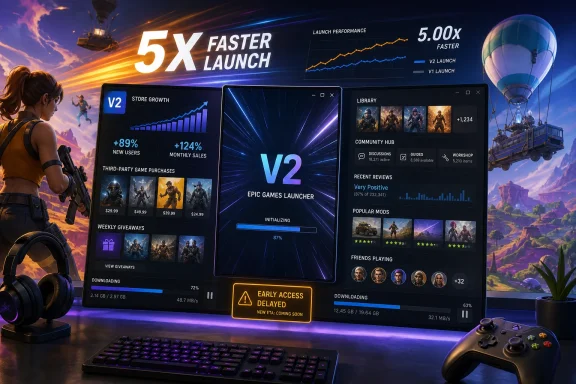
There is also an immediate complication missing from the broad “recovery” narrative. Epic’s June roadmap presented Launcher V2 as a summer project, but reporting on an August 13 Epic Games Store Discord AMA indicates that its public early-access release has slipped beyond August and will initially lack full feature parity with the existing launcher. For Windows players, the promised overhaul remains a preview, not a finished replacement they can benchmark today.
That delay does not invalidate the technical work. It does mean Epic is still trying to repair the storefront experience seven-and-a-half years after the Epic Games Store launched in December 2018 — while Steam’s advantages are less about app startup time than the accumulated value of a mature library, community, mod, review, discovery, and social platform.
 A faster client addresses a real Windows problem
Epic has said Launcher V2 is a ground-up rebuild intended to improve speed and stability. Slides from Epic’s 2026 product presentations described an average five-times-faster cold launch and a 6.5-times-faster path from the Windows system tray back to a player’s library, along with a redesigned storefront architecture.
Those claims target a familiar frustration for PC players: the current Epic Games Launcher can feel disproportionately heavy for what is, at its core, a game library and storefront. A launcher that is slow to open, slow to move between Store and Library pages, or inconsistent when resuming downloads makes every purchase on the platform feel less convenient than buying the same game on Steam.
The proposed additions are more consequential than cosmetic polish. Epic has outlined personalized recommendations, quick-access categories, native third-party patch notes, player profiles, reviews, controller improvements, community spaces, voice chat, and game-independent parties. Some of those features are basic expectations in a 2026 PC launcher; others could make the Epic client more useful between purchases rather than only when a user needs to launch Fortnite or claim a free title.
But a rollout with fewer features than the existing client creates a difficult transition. According to reporting on the Discord AMA, Epic has moved away from describing V2 as a closed beta and intends to offer an early-access build more broadly, but the initial version will not contain every V1 feature. That makes the first release a performance and architecture test, not the comprehensive Steam alternative suggested by the roadmap.
For IT-minded Windows users managing several game libraries, that distinction is practical. A second launcher becomes tolerable when it stays out of the way, updates reliably, finds existing installations after a Windows reinstall, supports controllers consistently, and does not force a trade-off in ordinary library management. Faster startup is welcome; it is not a substitute for feature continuity.
Epic’s own figures contradict the idea of a simple collapse
Rosier’s larger argument is that Steam’s position is now effectively inevitable. That conclusion reflects the visible behavior of PC players who centralize purchases, friends lists, reviews, saves, Workshop content, and years of back catalog in Valve’s client. It is also supported by the awkward case of Blood West, where New Blood chief executive Dave Oshry said the game sold roughly 200% more copies on Steam on the day it was free through Epic’s holiday promotion.
That incident is revealing, but it is one publisher’s snapshot rather than proof that every Epic giveaway sends customers to Steam. Epic itself has claimed that titles participating in its Free Games Program saw a 40% lift in concurrent Steam players while free on Epic and that 77% set an all-time peak concurrent-player record on PC during that period. The figures do not establish that Epic loses the sale in every case, but they do show that a giveaway can function as broad advertising instead of converting a player into an Epic Store regular.
Epic’s February 2026 Year in Review offers a more complicated picture than “the store cannot recover.” The company said PC players spent $1.16 billion through the Epic Games Store in 2025, a 6% year-over-year increase. It also reported $400 million in third-party PC-game spending, up 57%, 2.78 billion hours in third-party games, up 4%, and a record 78 million monthly active PC users.
Those are vendor-reported figures, and they should be treated as such. Epic does not publish the comparable profit-and-loss detail, retention data, or per-title sales distribution needed to judge the store’s underlying financial health. Its third-party spending total also does not necessarily represent revenue that Epic retained, particularly where developers use their own payment processing or qualify for Epic’s promotional revenue-share programs.
Still, the available data does not describe a storefront in retreat. It describes one that has substantial scale but a weak conversion problem: Epic can attract users and activity, and it has begun to grow third-party spending again, yet it has not shown that its audience treats the store as a first-choice destination for ordinary paid PC releases.
The giveaway strategy has a ceiling
The most damaging number for Epic’s giveaway strategy came not from a critic but from Epic Games Store vice president and general manager Steve Allison. In an interview with GamesRadar+ earlier this year, Allison said that 16% to 18% of users acquired through the Free Games Program convert into paying customers.
Epic portrays that as an efficient customer-acquisition channel, and it may be. A conversion rate in that range means the program is producing buyers rather than only dormant accounts. But it also means that the large majority of people brought in by a free title do not go on to make a purchase, at least by Epic’s own measure.
That limitation matters because free games are designed to solve the hardest early problem for a new store: getting people to install the launcher, create an account, and return regularly. Epic succeeded at that. Its current support documentation still promotes a new free game every Thursday for PC and says claimed games remain in a user’s library permanently.
What giveaways have not clearly solved is habit. The cost of splitting a game library is not just another desktop icon. Players may prefer one achievements system, one controller configuration layer, one friends list, one family-sharing arrangement, one update history, and one place to search before buying. Steam has had decades to turn those small conveniences into a durable switching cost.
Epic’s low platform fee remains meaningful to developers, particularly after its June 2025 policy that lets developers keep 100% of the first $1 million in annual net revenue processed through the store for each product. That policy can attract releases, but it does not automatically create player demand. A storefront can offer a better commercial deal to publishers and still struggle to become the place where consumers choose to maintain a long-term collection.
Fortnite is an asset, but not a Steam replacement
Rosier is more optimistic about Epic’s future as a game developer and Fortnite operator than as a PC storefront challenger. That is a reasonable separation. Fortnite gives Epic a gigantic live-service audience, an established social space, and a powerful marketing venue for crossovers, game launches, and promotional items tied to purchases.
Epic is increasingly using Fortnite as a bridge to the wider games business, including cosmetics and collaborations built around game characters rather than only music and film personalities. That can give a publisher an unusually direct route to an audience that is already spending time inside Epic’s services.
Yet Fortnite’s strength cuts both ways. It ensures the Epic Games Launcher has a continuing reason to exist on Windows PCs, but it does not prove that users will buy unrelated premium games there. A player can regard Epic as the Fortnite launcher, the Unreal Engine launcher, and the weekly-free-game launcher while keeping paid purchases on Steam.
The company appears to understand this distinction. Allison told GamesRadar+ that Epic’s goal on PC is not necessarily to topple Steam, but to secure enough market share that publishers feel they need to be present. That is a more realistic standard than becoming the dominant PC game store — and it makes Rosier’s use of “recover” somewhat misleading. Epic is not attempting to restore a prior leadership position; it is attempting to turn a huge installed audience into a sustainable secondary storefront.
The delayed preview will show what Epic has actually fixed
The short-term verdict will not come from an analyst quote or another annual activity total. It will come when Launcher V2 reaches Windows users in early access and they can test whether Epic has fixed the daily irritations: launch performance, library browsing, downloads, updates, controller behavior, discovery, social features, and the friction of maintaining games outside Steam.
Epic has made its strongest case yet that its store is growing commercially, particularly in third-party spending. It has not made the case that free-game claims, Fortnite traffic, and a cleaner launcher have changed where PC players want their permanent library to live.
Until the delayed V2 release arrives with enough of its promised functionality intact, Epic’s situation is clear: it does not need to “recover” from irrelevance, but it still has to prove that an improved Windows launcher can convert attention into lasting purchasing behavior.