
Technology Magazine reports that Equinix has expanded Azure connectivity for customers in its Kuala Lumpur and Jakarta International Business Exchange facilities, giving enterprises a private path from colocated infrastructure to Microsoft’s cloud. The practical value is real: an Azure ExpressRoute circuit avoids the public internet between the customer edge and Microsoft’s network, using private connectivity and BGP routing instead.
But the announcement reads more like a commercial availability expansion inside Equinix Fabric than a new Azure geography or a new in-country Microsoft edge deployment. Microsoft’s own ExpressRoute directory already lists Kuala Lumpur and Jakarta as peering locations for Malaysia West and Indonesia Central, while Equinix’s documentation has long described Azure ExpressRoute as a Fabric destination. The important question for IT teams is therefore not whether Azure has arrived in either country—it did in May 2025—but exactly which Equinix service profile and physical path are newly orderable.
Microsoft opened Indonesia Central, its first Indonesian cloud region, on May 27, 2025. Malaysia West, Microsoft’s first Malaysian cloud region, became generally available the next day, May 28, 2025. Both launches were explicitly positioned around lower latency and in-country data residency, including three availability zones for Malaysia West.
That chronology changes the way this Equinix news should be read. It does not put Azure compute, storage, or AI services into Malaysia and Indonesia for the first time; those cloud regions were already operational for more than a year. Nor does private connectivity itself create data residency: it governs the transport path to Azure, while where customer data is stored and processed still depends on the Azure services, region selections, replication settings, backup configuration, and Microsoft’s service-specific commitments.
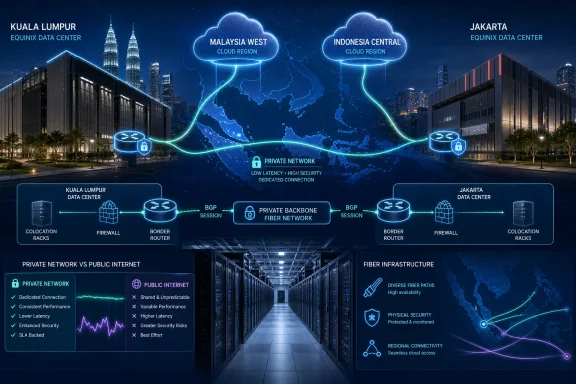
Equinix’s role is to provide the private interconnection layer. A customer with routers, firewalls, servers, or a network appliance deployed in an IBX data center can attach a Fabric port and provision a virtual connection to an Azure ExpressRoute circuit. Microsoft describes ExpressRoute as a logical connection through a connectivity provider, and Equinix’s Azure ExpressRoute documentation makes clear that customers still must complete BGP peering in the Azure portal before the connection is provisioned.
The distinction may sound procedural, but it separates an actual network design change from marketing shorthand. Azure resources remain in Microsoft’s Malaysia West or Indonesia Central cloud regions; customer equipment remains in the Equinix facility; and the ExpressRoute handoff enters Microsoft’s network at a designated peering location.
For Kuala Lumpur, Microsoft identifies the primary ExpressRoute location as TIME dotCom’s Menara AIMS facility, with Malaysia West listed as the local Azure region. Equinix is named as a connectivity provider at that location, alongside DE-CIX, TIME dotCom, Zenlayer and others. Microsoft separately lists a Kuala Lumpur 2 location at Telekom Malaysia Berhad, where Equinix is not named among the providers.
In Jakarta, Microsoft lists NeutraDC HDC as one peering location and NTT Global Data Center Indonesia as Jakarta 2. Equinix appears among the providers for Jakarta 2, which maps to Indonesia Central. That is a meaningful service-provider listing, but it is different from Microsoft saying that its Enterprise Edge routers sit inside Equinix’s JK1 facility.
Equinix does operate KL1 in Kuala Lumpur and JK1 in Jakarta. Its own documentation lists Fabric port availability at both: KL1 supports 1Gbps, 10Gbps and 100Gbps interfaces, while JK1 lists 1Gbps and 10Gbps interfaces, with higher-speed availability subject to confirmation. Equinix Fabric can then carry a virtual connection from those ports to an Azure service profile.
The missing detail is the decisive one: neither the supplied report nor the readily available Equinix and Microsoft material identifies whether the newly promoted offer terminates locally at a Microsoft edge, traverses Equinix Fabric to another facility in the same metro, or uses a broader provider path. For architects assessing latency, fault domains, and regulatory transit requirements, those are not cosmetic details. They determine the topology.
That does not prove that the current service scope is unchanged. Equinix could have added new Azure ExpressRoute service profiles, more direct ordering options, new capacity, or additional local routing choices since those earlier announcements. But it does establish that the headline should not be interpreted as “Azure connectivity has only now become available in Equinix Kuala Lumpur.”
The wording “expanded availability” is doing a great deal of work here. Equinix’s current Fabric documentation says Azure ExpressRoute connections can be created from a Fabric port, a Network Edge virtual device, Fabric Cloud Router, or a service token. It also says customers can connect to providers in a different metro through Fabric’s underlying network.
That flexibility is useful for hybrid infrastructure. A company can host physical security appliances and legacy systems in KL1 or JK1, extend a private path to Azure, and avoid building a dedicated WAN connection for each cloud-connected site. It also lets organizations use a common operating model for Azure alongside AWS, Google Cloud, Oracle Cloud, SaaS providers, and inter-IBX links.
Yet the convenience does not eliminate architectural responsibility. Fabric is a managed packet network that may cross facilities or metro paths. Equinix offers path diversity and redundancy mechanisms, but its current documentation does not list Malaysia or Indonesia among the countries covered by its Fabric Geo Zones feature for technically enforced in-country transit routing. That feature is available in several jurisdictions, including Japan and Australia, but not Malaysia or Indonesia in the currently published availability list.
For customers with hard requirements that data in motion remain inside national borders, “private” should therefore not be treated as synonymous with “domestic.” They need a written answer from Equinix on the actual Fabric route, failure routes, underlying-provider scope, and whether any part of the connection leaves the country before reaching Microsoft.
For many enterprise workloads, 5Gbps is substantial. It is enough for typical application traffic, database replication, VDI, backup windows designed with care, and a sizable set of AI inference or data-pipeline use cases. It is not automatically enough for large-scale data migration, high-volume image or media processing, continuous bulk replication, or a concentrated AI training environment that is moving datasets between customer-owned infrastructure and Azure.
Microsoft supports ExpressRoute circuits from 50Mbps through 10Gbps, depending on the provider and location. The fact that an Azure circuit can be purchased at a certain bandwidth does not mean an Equinix Fabric connection in a given metro can deliver that same rate. Teams should confirm the end-to-end orderable bandwidth rather than assume that the highest number on either vendor’s product page applies to the full path.
Pricing is also absent from the announcement. ExpressRoute involves Microsoft circuit charges and potentially gateway charges, while Equinix bills for Fabric ports and virtual connections under its own commercial terms. Microsoft also notes that partner services are outside Azure billing. A clean procurement comparison needs the complete recurring cost: cross-connect or port, Fabric connection, ExpressRoute circuit, ExpressRoute gateway, egress model, redundant circuit, and any managed router or firewall service.
Resilience needs equal scrutiny. A standard ExpressRoute circuit has two BGP connections to Microsoft edge routers at one peering location, providing equipment-level redundancy. Microsoft says that a single-location circuit does not protect against a site-wide peering-location failure and recommends two circuits across two different peering locations for critical production workloads.
That guidance has direct consequences in Kuala Lumpur and Jakarta. A customer can gain redundancy inside an Equinix deployment and still retain a shared facility, provider, or metro failure domain if both paths ultimately depend on the same ExpressRoute location. The network diagram—not the number of ports on a quote—determines whether the design survives a building outage.
Equinix has added a potentially valuable Azure option for organizations already colocated in KL1 or JK1, especially those replacing internet VPNs or backhauling cloud traffic through Singapore. But the verifiable facts point to an incremental private-connectivity offer, not a fresh Azure regional launch. Before signing, enterprises should demand the specific Azure ExpressRoute peering location, committed bandwidth, route and failover behavior, in-country transit assurances, encryption model, and the all-in cost of a second circuit.
 Azure was already local in Malaysia and Indonesia
Microsoft opened Indonesia Central, its first Indonesian cloud region, on May 27, 2025. Malaysia West, Microsoft’s first Malaysian cloud region, became generally available the next day, May 28, 2025. Both launches were explicitly positioned around lower latency and in-country data residency, including three availability zones for Malaysia West.That chronology changes the way this Equinix news should be read. It does not put Azure compute, storage, or AI services into Malaysia and Indonesia for the first time; those cloud regions were already operational for more than a year. Nor does private connectivity itself create data residency: it governs the transport path to Azure, while where customer data is stored and processed still depends on the Azure services, region selections, replication settings, backup configuration, and Microsoft’s service-specific commitments.
Equinix’s role is to provide the private interconnection layer. A customer with routers, firewalls, servers, or a network appliance deployed in an IBX data center can attach a Fabric port and provision a virtual connection to an Azure ExpressRoute circuit. Microsoft describes ExpressRoute as a logical connection through a connectivity provider, and Equinix’s Azure ExpressRoute documentation makes clear that customers still must complete BGP peering in the Azure portal before the connection is provisioned.
The distinction may sound procedural, but it separates an actual network design change from marketing shorthand. Azure resources remain in Microsoft’s Malaysia West or Indonesia Central cloud regions; customer equipment remains in the Equinix facility; and the ExpressRoute handoff enters Microsoft’s network at a designated peering location.
Microsoft’s directory does not place its edge in Equinix’s two IBXs
Technology Magazine’s description suggests that Malaysian and Indonesian customers can connect to Azure within Equinix’s local data centers. Microsoft’s published ExpressRoute location directory is more specific—and does not fully support that wording.For Kuala Lumpur, Microsoft identifies the primary ExpressRoute location as TIME dotCom’s Menara AIMS facility, with Malaysia West listed as the local Azure region. Equinix is named as a connectivity provider at that location, alongside DE-CIX, TIME dotCom, Zenlayer and others. Microsoft separately lists a Kuala Lumpur 2 location at Telekom Malaysia Berhad, where Equinix is not named among the providers.
In Jakarta, Microsoft lists NeutraDC HDC as one peering location and NTT Global Data Center Indonesia as Jakarta 2. Equinix appears among the providers for Jakarta 2, which maps to Indonesia Central. That is a meaningful service-provider listing, but it is different from Microsoft saying that its Enterprise Edge routers sit inside Equinix’s JK1 facility.
Equinix does operate KL1 in Kuala Lumpur and JK1 in Jakarta. Its own documentation lists Fabric port availability at both: KL1 supports 1Gbps, 10Gbps and 100Gbps interfaces, while JK1 lists 1Gbps and 10Gbps interfaces, with higher-speed availability subject to confirmation. Equinix Fabric can then carry a virtual connection from those ports to an Azure service profile.
The missing detail is the decisive one: neither the supplied report nor the readily available Equinix and Microsoft material identifies whether the newly promoted offer terminates locally at a Microsoft edge, traverses Equinix Fabric to another facility in the same metro, or uses a broader provider path. For architects assessing latency, fault domains, and regulatory transit requirements, those are not cosmetic details. They determine the topology.
Equinix had already advertised Azure access from KL1
There is another reason to be cautious about treating this as an entirely new capability. When Equinix announced the planned Kuala Lumpur expansion in June 2023, it said KL1 and Equinix Fabric would let customers connect privately to leading cloud providers including Microsoft Azure. The company completed a second phase of KL1 in May 2025 and opened JK1 in Jakarta that same month.That does not prove that the current service scope is unchanged. Equinix could have added new Azure ExpressRoute service profiles, more direct ordering options, new capacity, or additional local routing choices since those earlier announcements. But it does establish that the headline should not be interpreted as “Azure connectivity has only now become available in Equinix Kuala Lumpur.”
The wording “expanded availability” is doing a great deal of work here. Equinix’s current Fabric documentation says Azure ExpressRoute connections can be created from a Fabric port, a Network Edge virtual device, Fabric Cloud Router, or a service token. It also says customers can connect to providers in a different metro through Fabric’s underlying network.
That flexibility is useful for hybrid infrastructure. A company can host physical security appliances and legacy systems in KL1 or JK1, extend a private path to Azure, and avoid building a dedicated WAN connection for each cloud-connected site. It also lets organizations use a common operating model for Azure alongside AWS, Google Cloud, Oracle Cloud, SaaS providers, and inter-IBX links.
Yet the convenience does not eliminate architectural responsibility. Fabric is a managed packet network that may cross facilities or metro paths. Equinix offers path diversity and redundancy mechanisms, but its current documentation does not list Malaysia or Indonesia among the countries covered by its Fabric Geo Zones feature for technically enforced in-country transit routing. That feature is available in several jurisdictions, including Japan and Australia, but not Malaysia or Indonesia in the currently published availability list.
For customers with hard requirements that data in motion remain inside national borders, “private” should therefore not be treated as synonymous with “domestic.” They need a written answer from Equinix on the actual Fabric route, failure routes, underlying-provider scope, and whether any part of the connection leaves the country before reaching Microsoft.
A 5Gbps Fabric ceiling is the operational constraint
Equinix’s virtual-connection availability table puts the maximum Fabric virtual-connection speed for both the Jakarta and Kuala Lumpur metros at 5Gbps. That figure is lower than the physical port options at KL1, where 100Gbps interfaces are available, and it matters more than the top-line port number for an Azure connection made through Fabric.For many enterprise workloads, 5Gbps is substantial. It is enough for typical application traffic, database replication, VDI, backup windows designed with care, and a sizable set of AI inference or data-pipeline use cases. It is not automatically enough for large-scale data migration, high-volume image or media processing, continuous bulk replication, or a concentrated AI training environment that is moving datasets between customer-owned infrastructure and Azure.
Microsoft supports ExpressRoute circuits from 50Mbps through 10Gbps, depending on the provider and location. The fact that an Azure circuit can be purchased at a certain bandwidth does not mean an Equinix Fabric connection in a given metro can deliver that same rate. Teams should confirm the end-to-end orderable bandwidth rather than assume that the highest number on either vendor’s product page applies to the full path.
Pricing is also absent from the announcement. ExpressRoute involves Microsoft circuit charges and potentially gateway charges, while Equinix bills for Fabric ports and virtual connections under its own commercial terms. Microsoft also notes that partner services are outside Azure billing. A clean procurement comparison needs the complete recurring cost: cross-connect or port, Fabric connection, ExpressRoute circuit, ExpressRoute gateway, egress model, redundant circuit, and any managed router or firewall service.
Private routing still needs encryption and two-site design
A private connection is a security improvement over unencrypted public-internet transit for many architectures, but it is not encrypted by default. Microsoft’s ExpressRoute documentation explicitly says traffic over an ExpressRoute connection is not encrypted by default. MACsec is available only for ExpressRoute Direct physical links, not provider-provisioned circuits, so customers using Equinix as a connectivity provider must evaluate application-layer TLS, IPsec overlays, or other encryption controls if confidentiality in transit is a requirement.Resilience needs equal scrutiny. A standard ExpressRoute circuit has two BGP connections to Microsoft edge routers at one peering location, providing equipment-level redundancy. Microsoft says that a single-location circuit does not protect against a site-wide peering-location failure and recommends two circuits across two different peering locations for critical production workloads.
That guidance has direct consequences in Kuala Lumpur and Jakarta. A customer can gain redundancy inside an Equinix deployment and still retain a shared facility, provider, or metro failure domain if both paths ultimately depend on the same ExpressRoute location. The network diagram—not the number of ports on a quote—determines whether the design survives a building outage.
Equinix has added a potentially valuable Azure option for organizations already colocated in KL1 or JK1, especially those replacing internet VPNs or backhauling cloud traffic through Singapore. But the verifiable facts point to an incremental private-connectivity offer, not a fresh Azure regional launch. Before signing, enterprises should demand the specific Azure ExpressRoute peering location, committed bandwidth, route and failover behavior, in-country transit assurances, encryption model, and the all-in cost of a second circuit.
References
- Primary source: Technology Magazine
Published: 2026-08-03T14:09:37+00:00
Loading…
technologymagazine.com - Related coverage: equinix.com
Loading…
www.equinix.com - Related coverage: equinix.com
Loading…
www.equinix.com - Related coverage: newsroom.equinix.com
Loading…
newsroom.equinix.com - Related coverage: equinix.mediaroom.com
Loading…
equinix.mediaroom.com - Related coverage: azure.microsoft.com
Loading…
azure.microsoft.com - Related coverage: investor.equinix.com
Loading…
investor.equinix.com - Related coverage: news.microsoft.com
- Related coverage: news.microsoft.com
- Related coverage: investor.equinix.com
Loading…
investor.equinix.com - Related coverage: d1io3yog0oux5.cloudfront.net
Loading…
d1io3yog0oux5.cloudfront.net - Related coverage: blog.equinix.com
Loading…
blog.equinix.com - Related coverage: blog.equinix.com
Loading…
blog.equinix.com - Related coverage: learn.microsoft.com
Loading…
learn.microsoft.com - Related coverage: learn.microsoft.com
Loading…
learn.microsoft.com - Related coverage: newsroom.equinix.com
Loading…
newsroom.equinix.com - Related coverage: assets.kpmg.com
beyond capacity building indonesia intelligence sustainable data centers.pdf.coredownload.inline
PDF documentassets.kpmg.com
- Related coverage: docs.equinix.com
Loading…
docs.equinix.com - Related coverage: docs.equinix.com
Loading…
docs.equinix.com - Related coverage: antaranews.com
Loading…
www.antaranews.com - Related coverage: equinix.com.br
Loading…
www.equinix.com.br - Related coverage: info.equinix.com
Loading…
info.equinix.com - Related coverage: sustainability.equinix.com
Loading…
sustainability.equinix.com
