
The Exchange Team disclosed the migration in its August 7 post tied to Message Center notice MC1446796. Microsoft’s existing EWS retirement guidance independently confirms the broader deadline: Exchange Online will progressively disable EWS from October 2026, with a permanent shutdown scheduled for April 1, 2027. This announcement fills in an important gap from the general EWS guidance: some Exchange features will not move to Microsoft Graph directly. Instead, Microsoft is replacing the cross-tenant trust and request path with a Microsoft 365 policy model governed through Entra-era tenant relationships.
For most Microsoft 365 tenants, this is noise. Cross-organization sharing is not enabled by default. But enterprises with acquired subsidiaries, split business units, joint ventures, managed-service customers, or long-running partner relationships should treat it as an inter-company service migration, not as another EWS application inventory item.
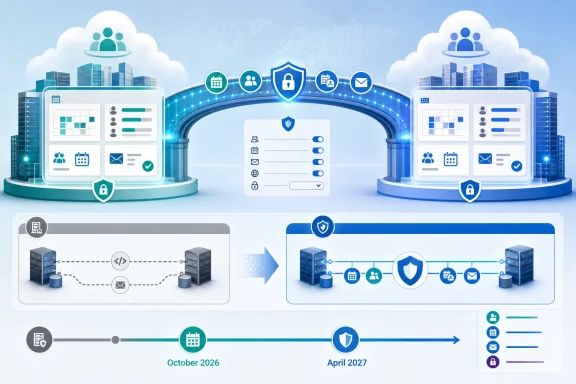 The old configuration may be older than the people maintaining it
Microsoft identifies three existing Exchange Online configurations that can put a tenant in scope:
- Organization Relationships that expose Free/Busy information or MailTips to another Microsoft 365 organization.
- Availability Address Spaces configured with
AccessMethod: OrgWideFBTokenfor cross-tenant Free/Busy sharing. - Sharing Policies assigned to mailboxes that permit
CalendarSharingFreeBusySimple,CalendarSharingFreeBusyDetail, orCalendarSharingFreeBusyRevieweraccess for an external Microsoft 365 domain.
These objects have often survived multiple Exchange admin changes because they work quietly. A scheduling assistant lookup succeeds, an external recipient sees an automatic-reply MailTip, or a partner employee opens a shared calendar — and no ticket is generated. The configuration may also be attached to a partner domain rather than a recognizable company name, which makes a tenant-wide inventory more valuable than relying on institutional memory.
Microsoft’s older Exchange documentation shows why this is consequential. Organization Relationships have long been the control plane for calendar availability across Microsoft 365 and Exchange organizations, while MailTips can expose information including external automatic replies, mailbox-full warnings, recipient restrictions, and moderation status. Those settings are business-process dependencies, especially for organizations that schedule resources, service calls, or regulated work across tenant boundaries.
The first practical task is therefore discovery, not migration. In Exchange Online PowerShell, administrators should review
Get-OrganizationRelationship,
Get-AvailabilityAddressSpace, and
Get-SharingPolicy, then identify whether each external destination is actually hosted in Microsoft 365. A disabled relationship or a policy that has never been assigned to a mailbox does not create a migration obligation.
There is a subtle trap in the Sharing Policy check. Anonymous publishing rules appear alongside organizational domain rules. Microsoft says anonymous calendar publishing with Free/Busy permissions is also in scope, meaning an admin cannot dismiss every
Anonymous:entry as unrelated merely because it is not a named partner tenant.
This is a tenant-pair migration, not a local Exchange setting
The significant operational change is that an Exchange-domain relationship is being replaced by a policy tied to the partner’s tenant ID. If several domains belong to one partner Microsoft 365 tenant, Microsoft says administrators should create one Cross-Tenant Access Policy for that tenant rather than recreate separate domain-based relationships.
That simplifies the target configuration, but it introduces a dependency that the old model could conceal: administrators need to know which tenant owns every partner domain and must coordinate the migration with the people who administer that tenant. A company may have a correct Exchange configuration on its own side yet be unable to complete a bidirectional cutover because a subsidiary, vendor, or parent company has not done its portion.
Microsoft draws a sharp distinction between one-way and two-way sharing. For one-way access, only the resource tenant — the tenant holding the mailboxes whose availability, calendars, or MailTips are being queried — has to configure the new policy. For bidirectional sharing, both organizations must configure Cross-Tenant Access Policy and disable their old sharing configuration before the new method works in both directions.
That last condition creates the main change-management risk. This is not a migration where an admin can safely build a parallel configuration and leave the legacy objects untouched indefinitely. Microsoft says old configurations can prevent requests from flowing over the new policy path. In practice, each partner relationship needs a coordinated cutover plan: identify the resource direction, build the replacement policy, verify access, remove or disable the legacy path as Microsoft directs, and retest from both tenants.
Organizations should record more than whether Free/Busy works. They should capture the level of information shared — availability only versus subject and location details — and the scope of users authorized to expose MailTips. Microsoft’s existing documentation shows that MailTips can be limited by type and restricted to specified users through a group. Rebuilding a relationship without verifying those boundaries could turn an EWS deprecation project into an unintended information-disclosure change.
Microsoft’s rollout dates do not fully agree
The Exchange Team’s post says the Cross-Tenant Access Policy model “becomes available starting September 2026.” Its rollout table, however, says the worldwide rollout begins in August 2026 and is expected to finish by September 1. GCC is listed as starting in mid-August and completing in mid-September; GCC High and DoD are listed as beginning in early September and finishing by the end of September.
Those statements are not the same schedule. As of August 7, 2026, a worldwide tenant could plausibly receive the feature during August under the table, even though the narrative directs administrators toward September. Microsoft has not explained whether August represents an early deployment phase, a documentation error, or feature exposure that is not intended for broad migration work.
Administrators should use the more conservative interpretation for project planning: begin inventory and partner outreach now, but do not schedule a production cutover until the relevant Cross-Tenant Access Policy controls are visible in the tenant and Microsoft’s migration guidance can be followed. For worldwide tenants, that may be before September; for sovereign cloud tenants, it could be later in September.
The short timeline is real regardless of which rollout line proves correct. The new policy may not be broadly available until late August or September, while EWS disablement starts October 1. That gives multi-tenant organizations weeks, not quarters, to identify old Exchange relationships, find partner administrators, agree on a maintenance window, and validate two-way behavior.
The EWS extension has a narrow but important exception
Microsoft’s February EWS retirement announcement described an October model in which
EWSEnabledand an EWS application allow list govern whether EWS apps keep working. A tenant left at the default state would be changed to blocked as the rollout reached it; a tenant setting
EWSEnabledto
Truewould generally need to manage the allow-list model.
The new Exchange Team post makes a more specific promise for these cross-tenant collaboration flows. It says that setting
EWSEnabledto
Truepreserves the legacy Free/Busy, MailTips, and calendar-sharing path through April 1, 2027, and that admins do not need to add App IDs to
EWSAllowedAppIDs. Microsoft’s explanation is that these requests do not depend on OAuth application IDs.
This is a material carve-out from the general EWS guidance, and it is useful for organizations that cannot complete a partner-coordinated migration before October. It should not be mistaken for a permanent exemption or a general EWS workaround. The final shutdown remains April 1, 2027, and Microsoft says there will be no extension after that date.
The extension also requires attention on both sides of a bidirectional relationship. If one tenant preserves EWS but its partner allows EWS to be disabled, users in the first tenant can no longer retrieve data hosted by the partner. The partner’s users can still retrieve information hosted in the tenant that kept EWS alive. That produces an asymmetric failure: scheduling can appear broken for only one organization, while the other believes the relationship still works.
Hybrid Exchange and Google calendar interop are separate cases
Microsoft excludes several scenarios from this immediate migration. Intra-organization calendar sharing is unaffected. Exchange hybrid Free/Busy, MailTips, and calendar sharing between on-premises users and Exchange Online users are also outside this Cross-Tenant Access Policy change, although Microsoft continues to push hybrid customers toward the Dedicated Hybrid App work associated with the broader EWS transition.
Cross-organization sharing with a fully on-premises Exchange organization is likewise not part of this deadline. Microsoft says further Message Center communication will address that scenario. Administrators with a partner that runs both Exchange Online and on-premises Exchange should separate the paths: the Microsoft 365-hosted portion is in scope now, even if the on-premises portion is not.
Google Workspace calendar interoperability through an Availability Address Space is another explicit exclusion. Microsoft says Exchange Online users can continue to retrieve Google calendar availability through that configuration, while Google Workspace must use Microsoft Graph rather than a legacy EWS connection when retrieving Exchange availability. By contrast, Availability Address Space sharing between the commercial Microsoft 365 cloud and the 21Vianet cloud is affected and must move to Cross-Tenant Access Policy.
The immediate consequence is straightforward: any Microsoft 365 organization that knowingly shares schedules, calendars, or MailTips with another tenant should open an Exchange Online PowerShell session now, inventory its three legacy sharing mechanisms, and contact every partner tenant owner before October. The policy rollout may arrive on an uneven schedule, but the April 1, 2027 EWS shutdown does not leave a second fallback once the temporary
EWSEnabledbridge ends.
References
- Primary source: Microsoft Exchange Team Blog
Published: Fri, 07 Aug 2026 19:19:23 GMT
Loading…
techcommunity.microsoft.com - Related coverage: learn.microsoft.com
Loading…
learn.microsoft.com - Related coverage: learn.microsoft.com
Loading…
learn.microsoft.com - Related coverage: techcommunity.microsoft.com
Loading…
techcommunity.microsoft.com