
IT Brief Asia reported the August 19 launch as a global availability move. But Exclaimer’s own public material shows the programme was already operating in more limited forms months earlier: its MSP provisioning documentation was published in May, and a June partner video described a U.S. early-adopter cohort. For MSPs, this looks like a broader commercial rollout of an existing portal and subscription model, rather than a product appearing for the first time today.
That distinction is useful. Existing Exclaimer partners should treat MSP Connect as a potential migration or commercial-path change to evaluate, not assume it is a wholly separate signature-management platform with a clean operational boundary from the service they already sell.
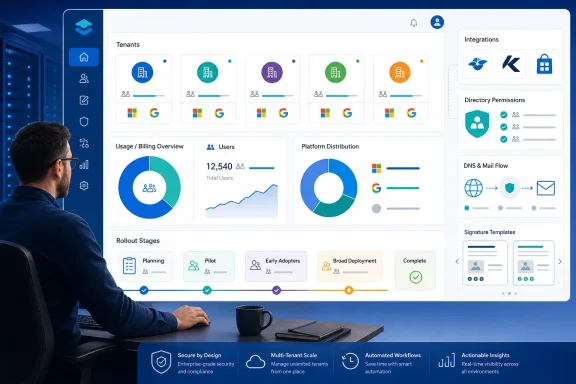 The operational problem MSP Connect is trying to solve
Email signatures are mundane until they become a recurring source of customer tickets. A staff member changes title, a company updates its legal entity wording, a marketing team wants a campaign banner, or a merger produces new branding requirements. In a Microsoft 365 estate, allowing Outlook clients and users to own those changes turns a simple governance task into a mixture of inconsistent signatures, stale contact details, and local exceptions.
Exclaimer’s pitch is that an MSP should manage those rules once for each client tenant, using directory data to populate identity fields while maintaining centrally approved templates and disclaimer content. That can make sense for an MSP already supporting Exchange Online, Entra ID, and Microsoft 365 administration across many small and midsize customers. The provider can package signature design, ongoing changes, and compliance-driven review into a recurring service rather than leaving the customer with a one-time configuration project.
ChannelPro’s August event programme independently described Exclaimer’s MSP offering as a way to manage a compliance-sensitive but frequently unmanaged part of a client’s Microsoft 365 environment. That framing is more grounded than the sales language around “high-margin” add-ons: the service is useful when a provider can standardize a task that otherwise arrives as scattered requests to help desk, marketing, and account-management teams.
The harder part is whether the management tooling genuinely removes work at scale. A portal alone does not achieve that. The value depends on whether it can create subscriptions, reflect accurate customer usage, and fit the MSP’s billing and service-management process without manual reconciliation each month.
August’s “launch” follows a May portal deployment path
Exclaimer’s own knowledge base gives a clearer view of what MSP Connect requires than the launch announcement does. Its May 15 guidance describes a dedicated MSP portal through which a partner can create a customer subscription outside Microsoft Marketplace, choose a data-center region, submit customer company and country information, activate the subscription, and launch setup.
For Microsoft 365 customers, the documentation also makes clear that this is not a zero-touch resale add-on. A customer-tenant Microsoft 365 Global Administrator must approve permissions for directory-data access, domain verification, and mail routing. The setup process also calls for an SPF record update. Exclaimer says the automated checklist can complete in under a minute once those approvals are in place, but that is only the final technical stage; collecting the right administrative access and coordinating DNS changes can still take longer in a real customer onboarding.
That is the important caveat behind claims that deployment can take less than an hour. The product configuration may be fast in a straightforward tenant, but MSPs should estimate onboarding around the customer’s change-control process, access model, DNS ownership, and security review. A client whose Microsoft 365 Global Administrator role is held by a separate internal IT team, parent company, or another service provider will not be provisioned on an MSP’s preferred timetable.
The underlying permissions also deserve routine scrutiny. An email-signature platform needs directory data to fill names, job titles, departments, phone numbers, and related fields; server-side signature application also requires mail-flow configuration. Those are expected requirements for this product category, but they make it essential to document what has been granted in each tenant, who owns the consent decision, and how the configuration will be removed if the customer changes provider.
The commercial model is the actual product change
Exclaimer says MSP Connect uses a consumption-based approach that adjusts as a customer adds or removes users, shrinks its environment, or leaves the service. For a managed-services business, that is more consequential than the signature templates. Annual commitments and fixed user counts can create a margin problem when a client reduces headcount or cancels services before the MSP’s vendor obligation ends.
The company acknowledges that its earlier MSP programme did not fit how providers operate, citing both usability and billing-model shortcomings. That admission is unusually direct, and it explains the emphasis on self-service controls. Exclaimer COO Jim Turner says partners should be able to change subscription details, add customers, and review billing without asking support to perform routine account administration.
Exclaimer says channel partners account for roughly one-third of its annual recurring revenue, which makes this more than a side programme for the vendor. The company’s stated aim is to move a larger share of revenue through partners, and MSP Connect is built to reduce the per-customer effort that can keep low-to-mid-value SaaS services from working through the channel.
For an MSP, however, “consumption-based” needs a precise commercial definition before it is sold. Exclaimer has not publicly set out pricing, billing measurement rules, minimum commitments, overage treatment, invoice timing, regional availability by marketplace, or the process for transferring a tenant after a customer departure. Those omissions do not make the programme unusual, but they are the details that determine whether a flexible subscription is genuinely flexible when a customer downsizes or disputes a count.
Integrations need validation beyond the launch claim
Exclaimer names ConnectWise, Kaseya, and Microsoft Marketplace as integrations or routes to market. Its June U.S. material specifically referred to Microsoft Marketplace resale, MSP API automation, PSA-based service management, and consolidated monthly billing. That points to the right operational targets: create or synchronize recurring agreements, map end customers to the right billing entities, and avoid keying user counts into multiple systems.
But Exclaimer has not published enough technical detail to show what each integration actually does. The public material does not establish whether ConnectWise and Kaseya connections support automatic company mapping, usage synchronization, invoice creation, alerting on failed provisioning, or simply commercial compatibility and manual workflows. MSPs should not assume API automation means a fully unattended billing integration.
Before putting MSP Connect into a standard Microsoft 365 bundle, providers should validate several items in a pilot tenant:
- The MSP should confirm exactly which Entra ID and mail-flow permissions are approved, and record the customer-side administrator who authorized them.
- The MSP should test how a user-count increase, decrease, disabled account, shared mailbox, and leaver are reflected in both Exclaimer and its PSA or billing system.
- The MSP should establish whether the selected data region follows the end customer’s Microsoft 365 tenant requirements and any contractual data-residency commitments.
- The MSP should send internal and external test mail after mail routing and SPF changes, including messages from mobile Outlook and shared-mailbox scenarios where applicable.
- The MSP should obtain a documented offboarding process covering subscription cancellation, consent removal, DNS cleanup, and the recovery of any customer-owned signature assets.
This is not busywork. Signature services sit at the junction of identity data, external communications, DNS, and Exchange Online routing. A small per-user subscription can produce disproportionate operational friction if the exit process is unclear or if the PSA integration cannot reliably reflect changes in customer counts.
A governance service, not a security control
Exclaimer positions signatures, disclaimers, and approved campaign banners as a way for marketing and IT to share responsibility without letting employees edit critical content locally. That is a reasonable governance argument, especially for organizations with regulated communications or tightly managed brand standards.
It should not be oversold as an email-security product. A centrally applied signature can standardize sender details and disclaimer language, but it does not authenticate a message, stop account compromise, block phishing, or replace Exchange Online Protection, Microsoft Defender for Office 365, DMARC, DKIM, or SPF. The required SPF update is part of making Exclaimer’s mail routing work properly; it is not a substitute for a broader domain-authentication programme.
For Windows and Microsoft 365 administrators, the strongest use case is straightforward: use the platform to take user-controlled formatting and contact data out of Outlook clients, while preserving clear ownership of directory attributes, mail flow, and DNS. The weakest use case is buying it merely to add another SKU to a bundle without a repeatable onboarding, support, and offboarding process.
Exclaimer has made MSP Connect globally available, according to IT Brief Asia, but the company’s recent public material still reflects a staged rollout from an earlier U.S. cohort. Providers should verify their regional purchase route, integration depth, and billing terms before treating the programme as a standardized global service. The first customer deployment should prove the workflow from Global Administrator consent through monthly reconciliation—not simply that a branded signature appears in an outbound email.